
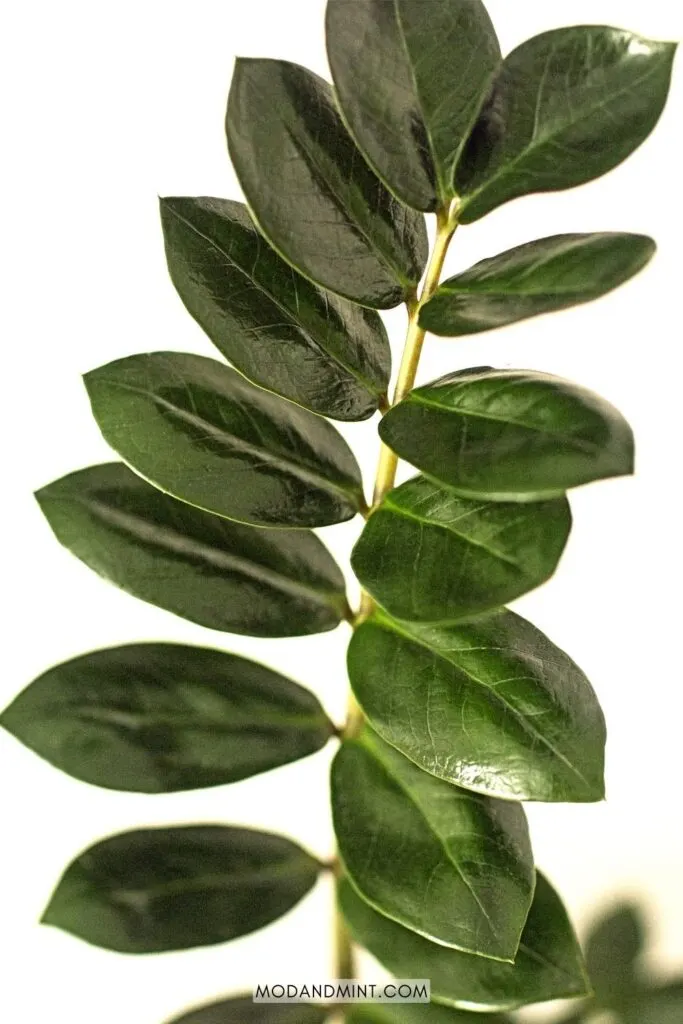
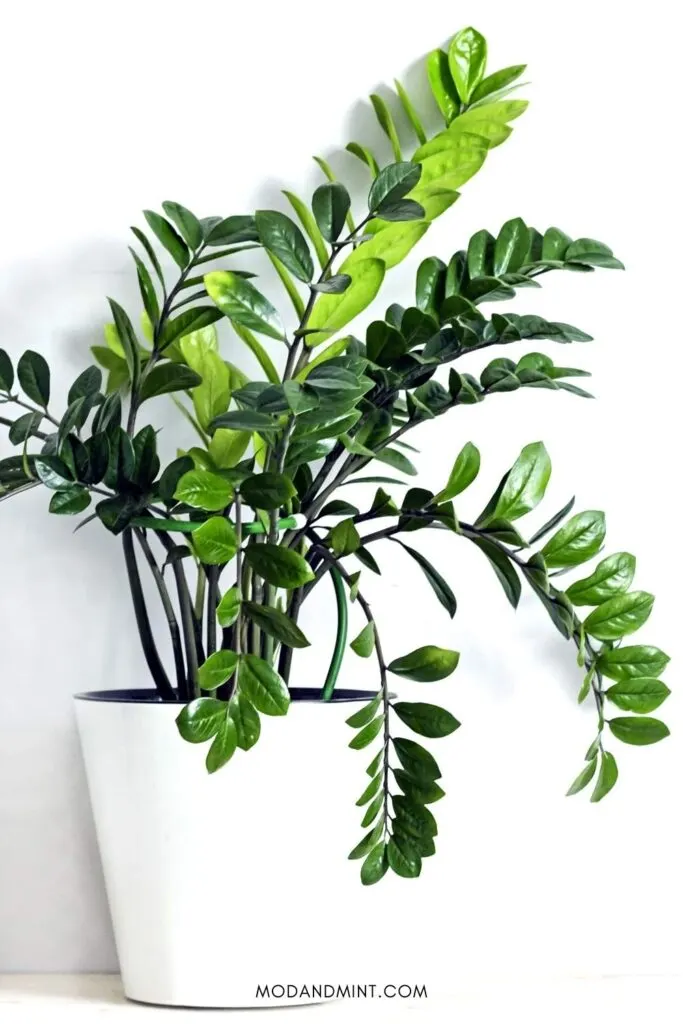
Zamioculcas zamiifolia (pronounced Zam-ee-oh-KUL-kass zam-ee-FOH-lee-uh) is a very easy-to-care-for houseplant. It grows smooth, shiny leaves on upright stems
It has low requirements when it comes to watering, and it can grow in a wide range of light conditions, from low to bright. This makes it a perfect plant for beginner plant parents, or to grow in dorm rooms or offices.


Want to buy a Zamioculcas zamiifolia? There are plant growers that sell them on Amazon!
Zamioculcas Zamiifolia
Botanical name: Zamioculcas zamiifolia. Common names: ZZ plant, Zuzu plant, Zanzibar Gem.
ZZ plants have been around for centuries, growing on the dry grasslands and forests in Eastern Africa. It became popular as a houseplant in the late 90s when Dutch nurseries started to propagate the plant for wide-scale commercial use.
Related reading: Beginners Guide to Houseplant Care.


Light Requirements
ZZ plants can tolerate low-light situations. But semi-shade may cause growth to slow down and leaves to stay smaller.
It is best to put your plant in medium to bright indirect light in a north, east, or west-facing window. Rotate it regularly to make sure it gets adequate light on all sides and grows evenly.
Avoid direct sunlight. Dry, brown spots on the leaves can be a sign of sunburn. Move your plant further away from the window, or filter the light with a sheer curtain.

Watering
In its native habitat, the Zamioculcas zamiifolia is used to long periods of dry conditions with the occasional heavy rainfall. It stores water in bulb-like rhizomes underneath the soil. So no need to water frequently.
Generally, water once the soil has dried out. Exactly when depends on the growing conditions. Time of year, location of your plant, humidity, type of soil and pot, etc.
The best way to know when it is time to water is to check the soil. If the top layer feels moist, don’t water but wait a few days and check again. If the soil feels dry, go ahead and water thoroughly. If you are unsure, you can purchase a moisture meter to help you out.
Water until it comes out of the drainage holes at the bottom of the pot. Discard any leftover water that accumulates in the saucer.
Related reading: How to water indoor plants – How to use a moisture meter.

Yellow Leaves
If the leaves turn yellow, feel soft, and drop, it’s usually a sign of watering too often. The roots need more time to dry out. Water less often to give the soil more time to dry out between waterings.
It could also be that your plant is getting too much direct sunlight. If the plant is too close to a window, it can be chlorophyll loss turning the leaves yellow, making them look faded. Put a sheer curtain in the window to protect your plant or move it further away from the window.
Fertilizing
Use a diluted liquid houseplant fertilizer to feed your ZZ plant monthly during spring and summer. Be sure the soil is damp before fertilizing and don’t fertilize in winter when growth slows down.
Newly bought or recently repotted plants don’t need to be fertilized for at least the first 4-6 months. The potting mix usually already has slow-release fertilizer in it.
Also never fertilize if your plant is having problems. Fertilizer gives your plant a boost of nutrients when it is actively growing. It is not plant medicine. Analyze, adjust, and when your plant recovers, continue your normal care routine.
Humidity
ZZ plants are not very needy when it comes to humidity levels. They can grow and adapt to average household humidity levels. If your home has very dry air, you might want to purchase a small humidifier for your plant.
Soil and Repotting
Repot your plant when the roots have filled the pot or roots are growing from the drainage holes on the bottom.
It is also time for a bigger pot when you see rhizomes pushing up against the inside of the container. Just like it happens when Snake plants get too big for their pots. In a plastic pot, you will see or feel bumps on the side. Rhizomes growing too crowded in a clay pot might actually crack it.
Even if there is still room to grow, you want to repot every two to three years. The soil will have lost all its nutrients and will need to be replaced with fresh well-draining potting soil.
Gently remove your plant from the pot. If needed tap the pot to loosen the soil and roots. Support the plant in one hand, and use your other hand to carefully take the pot off.
Make sure the new pot has drainage holes on the bottom. This is a must. You want any excess water to have a way out.
Related reading: Step-by-step how to repot your plants.


Zamioculcas Zamiifolia Propagation
ZZ plants are very simple to propagate from stem cuttings in water or soil, or by division.
If you prune your plant to maintain its size, or to remove leggy stems, don’t toss out those cuttings. Use them for propagation!
Related reading: 6 Ways to propagate all your plants.
Propagate Cuttings in Water
Water propagation is an almost foolproof way to make more plants.
- Take a stem cutting with at least a few sets of leaves. Remove the bottom leaves.
- Place the cutting in a glass vessel with just enough water to cover the bottom part of the cuttings.
- Keep it in bright, indirect light.
- Make sure to change the water regularly
- Wait for roots to appear. When the roots are at least an inch long, plant them in soil. Water once, and wait to water again until you see new growth.

Propagate Cuttings in Soil
Another way to propagate your Zamioculcas is to skip the water rooting and go straight to the soil.
- Take stem cuttings with at least a few sets of leaves. Remove the bottom leaves.
- Dip the ends in rooting hormone. This powder helps the roots grow faster and stronger and prevents fungus growth. If you don’t have any, you can skip it. The process just might take a little longer without it.
- Place your cutting in potting soil, covering the part where you have removed the bottom leaves.
- Place the cuttings in indirect light and water very lightly to prevent overwatering.
- Wait until you see new growth. At this point, you can continue with regular care.
Propagation by Division
Propagating by rhizome division is easy and has a high success rate. It is a much quicker way to propagate than rotting cuttings in water or soil. When splitting the rootball and rhizomes and repotting the parts in separate containers, you have complete plants already. Whereas cuttings take a long time to grow into a decent-sized houseplant.
- Take the plant out of the pot. Gently remove as much old soil as possible without damaging the roots and rhizomes.
- Decide where to divide the plant. Each section needs some leaf growth as well as part of the rhizome and roots attached.
If there are multiple rhizomes and you can divide without having to cut through them, that should be the first choice. - If needed, make a clean cut through the rhizome and roots to split the plant. Otherwise, gently separate with your hands.
- Pot each part in its own planter. Keep them in bright indirect light.
- Water once and wait to water again until you see new growth.
Leaves Falling Off
It is normal for ZZ plants to occasionally drop an old leaf while new ones grow. But when more leaves turn yellow, and then fall off it is usually a sign of overwatering. If they are dry and drop off, it could also be the opposite, the plant has been kept too dry and needs water.
Sudden leaf drop can also happen when your plant is too cold or in a drafty location. Avoid air conditioning vents, doors, and other drafts.


Is the Zamioculcas Zamiifolia Toxic to Cats?
The ZZ plant is considered mildly toxic if ingested. It can irritate the mouth and stomach and possibly vomiting. Although it is uncommon for pets to get seriously hurt from eating plants, keep this one out of reach of children and pets.
Related reading: Non-Toxic Plants for Your Home.


Lara
Tuesday 31st of December 2024
If a stem appears rotten & mushy does it need to be trimmed?