
Propagation is starting new plants from established ones. You can make new plants from the ones you already have. For free!
If you end up with too many plants (is that even possible?), trade cuttings with friends or give rooted cuttings of your favorite plant as a gift for a birthday, shower, or as a thank you or get well soon gift.
I give propagated plants as end-of-year teacher gifts. Don’t tell this year’s teacher, he’s getting a couple of planted Haworthia offsets. With a care instruction gift card attached. : )

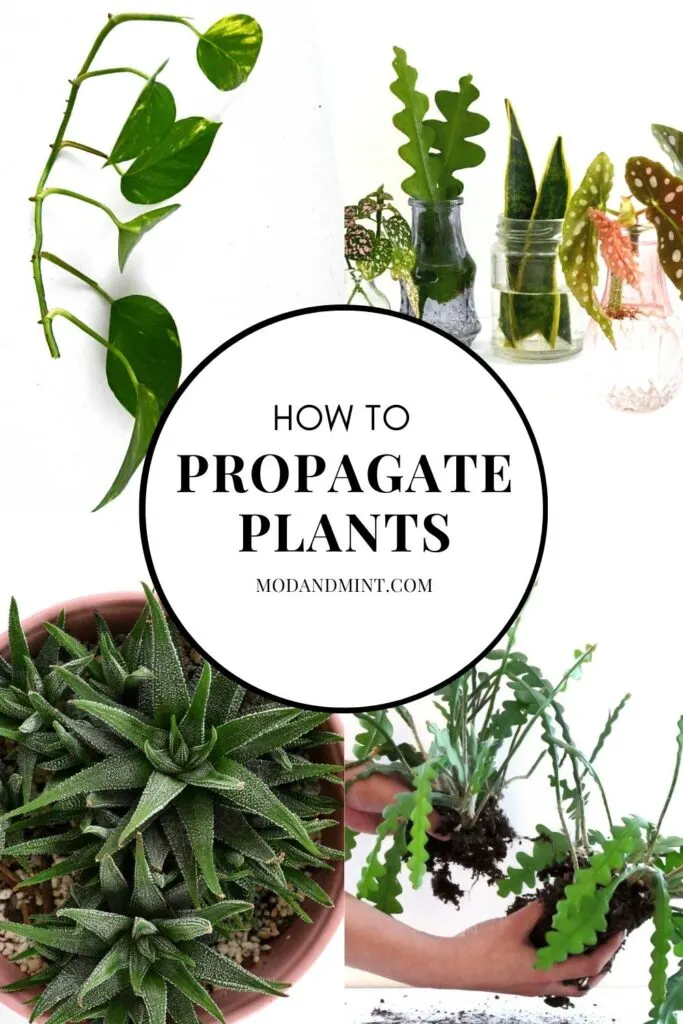
Plant Propagation Methods
There are a number of ways to propagate houseplants. The most common way to propagate plants is to grow plants from stem or leaf cuttings.
But you can also grow new plants from seeds, by air layering, division, or by taking offsets.
Which method of propagation you choose depends on the way your plant grows. Some plants can be propagated in several ways, whereas other plants can only be propagated in one certain way.


Plant propagation by Stem Cuttings
Taking stem cuttings is a popular way of propagating plants. You can propagate stem cuttings from bushy or vining houseplants that grow long stems with leaves along their length.
Some plants easy to propagate from stem cuttings are the Pothos, English Ivy, Jade plant, Arrowhead plant, and the Monstera adansonii, among many others.
Stem cuttings can be propagated in water or in soil.
How to cut plants for propagation
Take a healthy stem cutting about four to six inches long, with at least two sets of leaves. Cut right below a leaf node (the point where the leaves attach to the stem). That’s where the roots will form.
You can use any portion of the stem as long as it contains at least one leaf node.
Remove the bottom leaves of the cutting, They will end up in the water or soil and will rot.


Propagate Cuttings in Water
Water propagation is one of the easiest ways to start new plants.
A few plants that root quickly and easily in water are the Tradescantia, Spider plants, Polkadot begonia, and String of Pearls.
- Take a cutting as described above.
- Place the cutting in a glass or jar with just enough water to cover the bottom part.
- Keep it in bright, indirect light.
- Change the water regularly
- Wait for roots to appear. Pot them up when the roots are at least an inch long.
- Keep the soil slightly moist, not wet, until there is new growth. Resume regular care.
Propagation gets you more plants, and makes many plants branch out and grow back fuller and bushier.
Further reading: How to Water Propagate Plants.


Propagate Cuttings in Soil
Another way to propagate your cuttings is by rooting them in soil.
- Take a cutting as described above.
- Dip the ends in rooting hormone. This powder helps the roots to grow faster and stronger and prevents fungus growth. If you don’t have any, you can skip it. The process just might take a little longer without.
- Place your cutting into soil. Cover the part where you have removed the bottom leaves.
- Place the cuttings in indirect light and keep the soil slightly moist.
- Wait until you see new growth. Be patient, depending on the plant, it might take several weeks.
Do not disturb your plant while it is starting to grow roots. If you really want to check if roots are growing, give the plant a very gentle tug. If you feel resistance, it means roots have started to grow under the soil. Don’t do this too often.


Plant Propagation by Leaf Cuttings
There are two types of leaf propagation. Propagation of the leaf itself or part of it, and leaf petiole cuttings.
Petiole cuttings have the leaf stem (the petiole) attached to the leaf. Roots and offsets grow from the base of the petiole, such as African violet or watermelon peperomia.
Most succulent-type plants can be propagated from one leaf or part of a leaf. Plants such as the Snake plant, Echeveria, and Burro’s tail are easy to propagate this way.
Cut or break off healthy leaves, let the cuts callus over, and propagate in soil or root in water as described above. Gently remove the old leaf after the baby plant shows decent growth.
Further reading: How to Propagate Succulents.


Plant Propagation by Division
Propagate large plants by dividing the rootball into sections and repotting in separate, smaller containers.
This is the simplest and quickest way to propagate. You immediately have a complete plant.
Division is a great choice for plants that you can’t take stem cuttings from. Plants like Boston ferns, Prayer plants, African violets, Spider plants.
- Take the plant out of the pot. Gently remove as much old soil as possible without damaging the roots.
- Decide where to divide the plant. Each section needs some leaf growth as well as roots attached.
- Gently separate the roots and foliage with your hands.
- If the root ball is very tangled, make a clean cut with a sharp knife.
- Pot each part in its own planter. Keep them in bright indirect light.
- Water once, and wait to water again until you see new growth.


Plant Propagation by Air Layering
This method of propagation is a bit more complicated. Air layering allows a portion of the plant to root while it is still part of the parent plant by making a cut in the stem.
It’s done on plants with thick, woody stems such as Rubber plants, Crotons, Dieffenbachias, and Scheffleras.
You can buy clever reusable air layering pods or DIY with plastic wrap as described below.
The parent plant will often grow new shoots lower on the stem, growing back into a more compact plant.
How to Air Layer a Plant
- For a leggy plant: Select a spot about six inches below the bottom leaf. This will be the base of your new plant.
- Use a sharp knife to make a slanting cut halfway into the stem.
- Place a piece of toothpick into the cut to keep it open.
- Treat the wound with a rooting hormone powder.
- Wrap damp coco coir around the cut.
- Cover with aluminum foil or clear plastic wrap. Secure at the top and bottom with plant ties or tape to form a moisture-proof seal.
- Every two or three days, remove the plastic, spray the moss with water, and then put the plastic back on.
- Within three or four weeks roots will have grown out from the cut. Cut off below the roots and pot up, then water.


Plant Propagation by Offsets
Some plants grow baby plants, or offsets, around their base. These offsets are sometimes called pups, offshoots, suckers, plantlets, or babies. They can be removed with roots already attached, ready to be potted up.
Some popular houseplants that grow baby offsets are Haworthia succulents, Buddha’s temples, the Pineapple plant, Spider plants, air plants, and the Pilea peperomioides.
Don’t remove the offsets right away. Be patient and make sure you wait long enough for them to grow their own root systems and be able to survive on their own.
- Take your plant out of its pot. Remove some soil around the pup you want to separate.
- Remove the offset with roots attached. Gently wiggle and twist the baby plant away from the parent plant.
- Dip the bottom in rooting hormone if you have any.
- Pot in small pot and water lightly once. Wait to water again until you see new growth.
Further reading: Easy Tips to Propagate your Plants.

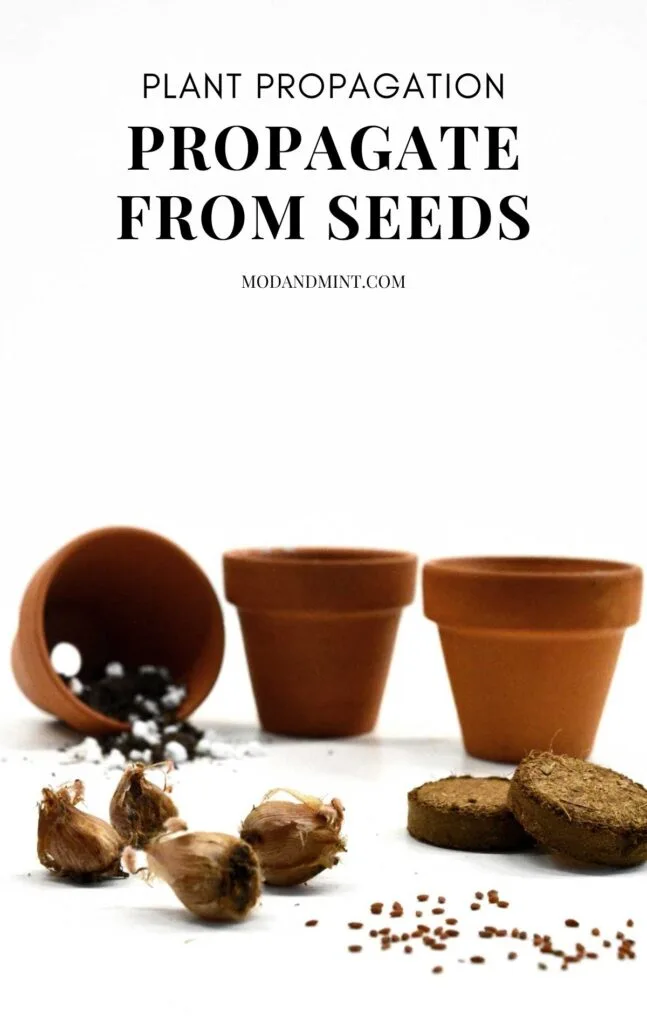
Grow From Seeds
Growing plants from seed is a bit more challenging and time-consuming than propagation methods such as rooting cuttings or planting offsets.
The advantage is that you can grow some rarer plants that aren’t easy to find in local nurseries and garden centers. Look for those wish list houseplants as seeds sold online.
- Fill a tray container with some damp rooting mixture.
- Sow the seeds about half an inch deep and an inch apart,
- Cover with plastic to retain humidity and warmth.
- Place in a bright, warm location (no direct sun), and keep the medium slightly damp.
- Allow air into the container every day or two by removing the plastic for a while and wiping off condensation.
- Completely remove the plastic when seedlings appear.
- Separate the stronger seedlings and put them into small individual pots.

Dale Hutchison
Monday 25th of March 2024
What a wonderful article. I have been bringing cuttings from my Chevrolet from Florida where they grow like a hedge. I have many many pots with cuttings in them and they all grow. Unfortunately, in my eight zone we have periodic freezing. So 90% of my share for are in pots. And they get bigger and bigger yet provide cuttings for newer plants. I will try some water propagation and some soil propagation for some of my other indoor plants. Thank you very much for your sharing and knowledge.