
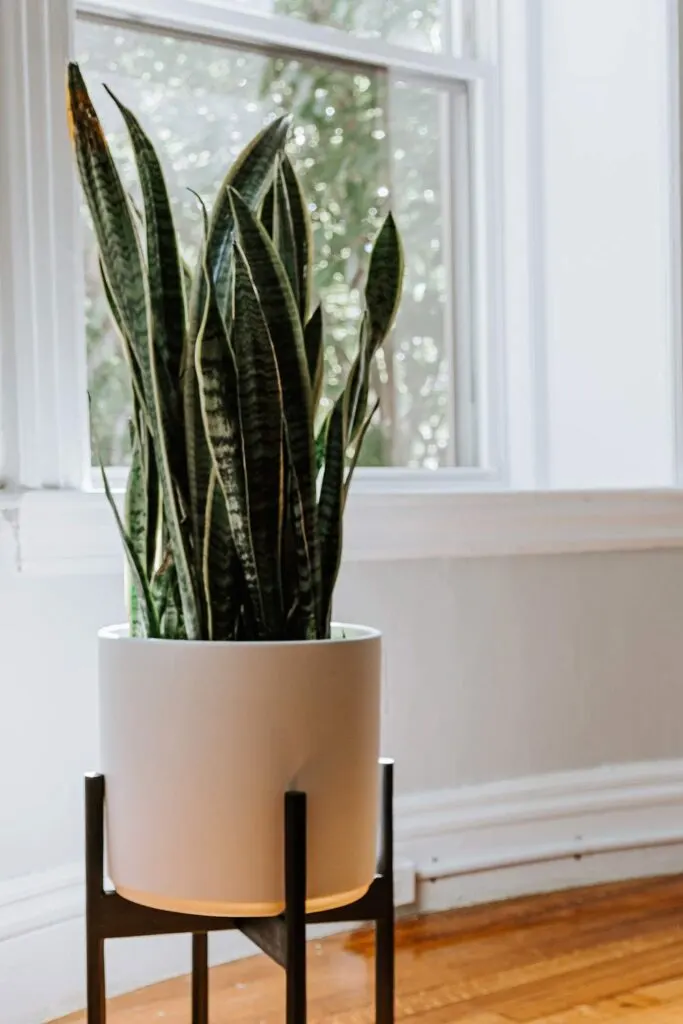
The Snake Plant (Dracaena trifasciata, formerly Sansevieria trifasciata) is one of the easiest to grow and care for houseplants.
These evergreen plants can tolerate some neglect, do well in both light and shady locations, and don’t mind dry air caused by our central heating.
Because Snake Plants are so low maintenance and with great visual impact, you often see these in places like dorm rooms, restaurants, offices, and hospitals.


Sansevieria Varieties
There are many varieties to choose from: there are over 60 different snake plant species and cultivars.
One of the most popular is the Sansevieria trifasciata. This variety has clusters of long upright dark green leaves. Similar is the variegated Sansevieria trifasciata laurentii, this one has yellow bands along the edges of the leaves.
Further reading: Popular types of indoor Snake plants.


Want to buy a Snake plant? Find it for sale on Amazon!

Basic Succulent Care Refresher: Beginners Guide to Succulent Care.
Light Requirements
Snake Plants can survive in very low light. One of the reasons they are so popular is indoor plants. This means you can place it in the corner of your hallway, or that empty spot a bit further away from the window, and it will be just fine.
However, if you can, put your plant somewhere where it gets at least a few hours of bright,
Occasionally wipe the leaves with a damp cloth to keep the dust off. This will help your plant to breathe and soak up as much light as possible.
Further reading: More easy care plants, perfect for beginners!


Watering
Snake Plants store water in their leaves, making them very drought-tolerant. Wait till the soil is completely dry before watering.
Water on the soil, not into the crowns of the leaf clusters. Water that sits in the crowns too long can also cause your plant to rot.
Read more: How often to water succulents.


Fertilizer
The Sansevieria is not very needy when it comes to fertilizer. You can fertilize to supplement poor soil or give your plant a boost during the growing season.
Feed it once a month in spring and summer with a diluted liquid succulent fertilizer. You can also treat your plant to a specially formulated fertilizer for snake plants.
Don’t fertilize in winter when the plant goes dormant and growth slows down.


Flowers on an Indoor Snake Plant
Mature Snake Plants can flower when they get enough light and are overall very happy with the care they are getting. Don’t worry if your plant doesn’t bloom. Most indoor Snake Plants don’t flower at all.
If they do, it is usually in spring or early summer. The flowers are small, and come out in clusters on a stalk. You can remove the stalks when they are done flowering.


Sansevieria trifasciata laurentii.
Soil and Repotting
There are a few obvious signs that your Snake plant needs to be transplanted into a bigger pot.
You might see roots coming through the drainage holes of the pot. If they don’t have
Another sign to
What happens is that your Snake plant is making rhizomes underneath the soil. These rhizomes need horizontal space to find their way up to the surface and form new leaves. If the pot gets too crowded these rhizomes will push against the inside of the pot. If your plant is in a plastic pot, you will see or feel bumps on the side. Rhizomes growing tight in a clay pot might even crack it.


Transplant in well-draining succulent soil in a pot one size bigger with drainage holes on the bottom.
Quick note: If your snake plant has orange roots, no worries. Although most plants have white roots, orange roots on a Sansevieria are perfectly normal. If you see black roots, that’s an indication of root rot and is a problem.
Snake Plant Propagation
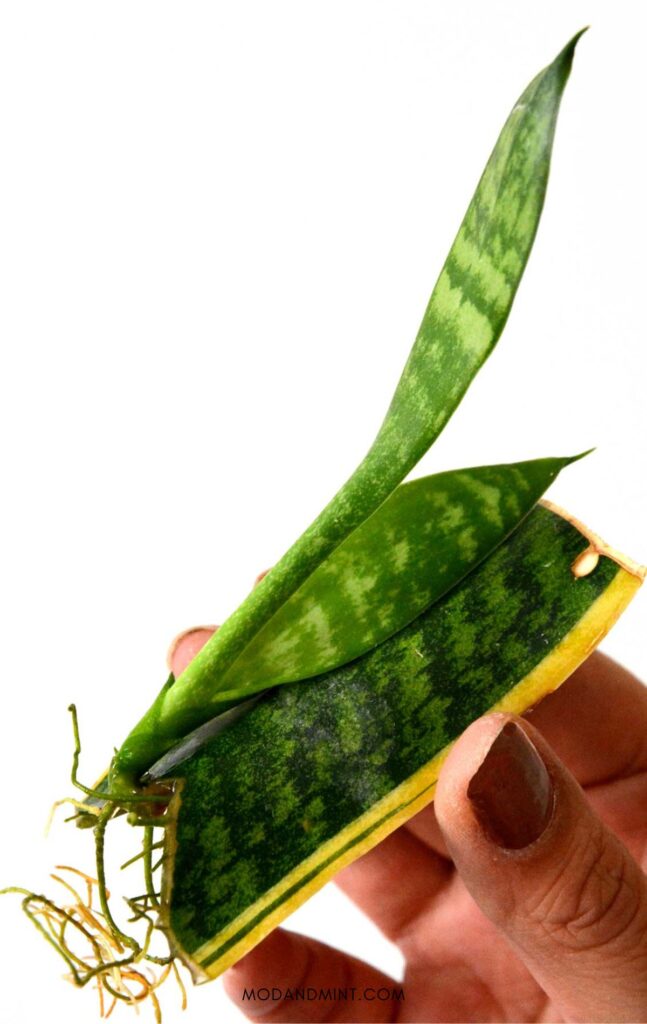
When your plant is growing too large, or you just want to make more plants, you can divide or propagate leaf cuttings.
One very important thing: When you propagate cuttings from a variegated Snake Plant like the Laurentii, with the yellow bands, that color will be lost on the new growth. Your propagated plants will be solid green. If you want to keep the variegation you should propagate by division.
Propagating snake plant cuttings will test your patience. Unlike plants like the Pilea peperomioides or Tradescantia and many others that will start growing roots within a week or so, snake plants can take weeks or months to grow roots and new leaves.
Further reading: How to propagate your snake plants.


Leaves Falling Over
If it’s just a random leaf drooping or falling over, that’s perfectly normal. Very tall leaves tend to fall over, not growing straight. It’s just gravitation. You can stake your leaf to keep it upright.
It gets more serious when multiple leaves are suddenly falling over. When this happens it usually is a sign that you are overwatering. Rot will set in from the bottom. Leaves will go mushy and soft and won’t be strong enough to stay up straight.
Related reading: Common Snake plant problems.
Are Snake Plants Succulents?
Yes, snake plants are types of succulents. Their native habitat is hot and dry. To survive long times of drought, they store water in their leaves, roots,
Do Snake Plants Clean the Air?
Back in the 1980s, NASA did a space station air quality study to look at which plants were best able to filter the air. Variegated Snake Plants are on the list of effective natural air purifiers.
So yes, they do clean the air from toxic chemicals, but to be honest, one plant in your living room won’t do very much. I don’t have the exact number, but you would have to have a lot of plants to end up with truly clean air.
Related reading: Fascinating Facts about Snake Plants.
Are Snake Plants Toxic to Cats?
Snake plants look very
But, they are mildly toxic. Ingestion can cause nausea, vomiting, and diarrhea. So keep them out of reach of your pets if they like to munch on your plants.
Be informed and get more information on the question – Are Sansevieria Snake Plants toxic? and read up on how to keep your pets and plants safe.


Related reading: Sansevieria Meaning and Symbolism.
Dale
Monday 29th of January 2024
What a wonderful and educational article! I have some of these mother-in-law plants that are subdivisions of plants 50 year hesitate grow bigger and bigger I literally put them on a chopping block and slowly slice them into quarters with a machete. I use a very good potting soil and use the finger method as mentioned in this article. I have a very high survival rate for these large cuttings and use these plants indoors and outside when the weather permits. I have a greenhouse where I store some of my larger plants and a sunroom to store many more. I plan on trying to propagate some in the methods that you suggest and hope to have many many more.
Mod and Mint - Deborah Green
Sunday 3rd of March 2024
Hi Dale, Sorry for my late reply, i had missed your comment before. Thanks for sharing your story, your greenhouse and sunroom sound wonderful! My dream is to have a sunroom attached to my house. Maybe one day...
Brenda
Friday 12th of January 2024
Very good info thank you I've had mine for 20years shes produced a many babies and yes I did witness the blooming years ago.
Mod and Mint - Deborah Green
Monday 15th of January 2024
That is amazing! It must be very happy in your care!
Cynthia Morey
Thursday 23rd of September 2021
My snake plant is splitting at the top of its leaf..should i worry about this
RT GILBERT
Saturday 24th of April 2021
A growth, resembling a rhizome but is greenish in color, is growing horizontally above the soil level, pushed thru one leaf and is approaching another. What is it?
patrice brousseau
Friday 26th of March 2021
Hi, I keep killing my Snake Plants. I tried using a mister rather than straight water but my snake plants leaves are turned in! Should I water straight from the water bucket and soak them down? I don't use my furance a the temperature is ideal. What do you suggest? With Much Appreciation, Trice