
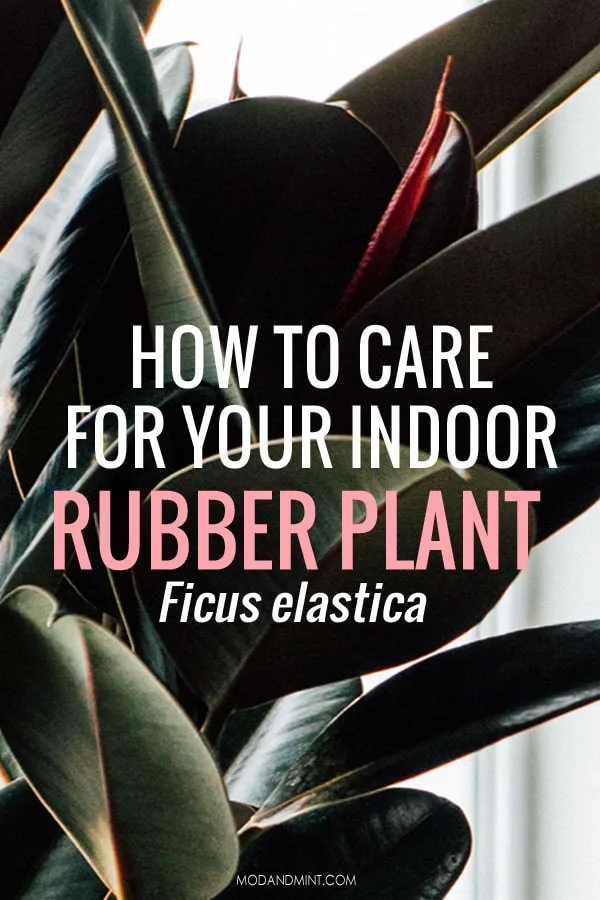
The Rubber plant (Ficus elastica) is a popular indoor plant with large, glossy leaves. These plants are strong and easy to care for. They can thrive in a variety of light conditions, making it a great choice for both beginner and experienced plant enthusiasts.
Provide bright, indirect light, water when the top inch of soil is dry, and maintain a warm indoor temperature. Regularly dust the leaves, and consider repotting when it outgrows its container.

Rubber Plants
The Ficus elastica is one of over a thousand varieties of Ficus plants. This means among many others, your fiddle leaf fig (Ficus lyrata), is related to your rubber plant.
If the stem of a rubber plant is scratched or cut, a sticky, milky liquid will come out. This latex sap could be collected and refined into actual rubber.
Now, this is NOT something I tell you to try at home. Just take it as a fun fact about your plant. The sap can even trigger allergic skin reactions, so be careful. More on this later.
Want to buy a Rubber Plant? Find it for sale on Amazon!


Need a plant care refresher? Check out the Beginners Guide to Houseplant Care.
Light Requirements
Rubber plants can tolerate growing in low light. One of the reasons they are such popular indoor plants.
However, it’s important to note that while they can survive in low light, your plant may not thrive or grow as quickly as it would in brighter conditions.
For optimal growth, provide your plant with a few hours of morning sun and bright, indirect light the rest of the day. Direct sunlight can scorch the leaves, while too little light can lead to slower growth and smaller leaves.
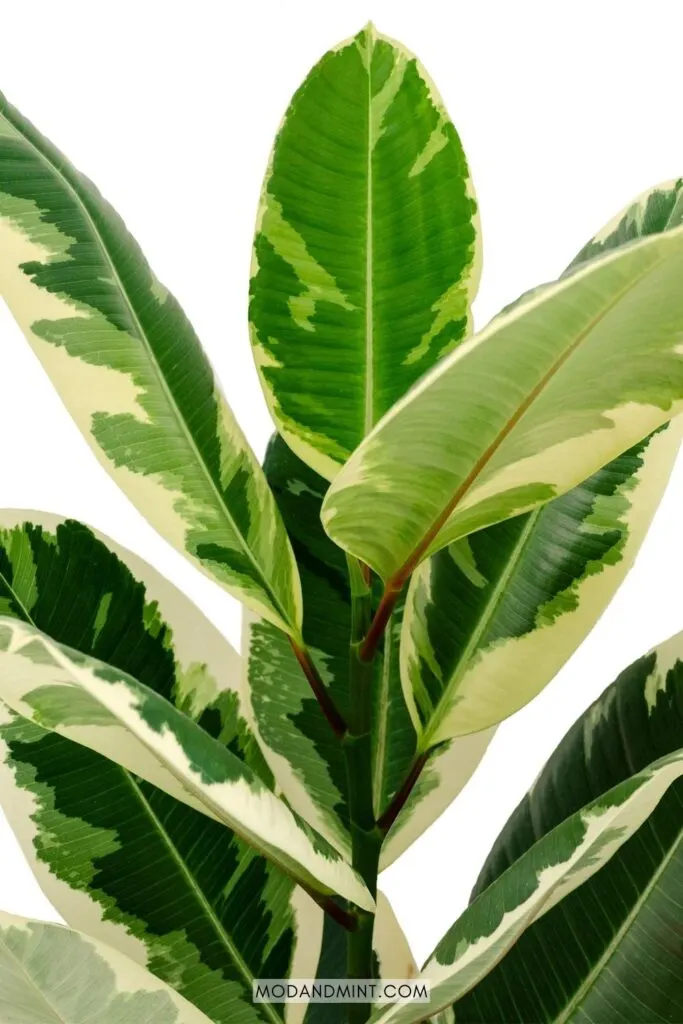
Variegated rubber plants, like the Ficus elastica ‘Ruby’ and the Ficus ‘Tineke’, require more and brighter light than regular rubber plants. If a variegated rubber plant gets too little light, the pretty colors may fade.
Occasionally wipe the leaves with a damp cloth to keep the dust off. This will help your plant to breathe and soak up as much light as possible.


Watering
Water your Ficus elastica regularly to keep the soil evenly moist, but not soggy. You want the soil to feel like a well-wrung-out sponge.
Never let the soil dry out completely. Too little water will cause the leaves to droop and eventually fall off, leaving the plant with bare stems.
Use a diluted liquid plant fertilizer to feed your plant about once a month in spring and summer. Don’t fertilize in winter.
You can use a moisture meter to tell if it’s time to water. And read up on the basics of how and when to water your indoor plants.


Humidity
Rubber plants are not very needy when it comes to humidity levels. They can grow in average household humidity. No need for misting or humidifiers.
Repotting
I have seen pictures of rubber plants sitting in pots that are way too small. Sometimes so much that they are top-heavy and about to fall over. If this happens, it’s definitely time to repot!
On the other hand, there are plenty of small rubber plants potted in pots that are way too large. If the pot is too large for your plant, the soil will stay wet for too long after you water it. This may lead to root rot, which could be the start of the end of your rubber plant.
When to Repot a Rubber Plant
Every two to three years repot in spring when the plant is actively growing. The soil will have lost its nutrients and will need to be replaced with fresh well-draining potting soil.
If your rubber plant has outgrown its pot, repot it in a pot one size bigger. Make sure the new pot has drainage holes on the bottom. Without those, excess water has no way to get out. Leaves will yellow and roots can rot.
In need of a repotting reminder? Follow the steps on how to repot your plants.


Pruning and Branching Out
Rubber plants can grow as high as 8 to 10 feet indoors. If you have the space and like the look of an indoor rubber tree, this is great.
But if your plant is getting too tall for your home, pruning can help to keep it at a manageable size.
Pruning from the top will encourage branching from a lower node. This way you can make your rubber plant grow more compact and bushier.
You can prune your rubber tree at any time of year. Usually, I recommend pruning plants in spring. But for the rubber plant, it is a little different. When your rubber plant is dormant in winter, the flow of the rubber sap will be slower, making it easier to handle. The flow is also slower at night versus in the daytime.
How to Prune a Rubber Plant
Rubber plants are hardy and can handle a good prune. But avoid pruning too much at once. Do not remove more than one-third of your plant’s growth. Plants need their leaves to grow and thrive.
Use sharp and clean pruning shears. The sharper the blade, the less damage the cut will do to your plant. Cut right above a growing point or node.
When you prune the top of your rubber plant, it will not grow any longer, but new branches will eventually grow below your cut.

Rubber Plant Sap
Be careful with the white sap coming out when you make your cut. This sap can irritate eyes and skin, especially if you are allergic to latex. So wear gloves when pruning your rubber plant. If you do accidentally get it on your skin, wash it off right away.
Sap bleeding is a natural process. The flow of sap will stop after some time. You can simply let it go and allow air to get to the wound and let it heal naturally. You could lightly cover it with an old rag to absorb most of the sap. But you don’t have to.
Do protect floors and other surfaces from the dripping sap. You don’t want this on your floors, trust me.


Propagation
Rubber plants are not the easiest houseplants to propagate, but it can be done.
The easiest way to propagate a rubber plant is to take a stem cutting from a healthy, non-woody branch and root it in water or directly in soil. Rubber plant cuttings don’t root very quick, so be patient.
For more about plant propagation: read the complete guide explaining the 6 different ways to propagate all your plants.
Propagation by Air Layering
Air layering is also an option to propagate your rubber plant. Especially if you are dealing with older woody stems.
Make a shallow cut on the stem in between two leaves. Pack damp moss around the cut and cover with plastic wrap to keep moisture levels high. Keep an eye on it to make sure it stays moist inside. After a while roots will start to grow from the stem into the moss. When this happens, you can cut the branch off below the moss and plant it in soil.


Leaves Falling Off
Rubber plants are sensitive plants and don’t like many changes. Leaves falling off is a common rubber plant problem.
Most often this happens due to overwatering or too much fertilizer. But your plant can also drop its leaves as a response to sudden changes in light or temperature, cold drafts or a recent repotting.
Leaves Drooping
If the leaves of the rubber plant are drooping, it is almost always a watering issue.
It is underwatered if your plant droops when the soil is dry. Give it a thorough soak and it should perk right up. When the leaves start drooping and the soil is still moist, then the droopiness is caused by overwatering. Let the soil dry out more and water less often going forward.
Yellow Leaves
The most common cause of yellow leaves on a rubber plant is overwatering. Water less often and make sure the pot has drainage holes on the bottom.
Is the Rubber Plant Toxic to Cats?
I’ve mentioned the sap inside the rubber plant, so you might already guess this, but yes, rubber plants are considered to be toxic.
Your pet may vomit and have a lack of coordination if they ingest parts of this plant. Stay safe and keep your rubber plant out of reach of children and pets.
Learn more about the risks of toxic houseplants around your pets (and find out which plants are non-toxic and safe!).


More Foliage Plants
Looking for more foliage houseplants? Check out these other popular plant articles.
- Dieffenbachia Houseplant Care Guide – How to Grow an Indoor Dumb Cane Plant
- How to Grow an indoor Monstera Deliciosa
- Indoor Boston Fern Care – Keep your Fern Lush and Green
- Begonia Maculata – How to Care for an indoor Polkadot Plant
- Indoor Prayer Plant Care Tips – Keep your Maranta, Calathea, or Ctenanthe alive
Chris
Monday 4th of September 2023
I'm have great success with rubber trees and find a couple issues. First, they are very drought resistant and do best when you let them fully dry out. I tell succulents. Doing this, my burgundy grows over a foot a month in peak season. Also, I find that the lighter colored versions require far less sun and are far more likely to burn. And finally when it comes to pruning to reduce height you really need to also adjust where the light is coming from. Their first instinct is going to be to branch from the highest node left behind and to continue growing straight up. When mine hit a 10-ft ceiling I trimmed off 3 ft from all branches and within a few months they were right back at the ceiling. What I do now is use a razor to cut off the little growth points on the top three nodes below the cut and then either block light up top or increase light from the sides
Gilly
Monday 19th of June 2023
My Nanna had a rubber plant it grew to the ceiling height then bent and started going along the bay window. She’d water it but also put the tea leaves from the pot in it coffee grounds and had even put the blood from liver and beef in it. It was fantastically shiny and healthy looking I was sitting in the chair next to it one day and a gust of wind through the door and open window caused it to fall on me ! No damage to it at all. I don’t know what happened to it as I moved away but I hope it went to a good home when she passed.
Tracy
Wednesday 26th of April 2023
Thanks for these helpful tips for my rubber plant.