
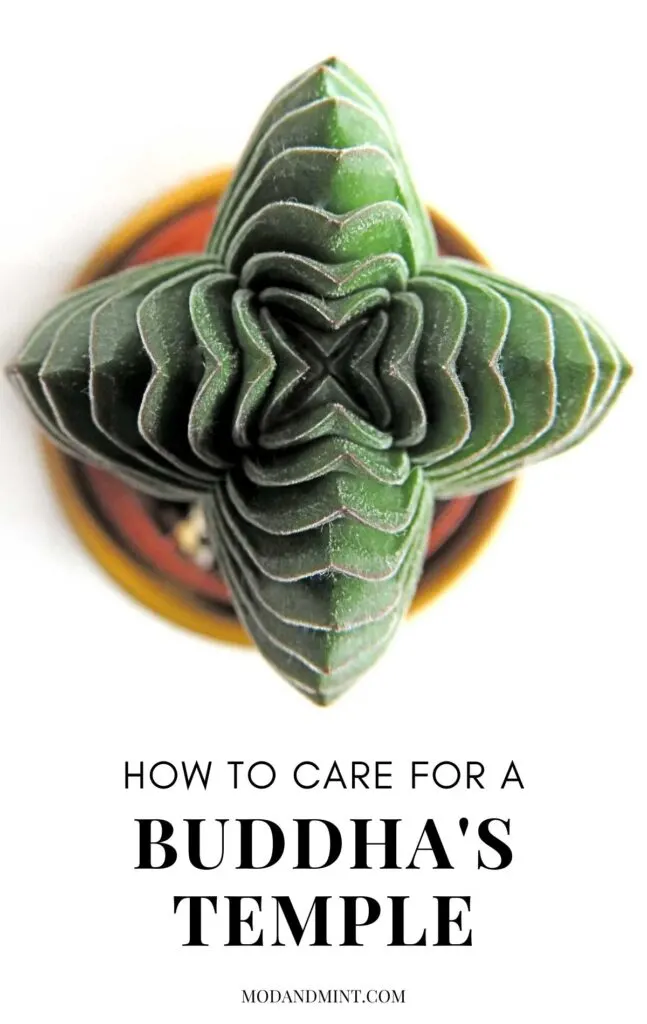
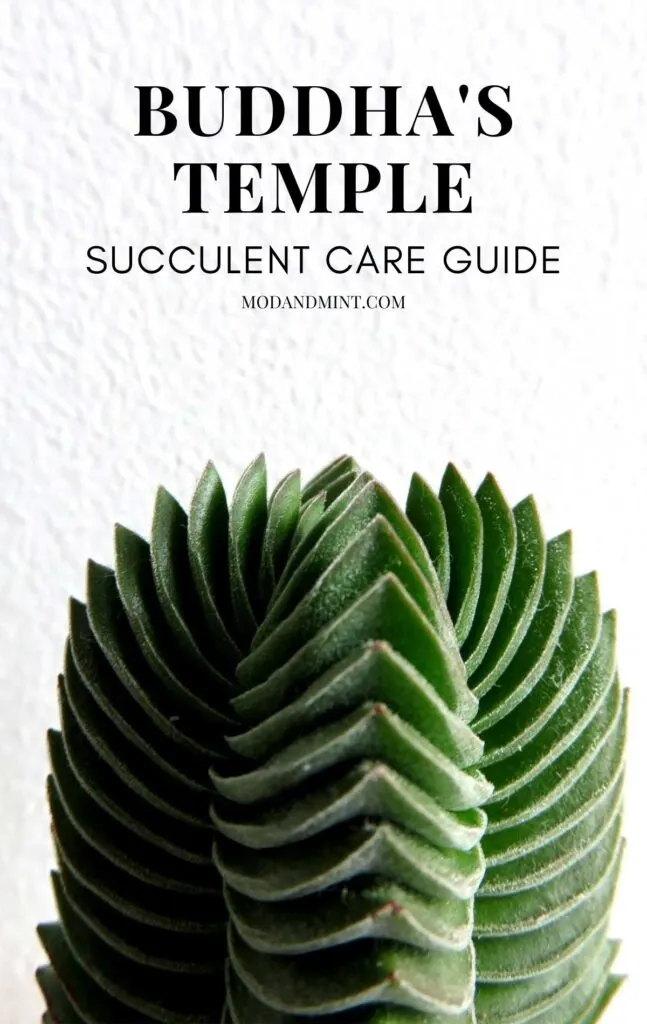
The Buddha’s Temple (Crassula pyramidalis compacta) is an unusual, relatively rare succulent. It grows upward columns of tightly stacked leaf rosettes forming a beautiful square geometric pattern that resembles a temple or pagoda.
This eye-catching plant stays small and is low-maintenance. Provide bright, indirect sunlight, allow the soil to dry between waterings, and maintain a comfortable indoor temperature.
Related reading: Beginners Guide to Succulent Care.

Light Requirements
Buddha’s temple plants grow best in a bright, sunny window with a few hours of sun and bright indirect light the rest of the day.
Lots of sun exposure can turn the leaves red. If you prefer the leaves to be more green, move your plant away from the window a bit.
If your plant gets too little light, the color will fade and will grow leggy. Leaves will not be stacked as compact as they should, stretching and leaning towards the light. Rotate your plant to make it grow in the opposite direction. This will straighten it out. Rotate slowly when offsets are growing.


With tall Buddha temple succulent plants, you can see from the side at which times the plant got less light and when it got more. The narrow part is when the plant went through winter dormancy, growing much slower in less light. The wider parts are when it was in its active growing season receiving plenty of light.


Watering
Buddha’s temple plants need little water. They are used to dry conditions and store water in their stem and leaves.
Generally, water only once the soil has dried out. If the soil feels moist, don’t water but wait one or two days and check again. If it feels dry, go ahead and water thoroughly. If you are uncertain, use a moisture meter to help you out with when to water.
Buddhas temples have a powdery coating, similar to the paddle plant, that can be washed away with watering or rubbing. So water the soil, not the leaves, to avoid losing this coating.
Water very sparingly in winter. Water it just enough to make sure the leaves don’t shrivel up.
Related reading: How to water indoor succulents.

Want to buy a Crassula Buddha’s temple? Find them for sale on Amazon.
Soil and Repotting
Buddhas temple plants are slow growers so they don’t need to be repotted very often. If your plant has outgrown its pot, repot it in a pot one size bigger than the original. Make sure the pot has drainage holes on the bottom. And plant in very well-draining succulent soil.


When Buddha’s temple plants grow and branch out, they might fall over under the weight of all the offshoots. To keep the plant from falling over, you can place a small stake next to it to keep it upright.
Related reading: How to repot your plants.
Buddha’s Temple Propagation
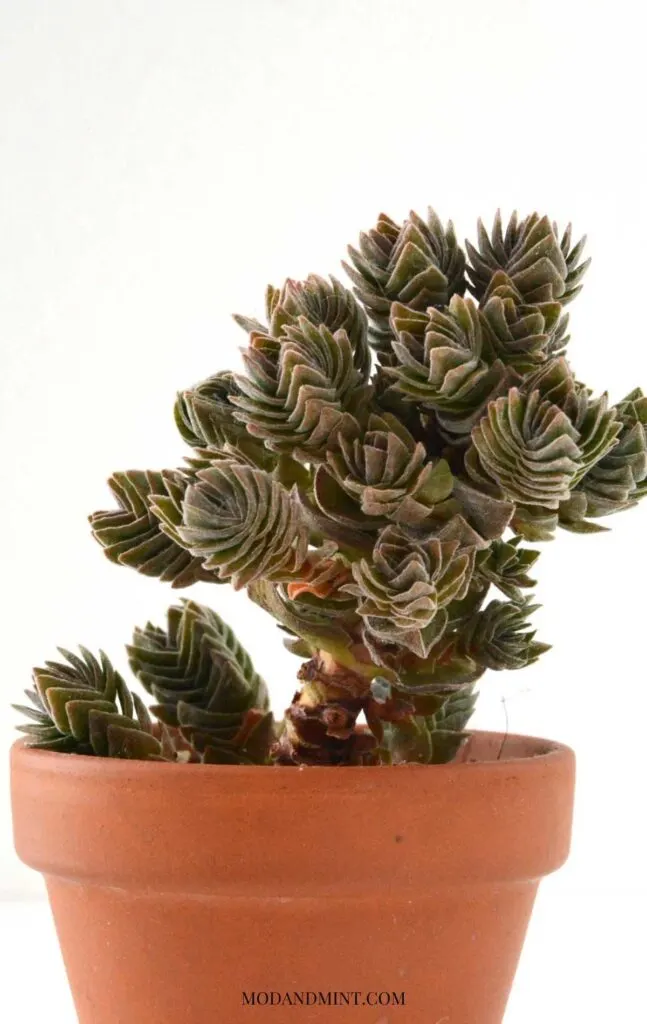
The Buddha temple starts growing in a single column. When it matures it will branch out. These branches are pups or offsets that grow in between the leaves and around the main column. You can remove the baby pups and root them in water or directly in soil.
They are slow to root, so be patient. And some cuttings might not take. Even if you are doing everything right. Buddha’s temples are just fussier than most succulents to propagate.
The longer you keep the pup attached to the main plant to grow, the better chance you have of it surviving the transplant to its own pot.

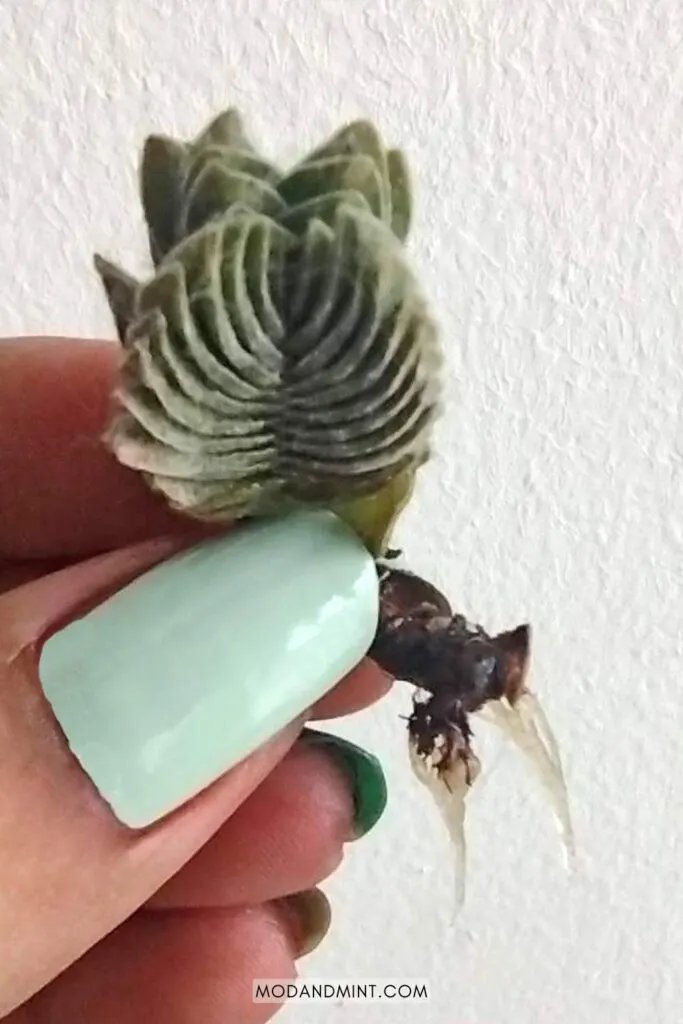
- Gently wiggle the offset away from the parent plant.
- Remove a few leaves from the bottom of the cutting. This is where the roots will grow from.
- Let the cutting rest and dry out for a day or two.
- Dip the bottom in rooting hormone. This powder helps the roots to grow faster and stronger. If you don’t have any, you can skip it, the process just might take a little longer without.
- Place the cutting in water and wait for roots to grow. Change the water regularly. Transplant into well-draining soil when the roots are about 2″ long,
or - Plant the cutting directly into soil and mist lightly once. Resume regular care when there are roots and new growth.
Want more easy-to-propagate plants? All these plants grow pups: the pineapple plant, spider plants, haworthia succulents, air plants, and the pilea peperomioides.

Is a Buddha’s Temple Plant Toxic to Cats?
The Buddha’s temple is considered mildly toxic when ingested. Keep out of reach from cats and dogs.
It is quite rare for pets to get seriously hurt from eating plants. But it is always important to research and find out what type of plant you’re bringing home.
Learn more about the risks of toxic houseplants around your pets (and find out which plants are non-toxic and safe!).


Desmond Aicken
Wednesday 21st of December 2022
As aye have a Buddhist temple plant but as it States that too keep it & grow it in full light & as aye have this now about 4,years was about inch & half when aye bought it & has been growing on a windowsill ever since full light but it is now about a foot tall good health condition but is just tall but with no side growth shoots, is this normal or why is it not put on any side shoots,! As only 1,other thing aye can think off is that pot is reasonably small & haven't fed it next too none other when Potted it when aye Received it mixed in with the soil,!? as can you tell me if this is the only other reason for it growing in this manner,,!?, THANKS,, D, AICKEN,, // CHEERS,,
Marilyn Myall
Sunday 20th of November 2022
My Budda's Temple was just 2cms tall when I bought it spring 2021, now it's almost a leggy 19cms tall. I've had to put a wooden skewer and tie a piece of string loosely to to stop it leaning too far. No offshoots as yet. It's in a succulent medium. It's very healthy just very tall. Not sure what to do now.
Mod and Mint
Saturday 26th of November 2022
Hi Marilyn, you can leave your plant growing as is if it is overall healthy like you say. Maybe give it some more light so it doesn't grow so narrow. I have had one of mine with a skewer to keep upright for a while as well. Eventually, it started to grow a lot of offshoots and I just cut the long top off. You can cut it if you want, remove some of the bottom leaves, let the cut callous over, and propagate the cutting. The part in the soil will continue to grow, maybe even grow babies over time.