
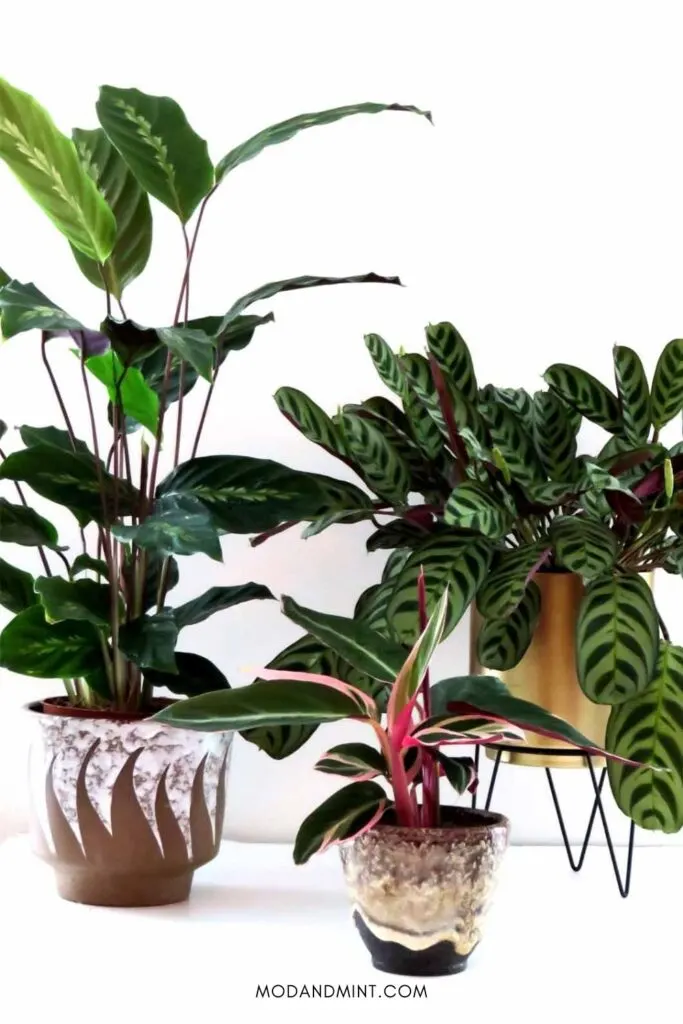
Prayer plants are captivating houseplants known for their patterned leaves that move and fold up at night, resembling hands in prayer.
Their vibrant foliage and ability to thrive in indoor conditions make them popular to grow as indoor plants, adding a touch of elegance and fascination to any home.
This plant guide has easy care tips on watering, light, humidity, propagation, and more, so you can successfully grow Prayer plants in your home!

Want to buy a Prayer plant? Find it for sale on Amazon!
Indoor Prayer Plant Care Tips
Prayer plants belong to the Marantaceae plant family, and are scientifically known as Maranta, Calathea, Ctenanthe, and Stromanthe plants, amongst others.
These are different types of plant species but are closely related and require mostly similar care.
Prayer plants are not the easiest plants to grow indoors. They can pose a challenge and may not be the best choice if you prefer low-maintenance plants. However, do not dismiss these plants too quickly.. With some basic care tips, you can grow beautiful prayer plants indoors!
Basic Plant Care Refresher: House Plant Care for Beginners.

How much Light does a Prayer Plant need?
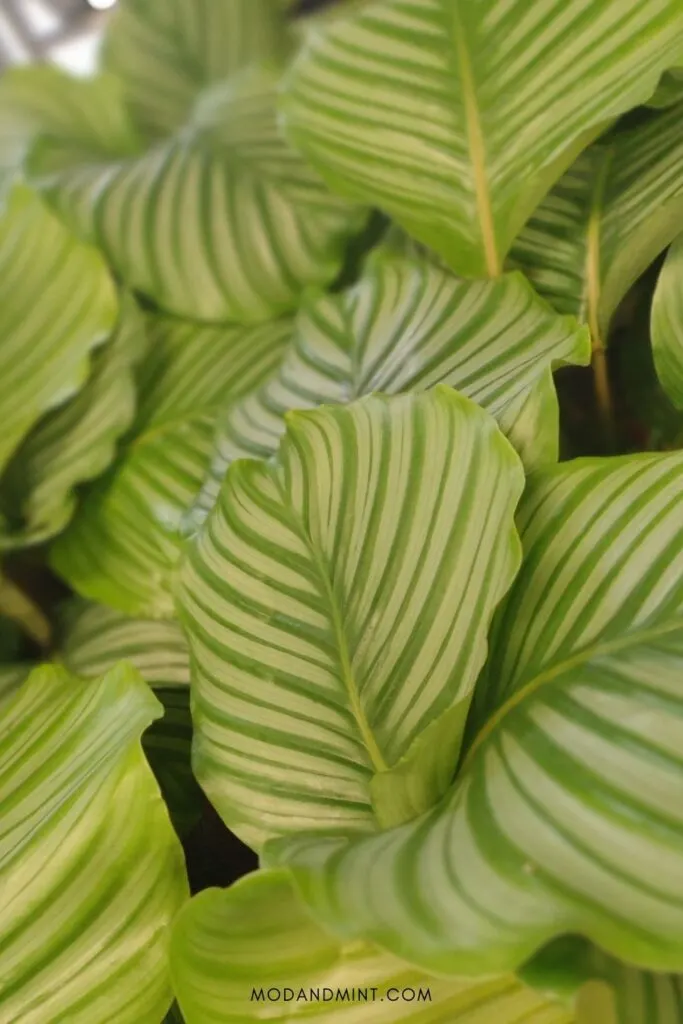
Indoor prayer plants prefer bright, indirect light. They can tolerate lower light conditions, which is common in many indoor settings.
But if the light is too dim, the leaves stay smaller and maybe lose variegation. It also needs sufficient light to open its leaves completely during the day.
At the same time, keep it out of direct sunlight. If the light is too strong, it can fade and scorch the leaves.


Occasionally wipe the leaves with a damp cloth. It removes dust and helps the plant to photosynthesize and soak up as much light as possible.
Prayer Plant Watering


In your home, water your prayer plants regularly to keep the soil slightly moist. The soil should feel like a wrung-out sponge.
If the soil feels wet, wait for one to two days and recheck the soil. If the soil is dry, go ahead and water generously, to saturate the soil. Allow any excess water to drain out of the bottom of the pot. Then allow the top layer of soil to dry out before watering again.
Overwatering can lead to yellow leaves and root rot, while underwatering can cause the leaves to droop, wilt, and dry out. Leaves should feel firm.
When in doubt, hold off on watering. It’s easier to fix underwatering than overwatering. If you’re unsure, a moisture meter can be a valuable tool to determine when to water.
Further reading: How often to water houseplants – How to use a moisture meter.


Fertilizing
Use a diluted liquid plant fertilizer to feed your prayer plant every two to three weeks during the growing season in spring and summer.
Remember, over-fertilization can be more harmful than under-fertilization. If you notice signs of nutrient burn, such as yellowing or browning leaf tips, you might want to cut back on the fertilizer.
Be sure the soil is damp before fertilizing and don’t fertilize in winter when growth slows down. Also never fertilize if your plant is recently repotted or is having problems. Fertilizer gives your plant a boost of nutrients when it is actively growing, it is not plant medicine.

Prayer Plants Humidity
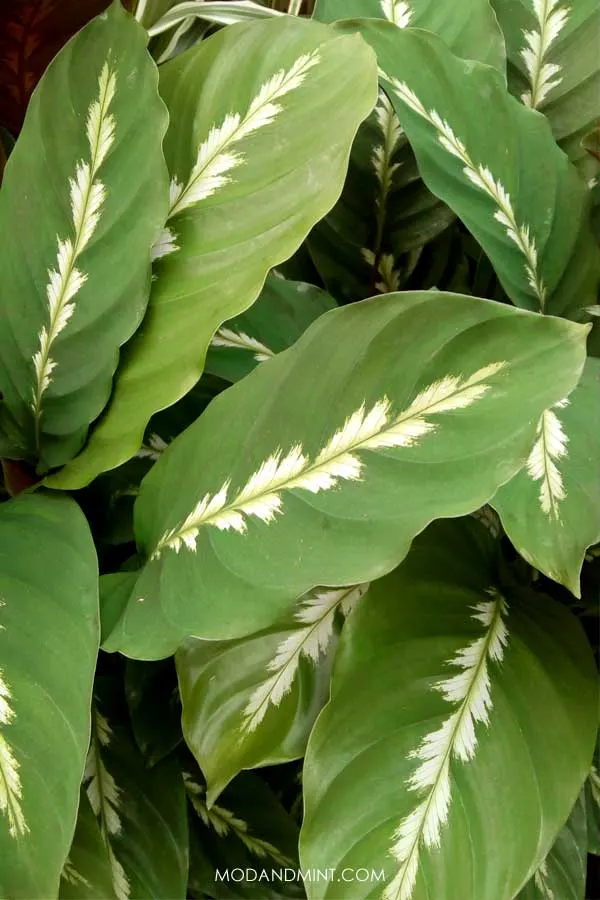
Humidity, humidity, humidity. Prayer plants are tropical plants and like warm temperatures and high humidity.
Crispy or brown leaf tips are often the first sign that your plant is not getting enough humidity. The leaves may also start to curl.
You can raise the humidity by placing a small humidifier near your plant if the air in your home is very dry.
A good place for your prayer plant is in a bathroom or kitchen with a bright window. The steam from the shower or cooking will provide your plant with the humidity it loves.


Soil and Repotting
Every two to three years repot in spring when the plant is actively growing. The soil will have lost its nutrients and will need to be replaced with fresh well-draining potting soil.
Repot in a pot one size up if your prayer plant has outgrown its original pot. You will notice the roots have filled the pot, or are growing from the bottom of the pot.
Make sure the new pot has drainage holes on the bottom. If it doesn’t, use the pot as an outer cache pot and place a planter with drainage inside it.
Read more: How to repot your houseplants.


Propagate Prayer Plant
Propagating prayer plants by division is easy and has a high success rate.
- Carefully remove the plant from its current pot. Loosen the soil around the edges and gently lift the plant out, trying not to damage the roots.
- Look for natural divisions in the plant where it has formed separate clusters of stems and leaves. These are the sections you’ll want to separate.
- Using your hands or a clean, sharp knife, gently separate the divisions. Each division should have its own set of roots.
- Plant each division in its own pot filled with a well-draining potting mix. The pot should be deep enough to accommodate the roots and allow for growth.
Propagation may be done at any time of year but is best done during the active growing period in spring or early summer, as in winter growth slows down. The warmer weather and longer daylight will help encourage new growth.


Most Prayer plants can also be water propagated with stem cuttings. Cut right below a node and place the cuttings in water until roots develop.
Read more about plant propagation: 6 different ways to propagate your plants.


Why are the Prayer Plant Leaves Curling?
Curling leaves on prayer plants is a common problem and can have a few causes.
Low Humidity: One reason is insufficient humidity in the plant’s environment. Prayer plants come from tropical regions and thrive in high humidity. When the air is too dry, their leaves may curl as a defense mechanism to conserve moisture.
Underwatering: If the plant is not receiving enough water, it can respond by curling its leaves to reduce surface area and minimize water loss.
Overwatering: Ironically, overwatering can also lead to leaf curling. When the soil is consistently soggy, it can prevent the plant’s ability to take up water, causing leaf curl.
Maybe the curling leaves are not a problem at all. New leaves on a prayer plant typically emerge curled up from the center of the existing leaves.
New leaves are rolled up and as they mature, they slowly uncurl, revealing the beautiful patterns and colors. This growth is usually more vibrant and lighter in color but darkens as the leaf matures.


Prayer Plant Leaves Not Moving
Prayer plants are known for their leaf movements, which are a response to changes in light during day and night.
If your prayer plant’s leaves are not moving at night, it is probably getting too much light. These plants need a noticeable difference in light and dark for the leaves to open and close.
On the other hand, if your plant isn’t opening its leaves during the day, it is probably not getting enough light.
Additionally, the plant’s movement can be subtle and slow, so you might not notice it immediately. If the plant is otherwise healthy, there’s no need to worry.
Further reading: Common Prayer plant problems.


Are Prayer Plants Toxic to Cats and Dogs?
Prayer plants are considered non-toxic when ingested. It is safe to grow at home around your cats or dogs.
However, it’s always a good idea to prevent pets from chewing on houseplants, as it can cause mild digestive upset.


Emily
Thursday 30th of December 2021
I have a prayer plant and it’s only had one new leaf but that leaf has stopped maturing and is just light green with a little bit of purple. It also seems to be getting thin near the stem of the leaf. What should I do?
Em Jay
Tuesday 30th of November 2021
Hi there,
I am desperate for some help with my ctenanthe lubberisana!
She was happy during the summer (I live in Canada), got a little sad due to being root bound and so I up potted her… and for the winter I’ve put her next to a humidifier , about 8-9 feet away from a west window. She has been losing many lower leaves, and when I noticed new growth coming in soft, I held off on watering. However, her leaves are now still browning and crispy. No signs of pests.
Any advice is greatly appreciated!
Marc
Tuesday 27th of April 2021
Hello, I have 8 clathea plants of the 8, I'm having problems with 3 of them, the leaves have turned brown and are curling. I think it's because I watered them without letting the water sit overnight. I do have pictures of what is happening if you would like to see them. I'm thinking of cutting them down to see if this hepls and they start to regrow. The stems on all the plants look green and healthy for the most part. Any advice you can give would be fantastic.
Mod and Mint
Saturday 8th of May 2021
Hi Marc, how are your plants doing? I don't think the issues area caused by not letting the water sit out. When I hear that Calathea leaves are turning brown and curling up, I would sooner think that the soil was kept dry too long. Calathea plants do not like dry soil. If it's mostly just the edges of the leaves browning it could also be that the air is too dry and your plant wants some more humidity. Hope this helps!
Nicole Salgado
Sunday 30th of August 2020
I bought a tricolor prayer plant and the leaves keep turning yellow and then drying out and wilting. I live in Texas so it’s very hot right now and I keep it in a place where I know it won’t get direct sunlight. I’ve been spraying neem oil on the top soil because I have a gnat problem from my fiddle leaf. I Water it once a week and make sure I don’t over water. I’ve tried everything but nothing seems to work 😩 HALP!
Mod and Mint
Tuesday 1st of September 2020
Hi Nicole, I do not know if the neem oil and the gnats have any effect on the state of the leaves. Maybe someone else here does? But my guess is it could definitely have an impact. Besides that, it usually is a light issue that can be hard to get right indoors. It sounds like you are doing things right. Maybe try to slowly move your plant to a spot with more or less light, let it adjust and see if it helps. Good luck!
Vishwa
Friday 26th of June 2020
My calathea is dying I bought it recently, it had many leaves then n now it has browned a lot of leaves ony 2-3 leaves are left !!
Mod and Mint
Monday 14th of September 2020
Hi Vishwa, Without seeing the plant or knowing its care and living conditions it's hard to tell you exactly what is happening. When you bring a new plant home, it's common for the plant to go through a little stress with having been moved to a new location and adjusting to the care you give. So a leaf drop or two in the first days after purchase is nothing to worry about.
But it seems like your Calathea is having more problems than that. Go through all the basics. How much light has it been getting? How much and how often have you watered it? How is the humidity around your plant? Think about it and adjust your care as needed. Hope your plant pulls through!