
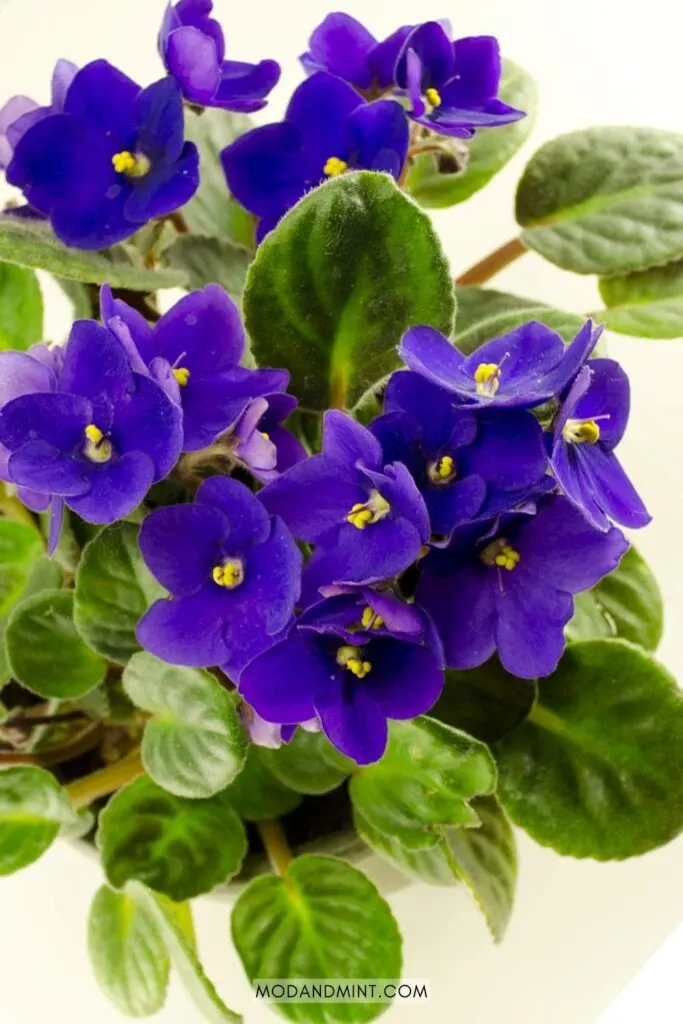
African violets (Saintpaulia ionantha) thrive in conditions that exist in most homes. As a result, African violets are one of the most popular flowering houseplants.
The plants are small and the flowers can be purple, blue, lavender, white, pink, or red. You can even find very pretty multi-colored variegated African violets.


Want to buy an African Violet plant? Find them for sale on Amazon!
How to Care for African Violets Indoors
African violet plants are easy to care for but do need some special attention. They won’t endure neglect like a snake plant or ZZ plant do.
With the proper care, African violet plants can live for 10 or 15 years and may bloom 10 – 12 months a year.

Need a plant care refresher? Check out the Beginners Guide to Basic Houseplant Care. Filled with all you need to know to take care of your indoor plants.


Light Requirements
Indoors, the best place for your plant is in a spot with bright, indirect light, such as an east-facing or north-facing window. This gives your African violet enough light in the morning or late afternoon, and plenty of bright indirect light the rest of the day.
If placed in a west or south-facing window, provide some shade with a sheer curtain during the afternoon, or set the plants a few feet away from the window sill.

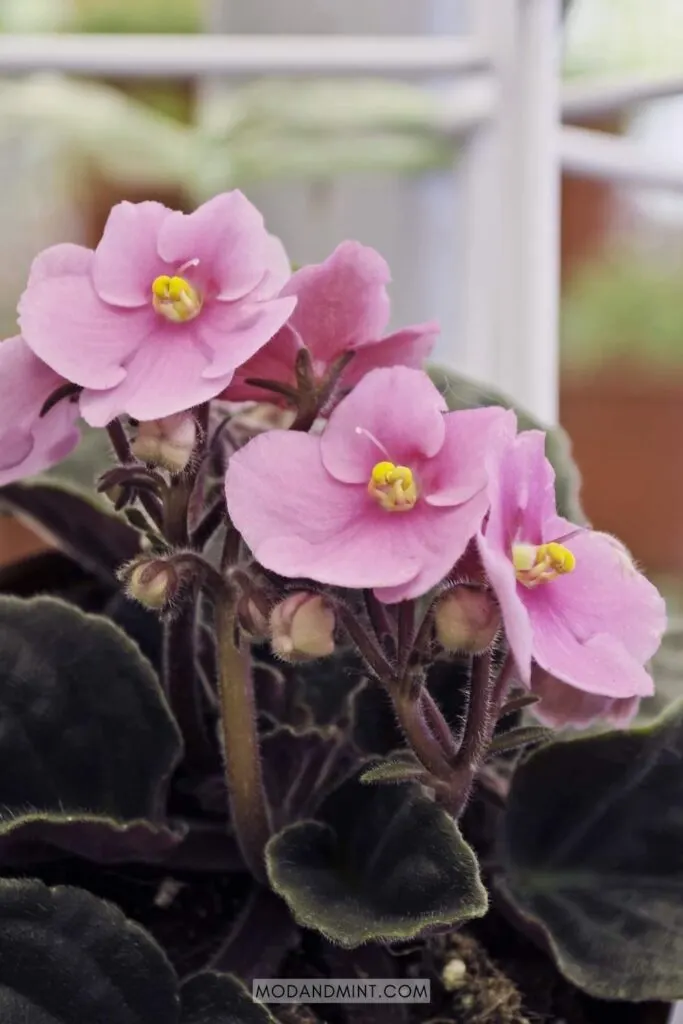
Too much light produces pale leaves with possible burned spots. Too little light may cause long, leggy stems and few flowers if any at all. If you can not give your plant enough light, consider supplementing with a grow light.
Rotate your African violet plant regularly to make sure it gets adequate light on all sides and grows evenly.
Occasionally use a soft bristle brush to remove dust from the leaves. Dust collected on the leaves clogs the leaf pores and gives the plant a hard time taking in light.
Watering
Water your African violets regularly to keep the soil slightly damp, but not saturated and soggy. Check every few days for dryness and water when the surface soil is dry to the touch.
Avoid overwatering. If you overwater (meaning you water too often), the top layer of the soil does not dry out and the roots of your plant can start to rot. So give the top layer of soil enough time to dry out so it doesn’t stay wet for several days at a time.
African violets like to be watered from the bottom. Always use room temperature or slightly warmer water. If the water is too cold, the leaves will turn brown.
You can also grow African violets in self-watering planter pots to maintain evenly moist soil. Read more about self-watering your indoor plants, and how to set up your own DIY self-watering system.
If you are unsure if it is time to water or not, you can purchase a moisture meter to help you out and read up on How to water indoor plants for a quick refresher on houseplant watering.
Fertilizer
Feed your violet plants every three to four weeks in spring and summer with a (diluted) liquid African violet fertilizer.
Be sure the soil is damp before fertilizing and don’t fertilize in winter when growth slows down.
Also never fertilize your African violet plant if it is having issues. Fertilizer is not a plant medicine. It will only stress out an already stressed-out plant. Analyze, adjust, and when your plant recovers, continue your normal care routine.


Humidity
African violet plants are used to a warm and humid environment. At home, the humidity is most likely lower. You will need to raise the humidity around your plant for it to grow well.
When the humidity is too low, your African violet may drop flowers and flower buds. Or the plant might not bloom at all.
You can group plants, away from radiators, or put your plant on a tray with water and pebbles in such a way that the bottom of the pot doesn’t touch the water. The water will evaporate and raise the humidity around your plant. Another option is to use a small humidifier and hygrometer to help with the humidity.
Repotting African Violets
Repot your African violet in spring when roots have filled the pot so much that it has become root-bound, you usually see roots growing from the drainage holes on the bottom.
Use clean pots only a little larger than the root ball. In a pot that is too large, the soil stays wet for too long for the roots to absorb.
Make sure the new pot has drainage holes on the bottom. Otherwise, excess water has no way to get out and this will drown the roots.
Violets love damp soil, so moisture-holding plastic pots work well. Clay pots can be used but will need more frequent watering since terra cotta is porous and water will evaporate quicker.
Use a good well-draining African violet potting soil. Press the soil firmly around your plant so that the crown is just above the surface. Leave a space below the rim to allow for watering.
After repotting wait at least four to six months before using any fertilizer. The potting mix usually already has slow-release fertilizer in it.
In need of a repot reminder? Read on for all the tips on how to repot your plants.

Propagating African Violets
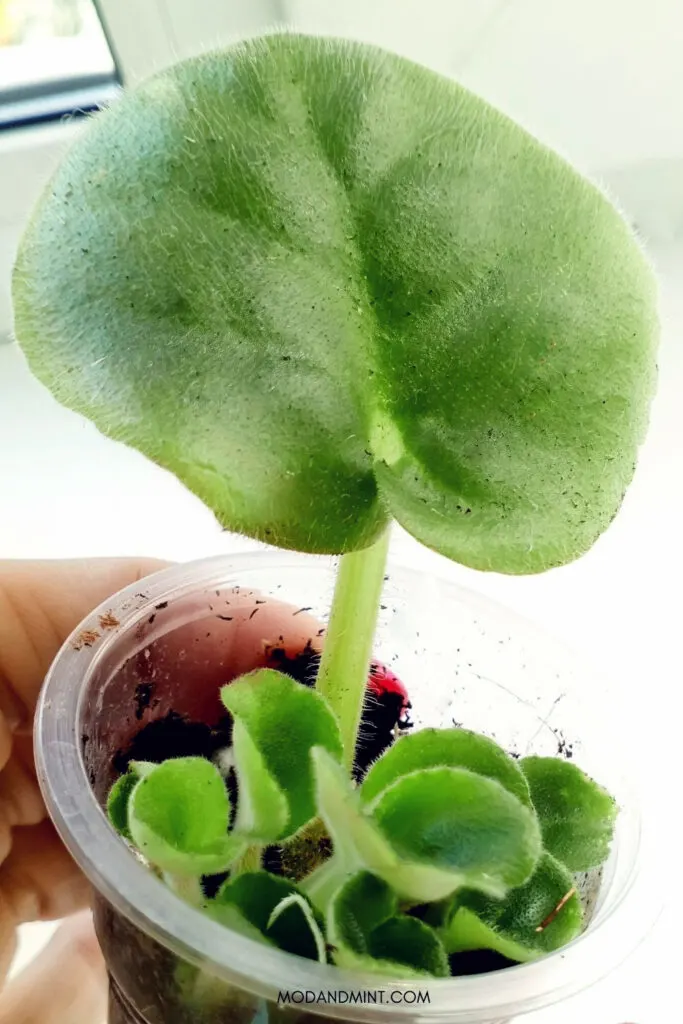
There are a few different ways to propagate your African violets. A leaf, a division, an offshoot, all will easily grow into new plants for your collection.
Propagate Cuttings in Water
The simplest way is to take a leaf cutting and put it in a little water. Stand it in a bright window, and eventually, roots will grow from the base of the stem. You can then plant the leaf in a small pot.
Although simple, propagating African violet cuttings in water is hit or miss.
- Take a leaf cutting with at least 1,5 inches of stem attached to the leaf.
- Place the cutting in a glass or jar with just enough water to cover the bottom part of the cutting.
- Keep it in bright, indirect light.
- Make sure to change the water regularly.
- Wait for roots to appear, then plant in a small pot.
When new plants start to grow you can separate them and pot them up individually.
Further reading: How to Water Propagate Plants!
Root cuttings in soil
Another method is to propagate African violet leaf cuttings in soil.
Choose healthy mature leaves. It’s important not to use the older, outside leaves, which lack the strength to encourage new growth.
- Take a leaf cutting with at least 1,5 inches of stem attached to the leaf.
- Insert an inch of the stem in a small container with African violet soil mixed with vermiculite, or perlite.
- Cover with a plastic bag that has a few holes punched in it so that air can circulate inside. The plastic bag will produce a humid atmosphere and keep the potting medium moist but not saturated while the leaf is growing roots.
- Place the cuttings in bright, indirect light, no direct sun.
Often several young plants will sprout from the base of a leaf and they should be separated and potted in African violet potting mix after three good-sized leaves have formed on each.
You can carefully remove the old leaf when new plantlets have formed.
You can use a rooting powder to speed up the propagation process. Dip the bottom of the cuttings in water first, then dip them in rooting powder before you place it in the potting medium. The powder stimulates the formation of roots and results in stronger, better-rooted plants.
Want to learn more about plant propagation? Read the complete guide explaining the 6 different ways to propagate all your plants.
Propagation by Division or Offsets
African violets can start to grow multiple crowns and or baby offsets, so-called suckers. Propagating these extra crowns or offshoots is not as tricky.
You can easily separate them into several smaller, individual plants.
The suckers are small babies that form on the side of the mother plant below the main crown. These suckers can suck energy from the mother plant. Making blooming harder. Eventually, these offshoots will grow into their own crowns, changing the shape of the mother plant.
Start with a slightly dry plant, remove it from its pot, and lay it out on a newspaper. Carefully pull apart the outside crowns. Or remove some soil around the baby violets you want to separate. Find where it is attached to the main stem and gently wiggle the baby plant away from the mother. Pot each crown or offshoot separately.
Want more baby plants? Other plants that grow baby plantlets are the pineapple plant, spider plants, Haworthia, and the Pilea peperomioides.

How to get African Violets to Bloom
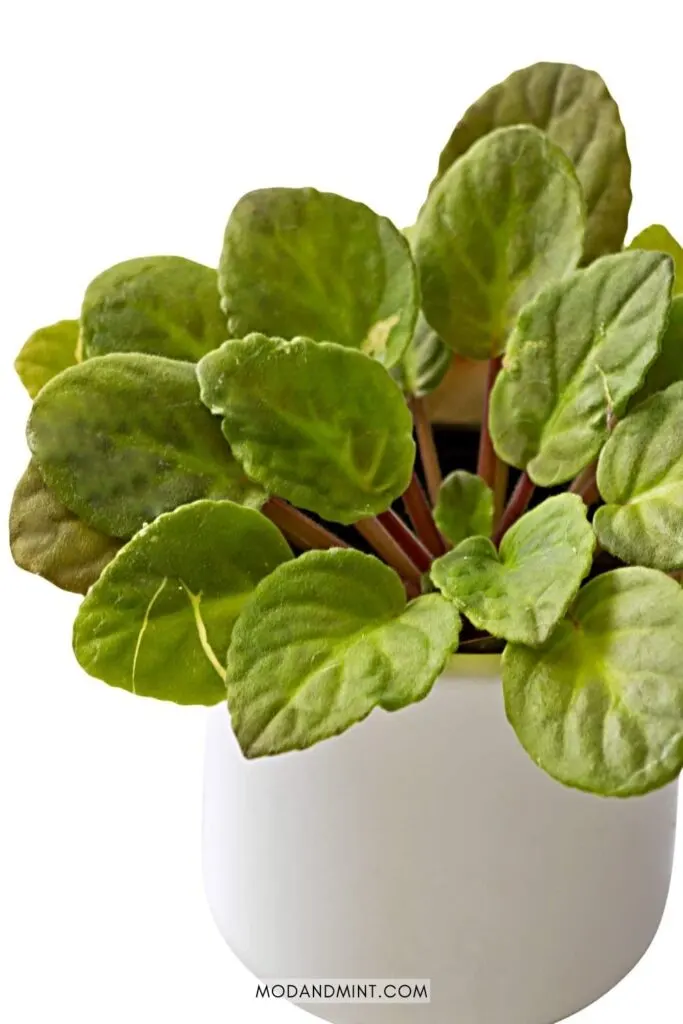
Lack of light is usually the cause of African violets not growing flowers. If your African violets have stopped flowering, and you want to make them bloom again, you should provide more light.
With the right care, African violets can flower almost year-round. Resting perhaps two or three weeks per year.
Jeanne D Dettorre
Sunday 12th of October 2025
My A. Violets are 27 years old, I rec’d them when my 3rd child was born. They have done great all of these years. Two years ago the decided to have babies ! I separated them, repotted them, gave some away, kept the mamas, they have survived a move and are doing pretty well. One have reproduced again! Is it better to separate I or leave it alone for now and see if the others will join in? So far this is the only one.
Carol Scandridge
Friday 3rd of November 2023
I had gorgeous deep purple AV that had sparkles on the flowers. It was gorgeous and I had it for many years, but it eventually died. I have looked and looked but have never seen one with the sparkles. I bought it about 32 years ago in Canton, Ohio at the local Kmart. Have you ever heard of that kind and where could I buy one? Your information is very thorough and helpful. Thank you.
Donna Donnell
Sunday 6th of August 2023
I can’t find any African violets in Utah Co.
Mod and Mint
Sunday 6th of August 2023
Hi Donna, There is a Utah African violet Facebook group, maybe they can help you with local addresses where you can purchase African violets near you. Otherwise you can look for them on Amazon and get them delivered. Hope this helps!