
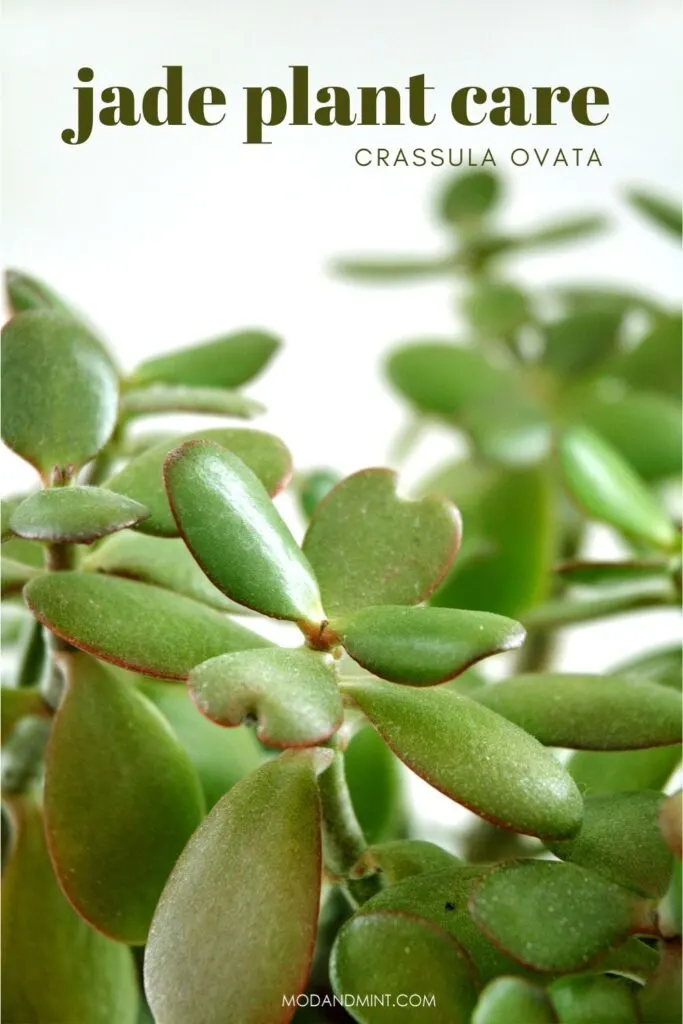
The Crassula ovata, commonly known as the jade plant, is a popular succulent houseplant. It grows thick, glossy, green leaves and thrives indoors with minimal care, making it an excellent choice for beginners and seasoned plant lovers alike.
This guide to indoor jade plant care is packed with all my practical tips and advice to help you to keep your plant looking its best.


Love the Crassula ovata Jade plant? Check out its relative, the Crassula ovata ‘Gollum’, it grows fun tubular leaves with tips that look like suction cups!
Jade Plants
Your Jade plant is native to South Africa, where it grows on dry, rocky hillsides. It is used to grow in lots of sunlight.
The succulent leaves store water inside. So no need for frequent watering. No need for misting either. They grow well in average household humidity levels.
Related reading: Beginners Guide to Succulent Care.


Want to buy a jade plant? Find it for sale on Amazon!
Light Requirements
Indoors, the best place for your jade plant is a spot that gets two to four hours of morning sun and bright, indirect light the rest of the day.
The green, fleshy leaves develop red edges or a red tint when grown in a lot of light. Protect it with a sheer curtain or move it away from the window to keep it green.
If your jade plant is growing tall and leggy and leaning to one side, it is not getting enough light. It is stretching for more light. To stop the leggy growth, move the plant closer to a window or use a grow light.
Related reading: How much sun succulents need.


Further reading: Best beginner house plants.
Watering
The jade plant stores water in its leaves, stems, and roots, so it doesn’t need to be watered too often.
Leaves should feel firm. Drooping, wrinkled leaves drying up are signs your plant needs water. If the soil feels moist, don’t water but wait one or two days and check again. If the soil is dry, go ahead and water thoroughly to saturate all of the soil. Then let the soil dry out between waterings.
Overwatering can lead to yellow leaves and root rot, while underwatering can cause the leaves to wilt and dry out. If in doubt, don’t water yet. An underwatered plant is easier to revive than an overwatered plant.


If you are uncertain, you can use a moisture meter to help you out with when to water. And read up on How often to water succulents for all the basic watering instructions.


Fertilizer
Use a diluted liquid succulent fertilizer to feed your Jade plant once a month in spring and summer. Be sure the soil is damp before fertilizing, and don’t fertilize in winter when growth slows down.
Newly bought or recently repotted plants don’t need to be fertilized for at least the first 4-6 months. The potting mix usually already has slow-release fertilizer in it.
Also never fertilize if your plant is recently repotted or is having problems. Fertilizer gives your plant a boost of nutrients when it is actively growing. It is not plant medicine.


Soil and Repotting
Repot in spring in a pot one size up when roots have filled the pot, and or when you see roots growing from the bottom of the pot. Even if your plant still has room to grow, you want to refresh the soil every two to three years. The soil will have lost all its nutrients and will need to be replaced with fresh, well-draining succulent soil.
Gently remove your plant from the pot. If needed, tap the pot to loosen the soil and roots. Support the plant in one hand, and use your other hand to carefully take the pot off. Make sure the new pot has drainage holes on the bottom. This is a must. You want any excess water to have a way out.
Related reading: How to repot your houseplants.


Pruning
Pruning your Jade plant keeps the size under control or gets rid of any leggy growth. It will also make your jade plant branch out and grow more compact and bushy.
Pruning stretched stems or pinching off the growing tips will encourage new growth. Leaving you with a fuller plant. Pruning is best done at least once a year, in spring. Make pruning a yearly plant care habit.
When pruning stems, look for a leaf scar, this will look like a ring around the stem. Prune about 1/4 from the top, just above one of those leaf scars. This is where your plant will branch out.
Pinching Leaf Tips
It may sound counterintuitive, but pinch off the newly sprouted leaves on the end of each branch. Two new shoots will grow from where the leaves were pinched off.
This is especially helpful when you start with a small jade plant. Begin pinching when it is still young and make it branch out evenly from the start.


Avoid pruning too much at once. Do not remove more than one-third of your plant’s growth. Plants need their leaves to grow and thrive.


Jade Plant Propagation
The easiest way to propagate your Jade plant is by taking stem cuttings and rooting them in water or soil.
Simply cut a stem cutting with a few leaves. Remove the leaves from the lower part of the cuttings. Let the cuttings callous over.
To water propagate, place them in water and keep them in bright, indirect light. Change the water regularly, and after a few weeks, roots will start to grow. Transplant to soil when roots are about 1 – 2 inches.
To propagate straight in soil, plant the cuttings in a small pot with well-draining soil. Keep in bright, indirect light. Mist or water very sparingly until you see new growth.
To speed up the propagation process, you can use rooting powder on your cuttings. Dip the bottom of the cuttings in water, then dip them in the powder before planting. If you don’t have any, you can skip it, the process just might take a little longer without.
Propagating Leaf Cuttings
Propagating succulents from leaf cuttings is a popular method to propagate. With care and patience, one propagated Jade plant leaf can grow into a new plant!
Carefully remove one or more mature, healthy leaves from your jade plant. Let the leaves dry out and callous over for a few days.
Related reading: How to propagate succulents from leaves – 6 Ways to propagate your plants – Complete guide to jade plant propagation.
Common Care Problems
Although Jade plants are hardy succulents, they can run into some care problems. Leggy stems, leaf drop, yellow leaves, and white spots are some of the most common issues.
Investigate, and adjust things like your watering schedule and the amount of light your plant is getting as needed.
Further reading: Common Jade plant problems.
Pin and save for later!



Joe
Friday 18th of October 2024
What type of soil mix is good
Elizabeth
Friday 13th of October 2023
I have a 3 year old jade plant that has gotten quite large, leggy, and has never been pruned. Not sure how to approach pruning it at this point. I'd love to send you a picture and get your advice. Thank you!
Mod and Mint - Deborah Green
Tuesday 31st of October 2023
Hi Elizabeth, Sorry for my late reply. How is your Jade plant doing now? Have you pruned it already? I'm waiting for spring to tackle pruning my largest Jade plant. I will do a step by step pruning tutorial by then.
Joey
Saturday 8th of July 2023
I had my jade tree flower a few years back, will it flower again?
Mod and Mint
Wednesday 12th of July 2023
Hi Joey, Jade plants can flower more than once, so I don't see a reason why it wouldn't flower again. They don't often flower indoors though. Keeping fingers crossed!
Carol
Saturday 23rd of April 2022
I have pups growing in the middle,underside of leaves still attached to stem. This is the first year I have seen this. The plant is very mature. The pups are tiny, one is now growing aerial roots. I have a picture. I am going to leave them to see what happens. There is nothing on google that even talks about this. Maybe my Jade, like most of my plants, is a freak of nature. 😅
Once they are too big, or the leaf falls off, i will replant it.
Thank you for any information you can give about this.
Sabrinna
Thursday 15th of December 2022
@Carol,
What do you mean by "pups"?
I think I may have the same thing.
When one fell off it very easily took root and turned into a new plant.