
Indoor Boston Fern Care Guide
The Boston Fern (Nephrolepis exaltata) is a popular tropical houseplant known for its lush green leaves that arch gracefully outward.
To grow a Boston fern indoors, provide bright, indirect light, maintain high humidity levels, and keep the soil consistently moist but not waterlogged. Avoid direct sunlight to help your Boston fern flourish.

Boston Fern Plant
Leaves of ferns are called fronds. New fronds grow by unfurling from a tight spiral known as a crozier or fiddlehead.
Ferns might have a reputation for being fussy, but they are truly very strong and hardy plants. Fern fossils are found dating back about 360 million (!) years. Over the years ferns endured the meteor crash that wiped out the dinosaurs and lived through extreme hot and cold temperatures. Think of ancient global warming and the ice age. These plants are survivors.
This resilience is one of the most common meanings given to fern plants. But there are more symbolisms that make this plant extra special!
Want to buy a Boston Fern? Find it for sale on Amazon!
Light Requirements
Ferns grow in the forest undergrowth. And are used to being in dappled or shaded light under the canopies of tall trees.
Indoors, give it plenty of bright, indirect light. Don’t place your Boston fern where it doesn’t get any light at all. Also, avoid direct sunlight, it can scorch and dry out the leaves.
Rotate your plant regularly to expose all sides to light and encourage even growth all around.

Watering
Boston ferns come from the tropical regions of South and Central America. They grow in the moist jungle ground or epiphytic on the trunks and branches of trees.
Never let the soil completely dry out. Keep the soil consistently moist, but not soggy. Waterlogged soil can cause the roots to rot. You want the soil to feel like a well-wrung-out sponge.
Use a watering can with a long spout to reach the soil or water from the bottom. To do this, fill a bowl or cachepot with water. Place your plant inside so it can soak up the water through the drainage holes on the bottom of its pot.
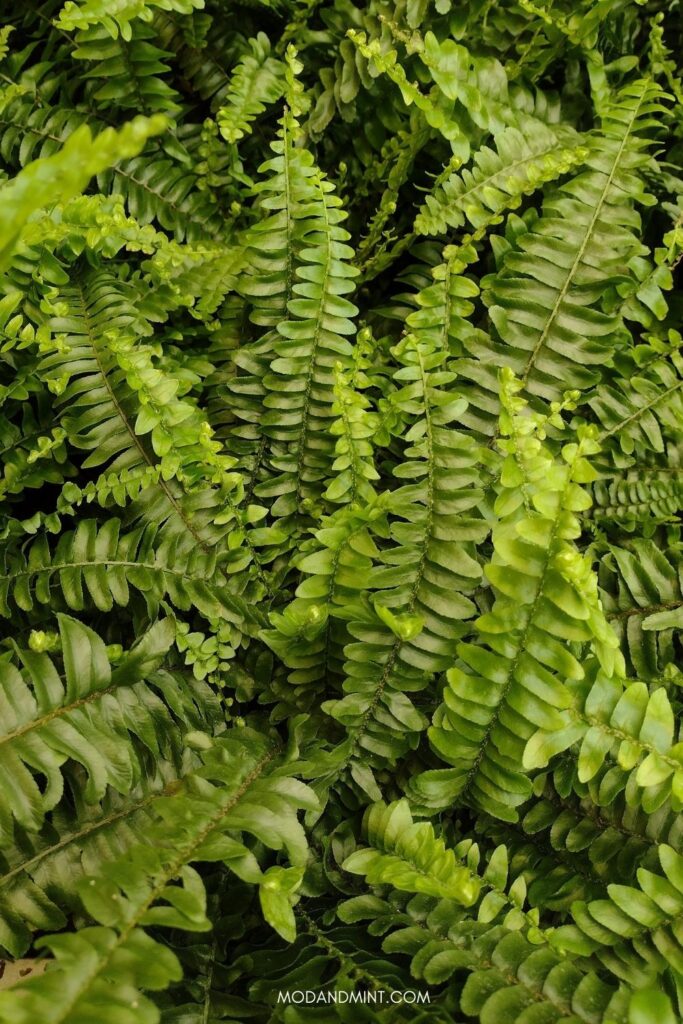
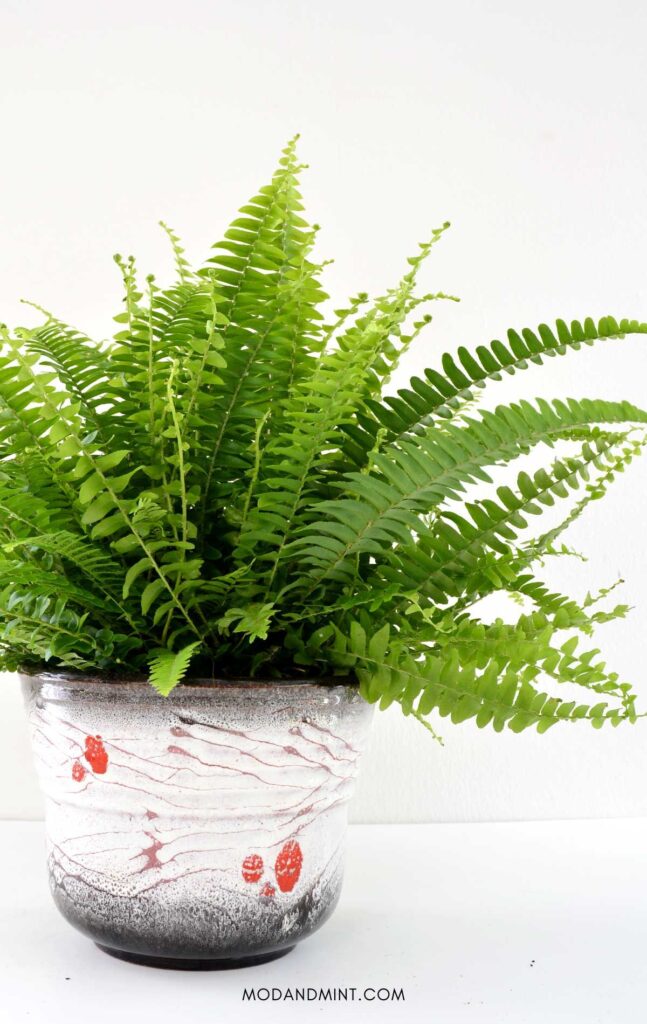
With the way the foliage drapes out all around, ferns are perfect to display on a plant stand, or as a hanging plant. If you’re crafty you can DIY an easy macrame hanger for it.
Humidity
In their native habitat, Boston ferns are used to a warm and humid environment. In our homes, the humidity is much lower. You will need to raise the humidity around your plant for it to grow well.
Brown, crispy leaf tips and dried-out leaves are often a sign that your plant needs more humidity.
If you have a bright bathroom, your fern will be very happy there. The steam from the shower will provide your plant with the humidity it loves.
If you don’t have a bathroom with a window, the best way to raise the humidity is to place a small humidifier nearby. Misting will only up the humidity for a short time, but if you like, you can treat your fern to a daily spritz.
Boston Fern Propagation
The easiest way to propagate your Boston fern plant is through division. This is as simple as it sounds. Take your fern out of its pot and gently divide the root ball into smaller sections. Re-pot the new plants separately.
Propagate in early spring at the start of the active growing season. Your plant will have all the energy it needs to heal and grow.
Want to learn more about plant propagation? Read my post about the 6 different ways to propagate your plants.

Soil and Repotting
Repot your plant in spring every year or two when the roots have filled the pot. Choose a planter with drainage holes and go one size up from the pot it was in before.
Plant your Boston fern in well-draining potting soil and keep it at the same level as it was. Don’t plant it too deep in the soil. Keep the crown above the soil to prevent crown rot.
After repotting wait at least four to six months before using any fertilizer. The potting soil usually already has slow-release fertilizer in it.
For more detailed instructions read my post about repotting houseplants.
Leaves Turning Brown
Older leaves will naturally turn brown or black when they age. This is perfectly normal. When more leaves start to turn brown, something is up that needs investigating. It could be several things.
In most cases, brown leaves are caused by letting the soil dry out too much and not watering enough.
On the other hand, brown leaves can appear when you overwater your plant as well. When more leaves dry out and turn brown in the center of your fern, it is usually because you have watered it too often.
It might be that your plant is getting too much direct sunlight and you need to move your fern away from the window a bit or protect it with a sheer curtain.
Brown Spots on the Underside of the Leaves
Brown spots on the underside of the leaves are completely normal. Those brown spots are called spores and are the reproductive cells of your fern. Spores appear when the fern is mature and healthy.
Leaves Dropping
It’s normal for an occasional leaf to drop. If more leaves are suddenly dropping, it usually means you are not watering often enough.
Another reason for your plant to drop leaves can be that it is stressed due to sudden changes in its conditions. Like when you have just bought it and taken it home from the store. The change in lighting and humidity can make your fern drop some leaves. It should recover after it settles in and adjusts to its new home.
Yellow Leaves
There are several possible causes for your Boston fern leaves to turn yellow. It could just be natural aging. If more than just a few old leaves start to turn yellow, it’s time to investigate.
It could be from using hard cold water, maybe there’s a draught affecting your fern, or the humidity is too low. But most often those yellow leaves are a sign that your fern has been overwatered.
You can safely trim off damaged leaves, brown tips, or leaves that have turned yellow. These leaves won’t recover.
Are Boston Ferns Toxic to Cats?
According to the ASPCA, the Boston fern is considered non-toxic. It is safe to grow this plant indoors around your pets.
Learn more about the risks of toxic houseplants around your pets (and find out which plants are non-toxic and safe!).

Want more hanging plants? Check out this list full of hanging houseplants!



Im a plant newbie bought a trio of ferns (at the recommendation of a nursery employee) to put on my windowsill I have a south facing window, but it’s into the neighboring building, so the light is indirect from an angle past the edge of the building. I’ve already had to repot 2/3 (the Boston and a birds nest) bc they were really cramped and all the new growth and frond edges were dying. I’m unsure if they have too much or not enough light? Also, I know these plants like humidity, but the only window in my room with much light is directly above my radiator. I just checked to see if I could move them to the living room, but that window has brighter light and is also above a radiator. I live in nyc lol, so that’s the extent of my options What can I do as winter comes to keep them from drying, and I do I even have the right conditions for them to grow? If not, I may have to gift them lol. The third fern (asparagus) seems to fit in the pot better and is largely alright, as is the calathea I got at the recommendation of a different plant shop employee. Help!
Hi Roz, hooray for ferns! If I read your story I would worry most about the lack of humidity. I have lived in NY for over a decade and my experience is that in most buildings the radiatiors get turned on super high in winter.
Do you have a window in your bathroom? They will love the humidity there. Or get a humidifier for the room you keep your ferns.
Hope your ferns make it! Good luck!
I place my Boston Fern outside during the summer months. This summer was no different but I went out to bring it in for the winter and realize. it was full of spiders not in the green leaves by in the roots down in the pot. I pulled it out of the lot and soaked it in water now I am waiting for it to dry and trying to decide what to do. Can you help?
Hi Diana, Do you mean spider mites or regular spiders? Either way, not something you want on your Boston Fern. I’m not sure how soaking it in water would help. You could try neem oil to get rid of spider mites, but with a full fern, it can be hard to get all the spider mites and eggs this way. If it’s a large infestation you might have to get drastic and cut your fern back to get rid of all the pests. Hope you’re able to save your plant!
Thank you. So much. This answer Ed all my problem questions.
Hi Katie, Glad you found it usefull!
Really great detailed tips in your article and glad it’s non-toxic as one of my cats loves plants. So, my Boston Fern is in my unheated breezeway. I live on Long Island, New York and it’s November (2020) so the breezeway is starting to get cold. As of late, the temp in the breezeway is around 40. I’m not sure yet what I want to do: I either would like to bring the fern in my basement with no light and minimum watering to let it go dormant. OR, use my grow light. Would you mind advising if letting it go dormant would be okay to do for this type of plant? I would prune it first before doing anything. It’s rather large and healthy, dropping a few leaves here and there. If I use the grow light, 1) I’m not sure how high above the plant to put the light (It’s a large rectangular light that hangs) and 2) how many hours should the light be set for.
Hi Donna, Hi Long Island! (I have lived in NY for 10 years of which a short while in Hempstead and Long Beach!) Have you moved your Boston fern already? Let me know how it’s doing! Always expect some leaf drop after a move of location, so if that happens, no worries.
Boston Ferns are evergreen and don’t necessarily go through dormancy. So if you can supply your fern with enough light and regular care throughout winter, it will continue to grow as usual.
If you don’t want to play around with a grow light, you could definitely opt to let your Boston fern go dormant. Like you said, put it in a dark basement or garage and water sparingly, about once a month. If you do opt for the grow light, be careful that it isn’t too close to the plant that it can burn the leaves. Just keep a close eye on it especially in the beginning when it is still adjusting.
Hello! My first plant is a Boston fern and I’ve had it for a month or two now. It’s a relatively small fern that sits on my side table next to a window but the curtain helps filter that light. It had been doing pretty well for a while but recently it has become extremely sparse, dried up at the middle/bottom, and some roots have popped out of the soil and seem very dry. I probably haven’t watered in a week but the soil is still moist and I’m afraid of overwatering it. I have a couple reasons why I think it might be acting up but I’m not really sure. I live in Ohio and it has become quite cold and dry. I spray it lightly everyday and occasionally bring it in the bathroom for humidity (no bathroom windows), when I first researched it said to let the soil dry up first then water it throughly. So that’s what I did. I used normal tap water and wet it through and let it drain. But the spout has a high pressure and I think it moved the soil around a lot and now roots are exposed. For a while I thought maybe this was normal in the winter rebut now I’m not sure. I need a some advice on what to do now! Thanks for the create post 🙂
Hi Abby, what to say, ferns can be fussy. It isn’t a plant that I would particularly recommend as a first starter plant. But you are doing a lot right for your plant. How is it doing now?
I think the main reason it is struggling is the lack of humidity. Even with the misting and trips to the bathroom, gold star there. With the radiators turned on now probably, the air gets even drier in the home than it was before. You could get a humidifier and place it near your fern. That might help.
About the missing soil because of the water pressure, you can just add some new soil on top to fill the pot back up. Good luck with your fern! Hope it pulls through!
I have an indoor Boston Fern that is 40 years old. I almost lost it a few times, but it comes back. I recently made a move from New Jersey to Georgia with my fern in tow. I placed my fern in a window facing the same direction as in NJ. It seems to like where it is but recently it has these “runners” growing from it. Must be 50 of them that are green at first and turn brown. They get no leaves and just hang down to the floor down the pedestal and dry up and get brown. Do you know what these are and why am I getting them for the first time in 40 years? Should I cut them off or just leave them? Will the eventually dry up and fall off? Thank you.
Hi Sharon, How is your fern doing? What you are describing is perfectly norman, those runners are so-called stolons.
You can remove these from the base of the plant (before they turn brown) and place the cut ends in fresh soil. They will grow roots and start a new plant. It will take some time, but it could be a fun plant experiment.
Let me know how it goes if you do try to propagate your fern this way. I love a good propagation story!
@Sharon Ramsey,
Hi Debra:
I would also love to talk about Boston ferns, especially from someone who knows about ferns.
Just bought my very first plant…a Boston fern. This article has been the most informative by far. And trust me I have been to a bunch of other sites first. I will definitely be referring back to this article. It is now my holy grail Boston Fern Manual. ❤️ ❤️❤️
Hi Janice! How is your fern doing? Thank you for your kind comment. I really appreciate it! 😊
Thanks… Very helpful!
What suggestions, tips and tricks could you offer along the lines of cutting longer fronds shorter? What should I look for before I start giving the plant a “haircut”? I have fronds as long as 4’. The pit sits on top of an urn that’s about 4’ tall.
Hi Donna,
I am 90 yrs old and live in a independent apartment in a senior complex. About five months ago, I rescued a boston fern from the trash in our building. It is a hanging plant in that brown grass and plastic. It was very small as a part of several plants in one pot. Well I have been very successful in bringing it back to a healthy large fern. It is now on my balcony, and I want to bring it in for the winter. I need to change to a larger pot with holes in the bottom, but would like to hang it in the window.
Do you have some advice for me? Thank you.
I gave my indoor boston fern a crewcut, cutting off all the leaves as they had all turned brown. Will this fern grow back or should I just toss it? Tips from this point?
Excellent info on growing a Boston French indoors. Thank you!
Hi Jane, Thanks for your kind comment, much appreciated!
My very large boston fern has long fronds. On several fronds there have appeared two to three shoots off them that look like the long fronds. What does this mean?