Tillandsia Cyanea Pink Quill Plant Care
The Tillandsia cyanea (now named Wallisia Cyanea), also known as Pink Quill or Feather plant, is a lovely and striking bromeliad air plant.
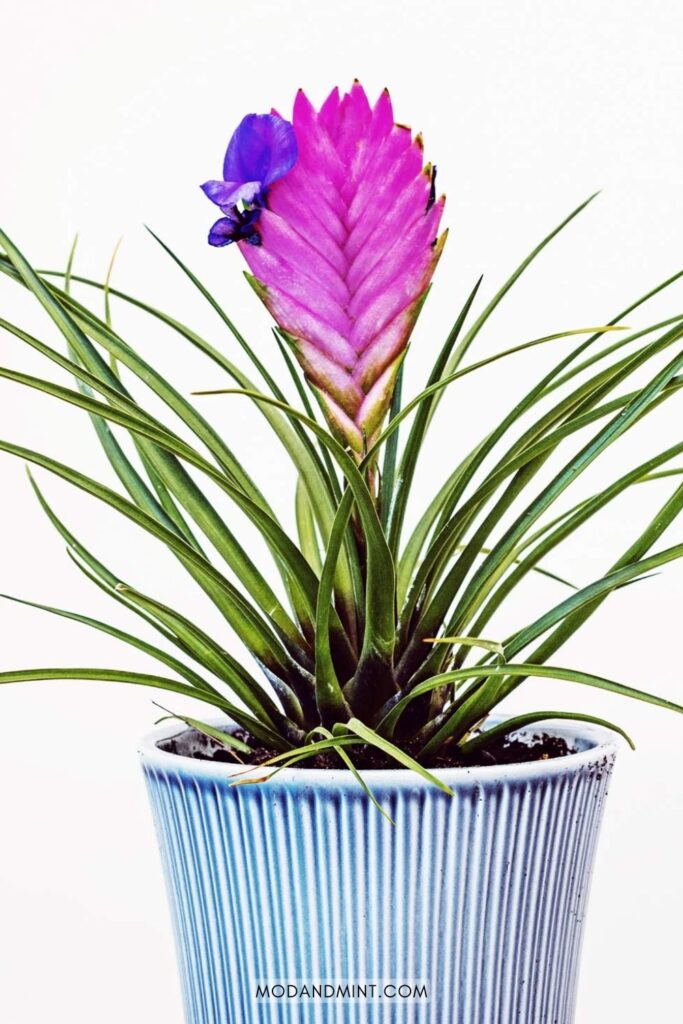
They grow long, slender grassy leaves arching in a bushy rosette pattern. It grows a compact pink bract with violet-purple flowers growing along the edges.
The Tillandsia cyanea is used to dry and sunny conditions, making it very drought-tolerant and easy to care for!

Looking to buy a Pink Quill Tillandsia Cyanea? Check out the plant growers on Amazon.
Tillandsia Cyanea Plant
The quill-shaped pink flowering bract is the main attraction and can last for weeks or months. It is native to South America and is part of the Bromeliad plant species.
Like many Bromeliads, the Tillandsia cyanea is an epiphyte. Meaning that in nature, it doesn’t grow in soil, but on branches of other plants and trees, holding on with small roots.
There are more than 500 different species of Tillandsia plants. Unlike most species, the this one can be grown in a pot as well as an air plant.
The Tillandsia cyanea is a relative of the pineapple plant, Tillandsia ionantha, the large Tillandsia xerographica, and other Tillandsia air plants.
Light Requirements
Give your pink quill plant plenty of bright, indirect light. Place in a bright room an east or west-facing window away from direct sunlight.
It can tolerate a few hours of direct (morning) sun. But be careful, if your plant gets too much sun, the leaves and the bract can dry out and suffer from sunburn.

Watering
The Tillandsia cyanea mainly takes in water through the leaves, so mist until the leaves are thoroughly wet a few times a week.
If you mist frequently you can keep the soil on the dry side. An underwatered plant is easier to revive than an overwatered plant.
If your pink quill is blooming, don’t soak the flowers when you water. It can cause them to rot and decrease how long they last.
Water the base of the plant only if the soil has completely dried out. Overwatering can lead to yellow leaves and a rotting base.
Tillandsia cyanea plants are sensitive to chlorine, so use distilled or purified water instead of tap water. Ideally, use rainwater.

Fertilizing
Use a bromeliad fertilizer spray to feed your plant once a month in spring and summer.
Don’t fertilize in winter when growth slows down. Also never fertilize if it is recently repotted or is having problems. Fertilizer gives your plant a boost of nutrients when it is actively growing.

Humidity
In their native habitat, Tillandsia plants are used to a warm and humid environment. In our homes, the humidity is much lower. Brown, crispy leaf tips are often a sign that your mint plant needs more humidity.
Misting will temporarily raise the humidity. You can also put your plant on a tray with water and pebbles or perlite in such a way that the bottom of the pot doesn’t touch the water. The water will evaporate and raise the humidity around your plant. The best way to raise the humidity around your plant is to use a small humidifier.
A good place for your Tillandsia cyanea is in a bathroom or kitchen with a bright window. The steam from the shower or cooking will provide the humidity it loves.

Repotting
Repot in spring in a pot one size up when roots have filled the pot, or when you see roots growing from the bottom of the pot.
Even if your plant still has room to grow, you want to refresh the soil every two to three years. The soil will have lost its nutrients and will need to be replaced with fresh soil. A special bromeliad potting mix is a good choice for your Tillandsia cyanea.
Make sure the new pot has drainage holes on the bottom. Without those, excess water has no way to get out and will drown the roots.
In need of a repotting reminder? Follow the steps on how to repot your plants.
Flowers
When the Tillandsia cyanea matures it can produce a beautiful, long-lasting tightly packed pink bract from the center of the leaves. This bract is not actually the flower. Small tubular purple or violet-blue flowers will grow out of the sides of the pink paddle bract.
Each flower lasts just a day or two. But the flowers grow one or two at a time, starting at the bottom and moving to the top, so the full show of blooms can last weeks.
After all the flowers have withered, the bract will lose its pink color, fading to green, and eventually turning brown. This is natural and nothing to worry about. You can remove the bract when it has faded.
Tillandsia plants are monocarpic, which means your cyanea will only bloom once. Once all the flowers have bloomed, the plant will slowly decline and die. Before it is completely gone, it will grow pups around the base that will grow into full new plants.

Tillandsia Cyanea Propagation
The easiest way to propagate your Tillandsia cyanea is by separating the baby pups. Usually, the pink quill will grow one or more pups at the base after flowering.
You can keep the pup attached, you don’t have to remove it. But if you want to propagate the pups, be patient and let them grow a bit before removing them.
When it has grown to at least 1/3th of the parents’ size, gently separate it at the base. Let the pup dry and the cut callus over for a day or two before planting in its own pot.
Want to learn more about plant propagation? Read the complete guide explaining the 6 different ways to propagate all your plants.

Plant Pests
Tillandsia cyanea plants are not very prone to pests, but they can be affected by common plant pests like aphids, scales, and mealybugs. Inspect your plants regularly to catch a possible infestation before it becomes severe.
Learn more about common houseplant pests and what you can do to get rid of them.
Are Tillandsia Cyanea Plants Toxic to Cats?
The Tillandsia cyanea is considered non-toxic. It is safe to grow at home around your pets.