
Tillandsia ionantha air plants, also known as Sky plants or Blushing bride plants, are small, unusual-looking houseplants. They grow long, slender leaves in a bushy rosette pattern looking like mini pineapple tops.
Ionantha air plants come in a number of different colors and sizes. Foliage is silvery-grey or green and may blush red or pink at bloom time. They don’t need any soil to grow and are easy to care for!


Tillandsia air plants are fun and fascinating plants that can add interest to your decor displayed in many different ways!


Looking to buy Tillandsia ionantha air plants? Find them for sale on Amazon.
Tillandsia Ionatha Air Plant
Tillandsia air plants are part of the Bromeliad plant species. And like many Bromeliads, air plants are epiphytes. This means that in nature they don’t grow in soil, but on branches of other plants and trees, holding on with their small roots.
In their native rainforests of Central and South America, they absorb moisture from heavy rainfalls and high humidity through their leaves.


Light Requirements
Give your Tillandsia ionantha plenty of bright, indirect light. Place in a bright room away from direct sunlight.
When your air plant gets too much sun, the leaves can dry out and suffer from sunburn. On the other hand, when it get too little light, they will slow their growth and their color can fade.
The Tillandsia Xerographica, an extra large air plant, requires similar care as the small Tillandsia ionantha plants. With the difference that it can handle some direct (morning) sunlight, and needs watering less often.


Watering
Air plants absorb all their moisture and nutrients through their leaves. Their leaves are covered with trichomes, tiny plant hairs that trap moisture and any airborne nutrients.
Misting frequently helps, but misting alone will not provide enough moisture to replace a (sub)tropical rain.
In addition to misting, water your airplant with a good soak at least once a week in summer, and once every two weeks in winter, depending on the temperature and humidity.
- Submerge your Tillandsia ionantha in a bowl of water (preferably rainwater).
- Let it soak for about 30 minutes. Remove from the bowl and carefully shake off excess water.
- Place upside-down on a paper towel until it is completely dry.
It is crucial to let your Tillandsia completely dry out after watering to avoid that it will rot from the center of the leaves.
Further reading: How to water indoor air plants.
Fertilizing
Air plants don’t get nutrients from the soil as potted plants do, so it is recommended to fertilize about once a month in spring and summer.
There are special fertilizer sprays for air plants to mist your plant with, or you can add liquid Bromeliad fertilizer to the water that you soak the plant in.

Flowers
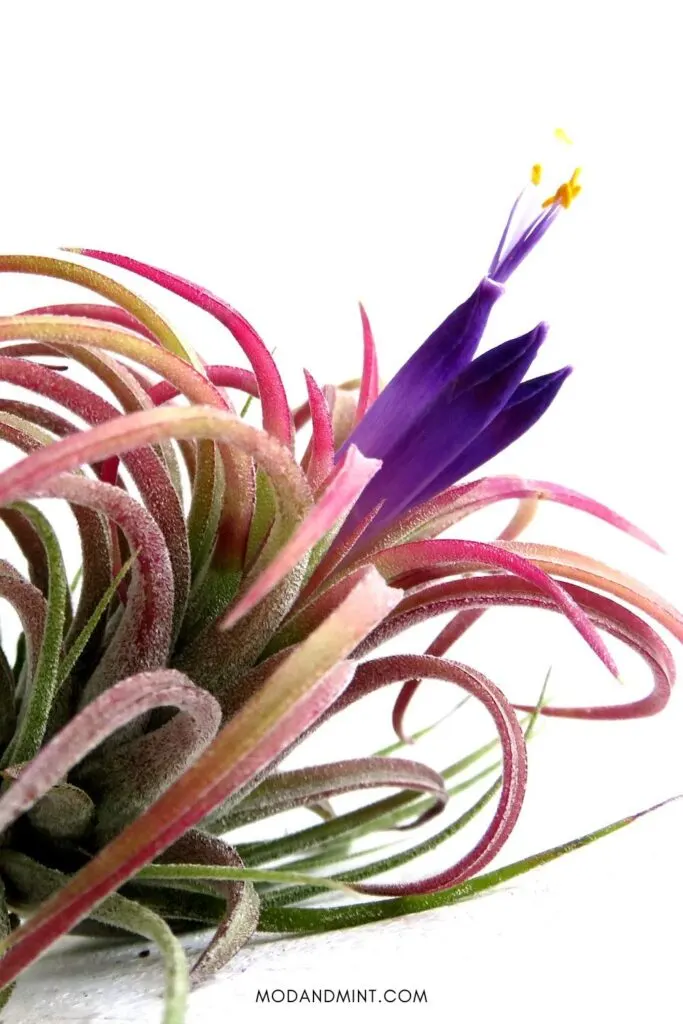
Mature Tillandsia ionantha plants can flower when they get enough light and are overall happy with their growing conditions. Frequent summer fertilizer can help the process.
When a flower starts to grow, much of the plant turns pink red. This is where the name Blushing Bride Plant comes from. The blushing leaves can keep their color for months.
The spectacular tubular purple or violet-blue flowers grow from the center of the rosette and will last a few weeks.
Don’t soak the flowers when you water them. It can cause them to rot and decrease how long they last.
Unfortunately, Tillandsia air plants are monocarpic, meaning they will only bloom once. Once the flower has dried up, the plant will slowly decline and die. Before it is completely gone, it will grow pups around the base that will grow into full new plants.


Tillandsia Ionantha Propagation
Tillandsia air plants can easily be propagated by removing pups growing from the base of the parent plant after it blooms.
You don’t have to remove the offsets, you can choose to keep them attached growing in a clump of pups.
If you want to propagate the pups, be patient and let them grow a bit before removing them from the parent plant. When the pup has grown to at least 1/3th of the parents’ size, gently separate it at the base. Try not to pull too hard and damage the leaves.
Want to learn more about plant propagation? Read the complete guide explaining the 6 different ways to propagate all your plants.
Plant Pests
Ionantha plants are not very prone to pests, but they can be affected by aphids and mealybugs. Inspect your plants regularly to catch a possible infestation before it becomes severe.
Learn more about common houseplant pests and what you can do to get rid of them.
Are Ionantha Air Plants Toxic to Cats?
The Tillandsia ionantha is considered non-toxic. It is safe to grow at home around your cats or dogs.

