
The Pickle plant (Delosperma echinatum) is an unusual-looking succulent that grows leaves that look like little gherkin pickles!
Pickle plant succulents stay small and are easy to care for. Provide bright, indirect sunlight and well-draining soil. Water sparingly, allowing the soil to dry between waterings, and ensure good air circulation to prevent moisture-related issues.
The leaves are covered with small white hairs that make it look like a cactus, but unlike a cactus, these don’t prick but are soft to the touch. Making this plant even cuter!


Want to buy a Pickle Plant? Find it for sale on Amazon!
Pickle Plants
Botanical name: Delosperma echinatum. Common names: Pickle plant, Pickle cactus, Delosperma Gherkin.
The Delosperma echinatum is native to dry mountains and desert areas of South Africa, growing in sandy or rocky soils. The stems grow low around the ground trailing along or spilling over the edges of rocks or other structures.


Need a succulent plant care refresher? Check out the Beginners Guide to Succulent Care.
Light Requirements
Pickle plants like lots of light. They do best in a bright, sunny window with a few hours of morning sun and bright indirect light the rest of the day.
Your plant can grow in partial shade, but if it gets too little light, it will grow leggy and stretch out, reaching to get more light. To stop the leggy growth, move the plant closer to a window or use a plant grow lamp.
Avoid too much direct sunlight. Dry, brown spots on the leaves can be a sign of sunburn. Move your plant further away from the light, or put a sheer curtain between your plant and the window.


Watering
Overwatering is the most common problem in pickle plant care. To prevent overwatering, let the soil dry out completely between waterings.
The pickle plant stores water in its leaves. This means no need for frequent watering. Let the soil dry out before giving water. If in doubt, don’t water yet. Underwatering is better than overwatering. Watering too often will lead to root rot and mushy leaves. Too little water could lead to some leaf shriveling but is easily fixed with a thorough watering.
You can buy a moisture meter to help you out with when to water. And read more about when to water succulents.
Allow all excess water to drain out of the bottom of the pot. Make sure the pot has drainage holes on the bottom. Without those, excess water has no way to get out and will drown the roots.
Water sparingly in winter. Water it just enough to make sure the leaves don’t shrivel up.


Fertilizing
Pickle plants don’t need a lot of fertilizer. But you can give your plant a boost during the active growing season. Fertilize about once a month in spring and summer with diluted succulent fertilizer. Don’t fertilize in winter when growth slows down.
Hold off on feeding your pickle plant if it is recently repotted or is having issues. Fertilizer is not a plant medicine. It will only stress out an already stressed-out plant. Analyze, adjust, and resume regular care when your plant recovers.
Humidity
These plants are not very needy when it comes to humidity levels. They can grow in average household humidity. No need for misting or humidifiers.
Pickle Plant Propagation
Pickle plants can be easily propagated by division or by rooting stem cuttings in soil.
Plant propagation is most effective at the start of the growing season. This is usually in spring, though you can propagate any time of year.
Want to learn more about plant propagation? Read the complete guide explaining the 6 different ways to propagate your plants.
Propagate Stem Cuttings in Soil
- Take a healthy stem cutting with at least a few sets of leaves.
- Remove a few leaves from the bottom of the cutting. This is where the roots will grow from.
- Let the cutting rest and dry out for a day or two to callous over.
- Dip the bottom in rooting hormone. This powder helps the roots to grow faster and stronger. If you don’t have any, you can skip it, the process just might take a little longer without.
- Plant the cutting in soil and mist lightly once. Resume regular care when there are roots and new growth.
Propagate by Division
Propagate a large pickle plant by splitting the rootball and repotting the parts in separate, smaller containers.
- Take the plant out of the pot. Gently remove as much old soil as possible without damaging the roots.
- Decide where to divide the plant. Each section needs some leaf growth as well as roots attached.
- Separate the roots and foliage with your hands.
- If the root ball is very tangled, make a clean cut with a sharp knife to split the plant.
- Pot each section in its own planter. Keep them in bright indirect light.
- Water once, and wait to water again until you see new growth.
Propagating by division is a much quicker way to propagate than propagating cuttings in water or soil. You basically have a complete plant already, whereas cuttings may take a long time to grow into full new plants.

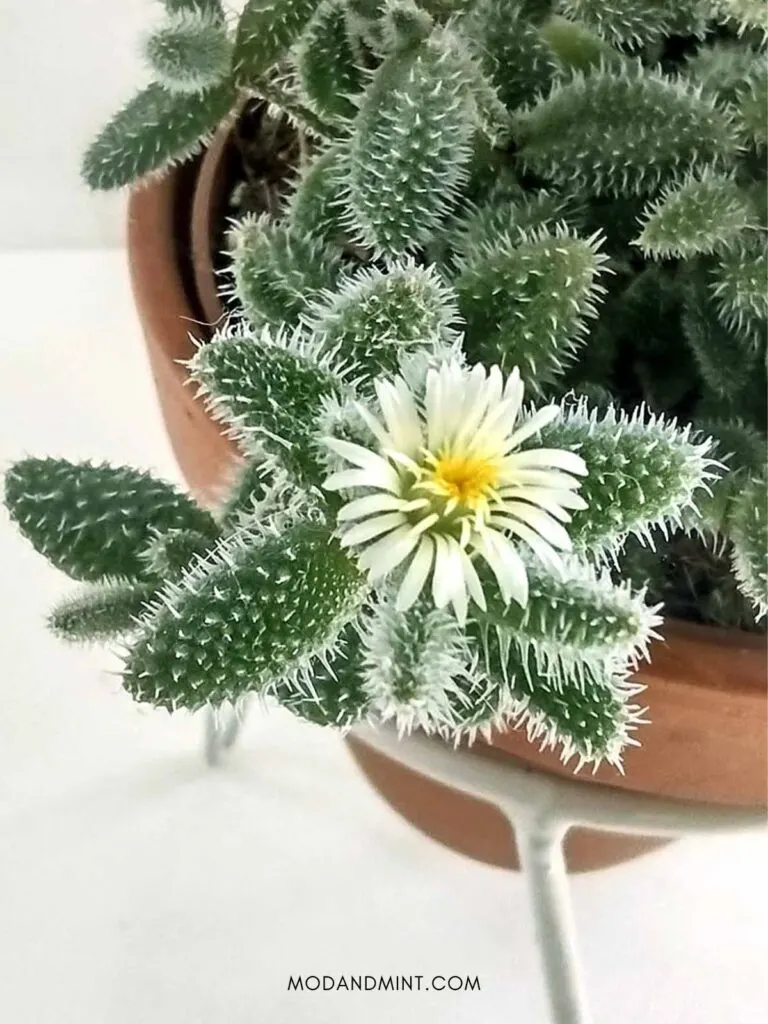
Flowers on a Pickle Plant
Mature plants can flower when they get enough light and are overall very happy with their growing conditions.
Pickle plant flowers are pale yellow and grow from the top of the stems. They kind of look like small daisies.
Don’t worry if your plant doesn’t bloom. Many indoor succulents don’t flower at all. If they do, it is usually in spring or early summer.


Plant Pests
Pickle plants are not very prone to many pests, but they can occur. The most common pests to watch out for are mealy bugs and aphids.
Learn more about common houseplant pests and how to get rid of them!
Is the Pickle Plant Toxic to Cats?
The Delosperma Echinatum pickle plant is considered non-toxic and safe to grow at home around your cats or dogs.
Even though they are not poisonous, these “pickles” are not meant to be eaten like regular pickles made from cucumbers.
Learn more about the risks of toxic houseplants around your pets (and find out which plants are non-toxic and safe!).

