
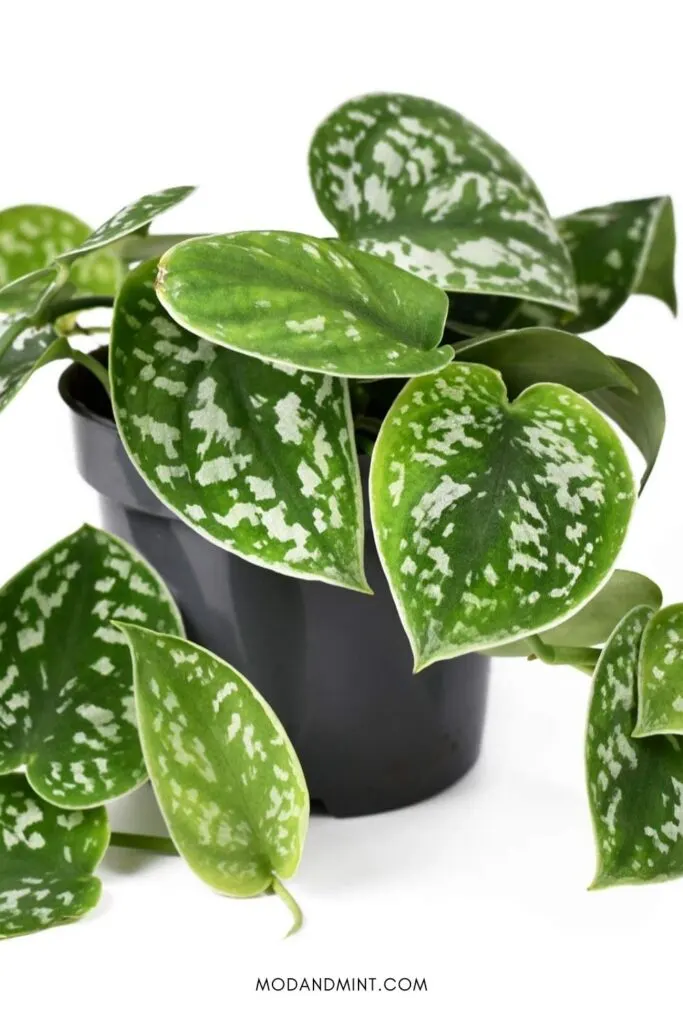
The Scindapsus pictus, commonly called satin pothos or silver pothos, is a popular and easy-to-care-for houseplant.
It grows vines with green heart-shaped variegated leaves, with splotches of silver. The leaves have tiny hairs on the surface, giving them a velvety matte finish.


Satin Pothos
Although the common name is Satin Pothos, the Scindapsus pictus is not a real Pothos. A so-called regular Pothos is an Epipremnum aureum. Different types of plants, but they are related both being of the Araceae plant family. They do look and grow similarly and have similar care needs.
Need a plant care refresher? Check out the Beginners Guide to Houseplant Care.

Light Requirements
The Scindapsus pictus is a tropical plant that likes a lot of bright, indirect light. A good place for it is near a window, just out of direct sunlight. Don’t let the sun burn the leaves.
You can grow your satin pothos in low to medium light, but it will not grow as fast. It will also grow leggy with lots of space in between each leaf. Not enough light can also cause the leaves to lose the variegation and eventually turn solid green. If you can not give your plant enough natural light, consider getting a grow light.


Want to buy a Scindapsus pictus satin pothos? Find it for sale on Amazon!
Watering
Water your satin pothos thoroughly, then allow the top layer of the soil to dry out before watering again. Allow all excess water to drain out of the bottom of the pot. Make sure the pot has drainage holes on the bottom. This is a must. Without those, excess water has no way to get out and will drown the roots.
If in doubt, don’t water yet. An underwatered plant is easier to revive than an overwatered plant. You can use a moisture meter to help you out with when to water.
Limp, curling leaves on your satin pothos is an indication it needs water. They will perk right back up after receiving water.
Leaves turning yellow is a common issue with satin pothos plants. Often this happens when the plant has been overwatered. A single yellow leaf isn’t anything to worry about, but if more leaves on the same vine suddenly turn yellow, check your watering regime.
In spring and summer treat your silver satin pothos to some liquid fertilizer about once a month. You can also treat your plant to a specially formulated fertilizer for Pothos plants. Be sure the soil is damp before fertilizing and don’t fertilize in winter when growth slows down.
Read more: The basics of watering your indoor plants.
Humidity
It can grow in average household humidity, but as a tropical plant, it does better in medium to high humidity levels.
Leaf tips turning brown and crispy usually indicate that the humidity is too low. Keeping the humidity up is especially important in winter when the heaters go on and the air indoors is usually drier. The best way to raise the humidity is to place a small humidifier near your plant.

Trailing or Climbing
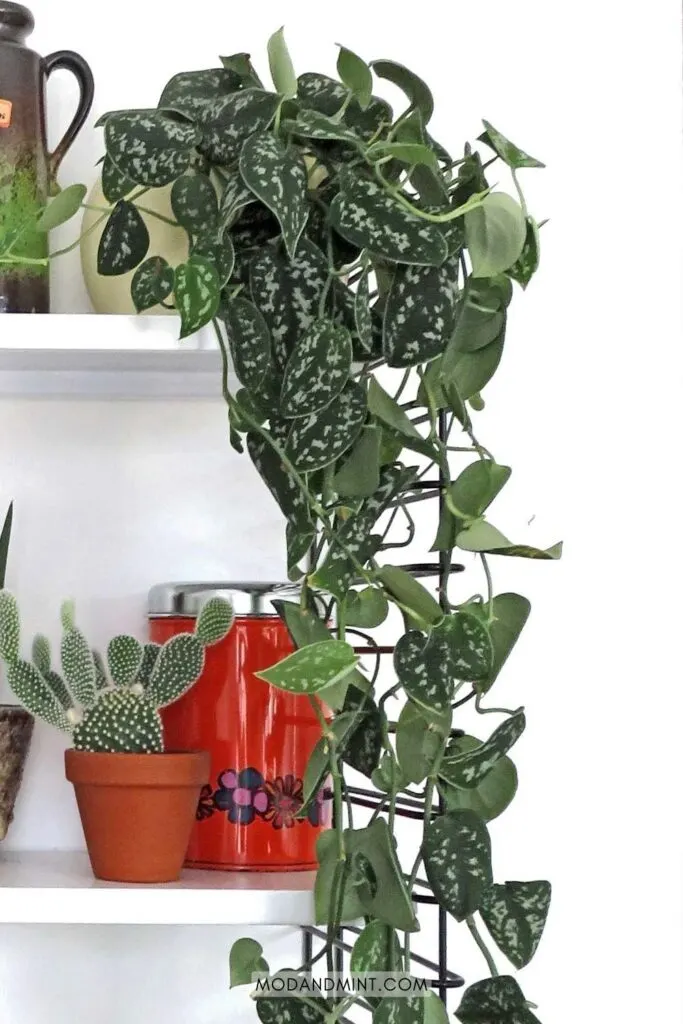
The Scindapsus pictus is great as an indoor hanging plant or placed on a plant shelf. Let the vines grow long and trail down freely.
In its natural habitat, the satin pothos uses its aerial roots to climb up trees and large branches. You can give your indoor satin pothos something to climb on. A moss pole is a great option.
Place the pole so leaf nodes are touching it, or at least are very near to it. Aerial roots will grow from these nodes, grabbing onto the stake. Mist frequently so the roots can attach themselves more easily.
Read more: How to attach plants to a moss pole!
Soil and Repotting
It is time to repot your satin pothos when the roots have filled the pot, and or when you see roots growing from the bottom of the pot.


Even if your plant still has room to grow, you want to refresh the soil every two to three years in spring. The soil will have lost all its nutrients and will need to be replaced with fresh well-draining potting soil.
Need a repotting refresher? Read the article with all the tips on how to repot your plants.


Pruning
Pruning can be done to help maintain size or remove leggy vines. Remove brown leaves and trim long branches to encourage branching and a more bushy plant.
Avoid pruning too much at once. Do not remove more than one-third of your plant’s growth. Plants need their leaves to grow and thrive.
Pruning will leave you with a more compact plant. And a bunch of long vine cuttings. The parent plant will branch out and regrow, and the cuttings can easily be propagated.
Propagation
Satin pothos cuttings grow roots pretty quickly. Propagating is a fun and easy process and a great way to get the kids involved and interested in plant care!
Use vine cuttings with a few leaves or cut the stem just before and after a leaf to have more cuttings from a single vine. You can propagate satin pothos vine and leaf cuttings in water or soil.
If you want to make the parent plant fuller, simply plant the cuttings back in the original pot.
Want to learn more about plant propagation? Read the complete guide explaining the 6 ways to propagate all your plants.
Is the Satin Pothos Toxic to Cats?
The Scindapsus pictus is considered to be mildly toxic when ingested. It may irritate the mouth, tongue, and lips, vomiting, and difficulty swallowing.
Although it is very rare for pets to get seriously hurt from eating plants, keep this one out of reach of children and pets.
Learn more about the risks of toxic houseplants around your pets (and find out which plants are non-toxic and safe!).


Want more hanging plants? Check out this list full of hanging houseplants!