4 Steps to Use a Moss Pole for your Plants
Moss poles, coco coir poles, or plant totems are handy plant care tools to provide support to a variety of climbing plants.
These types of support poles make an attractive base for climbing plants and allow them to grow to their fullest potential, even inside our homes.
Keep reading to learn more about the benefits of using a moss pole and how to attach your plants to the pole in just 4 simple steps!

How to Use Moss Poles for Indoor Plants
Moss poles mimic the way your indoor climbing plants naturally grow in the wild.
The moss or coco coir holds moisture so aerial roots can secure themselves for support. At the same time, the pole is a source of water and humidity for the plant. Growing this way also encourages larger leaves.
You don’t necessarily need a moss pole. There are alternatives you can use, like a regular plant stake or wire trellis. These will also help support the vines and give the plant something to grow on, but they don’t provide any moisture.

What Plants Grow on Moss Poles
Climbing house plants like Monstera Deliciosa, Monstera Adansonii, Arrowhead plants, Rhaphidophora Tetrasperma, Scindapsus pictus, Philodendron, and Pothos plants are so-called epiphytes.
In the wild, these epiphytes grow attached to other plants and trees around them. They attach themselves with long above-ground aerial roots and grow upwards towards the light above the canopy of the trees.
Indoors, moss poles help plants with aerial roots to grow vertically, mimicking their natural environment.
What Size and Type of Pole to Use
You can use PVC pipes or chicken wire wrapped in sphagnum moss or sheets of coco coir to make your own handmade moss pole.
It can be fun to DIY a moss pole, but it can get a bit messy. If you’re not feeling crafty, you can purchase ready-to-use moss poles or coco coir plant poles online.
There are single climbing poles available and moss pole kits that come with multiple poles, plant ties, watering spikes, plant labels, and other plant accessories.
If you want something a little different, there are bendable moss poles. You can get creative and bend the pole in the shape you like.
The size of the moss pole depends on the size of your plant. You want the moss stick to be taller than your plant’s tallest vine so it has space to climb.

How to Install a Moss Pole
When installing a moss pole into your plants’ pot, do it very gently. You want the pole to be in the center or a bit off the center of the pot. Be careful to damage the roots as little as possible.
If your plant is due for a bigger pot, that is a great time to insert a moss stick. This will minimize the damage the pole would do to the roots if stuck in the pot straight through the root ball.
In case your plant has a lot of branches, you can use two poles in one pot.
When your plant is already trained on a moss pole and needs to be repotted, you don’t need to remove the moss pole. You can keep the plant attached to the pole and replant it like that in the new pot.
In need of a repot reminder? Follow the steps on how to repot your plants.

How to Train a Plant to Climb on a Pole
It’s best to start training your plant to climb on a moss pole when the plant is still young. Nonetheless, if you have a more mature plant, it is not too late to give it a moss stick for support.
Gently position the vines towards and around the moss pole. Don’t force the stems to bend in ways they don’t want to.
Tie the vines to the moss pole with velcro strips, twine, plant wire, or any other type of string.
Do not tighten more than necessary. You don’t want to hurt the plant. The aerial roots will grow and attach themselves to the moss pole, just like they do in the wild holding on to the plants around them.
You can help and make it easier for your plant to find its way onto the pole. Guide already existing aerial roots around the pole, and position root nodes against the moss or facing towards it.
Once the roots have secured themselves onto the moss pole, you can remove the string if you want to.

Before and After
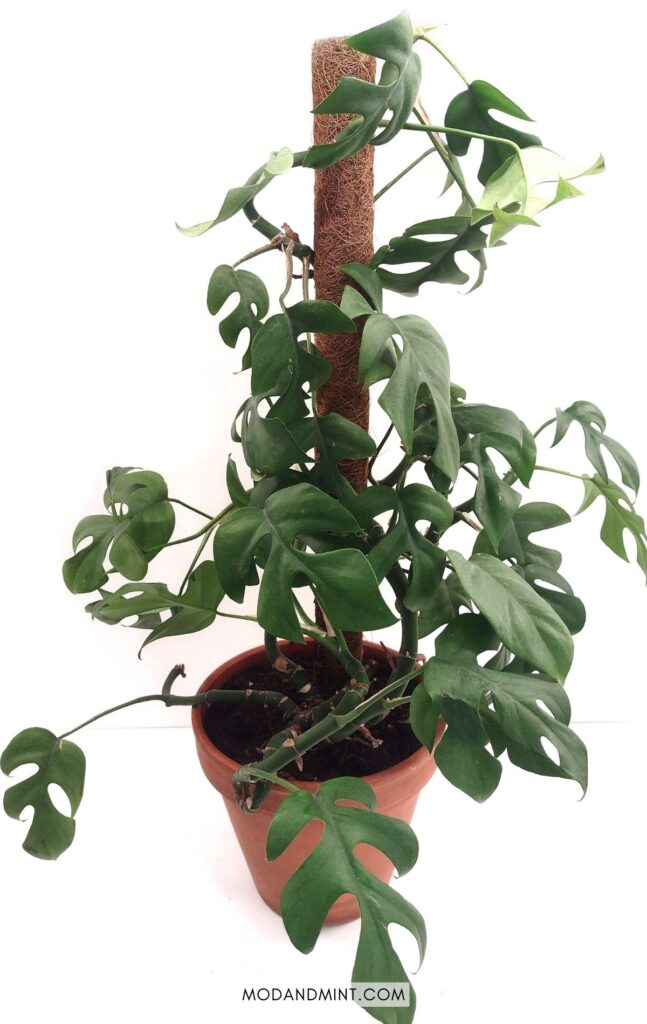
It’s always fun to see the transformation of a plant on a moss pole before and after. This is my Rhaphidophora Tetrasperma aka mini Monstera with a moss pole vs. without one.

This Mini Monstera plant had already grown long vines full of leaves. It had been growing on a wire trellis for a while. It looked pretty, but the plant grew too big and deserved a better upgrade.
It was also due a repot. I gathered all the materials, a bigger pot, fresh soil, plant wire, and of course the climbing stick. 30 Minutes later this is the mini monstera after getting its pole to grow on.

Keep it Moist
Before you place your moss pole or coco coir stick into the pot you should soak it in water until it is completely saturated. This will help the aerial root to attach more easily.
Once the pole is in place and the plant is trained around it, it is important to keep it moist.
Coco coir totem poles generally last longer than moss poles, but they hold less water. Whichever type of pole you use, make sure to mist it regularly, about 2-3 times a week.
There also are self-watering moss poles with water storage tanks on top that water it from the inside. These poles stay moist for 1-2 weeks.
What to do When the Plant Outgrows the Moss Pole
When your plant grows so tall that it outgrows the moss pole, you don’t need to remove or replace the pole.
You have a few options:
- Cut back the long vining stems. Propagate the cuttings to start new plants or replant them back in the original pot, making the parent plant fuller.
- Take the long vines and guide them back down the pole.
- Most moss poles and coco coir poles can be extended as the plant grows. This is as simple as putting a second pole on top of the existing pole to create a longer climbing stick.