
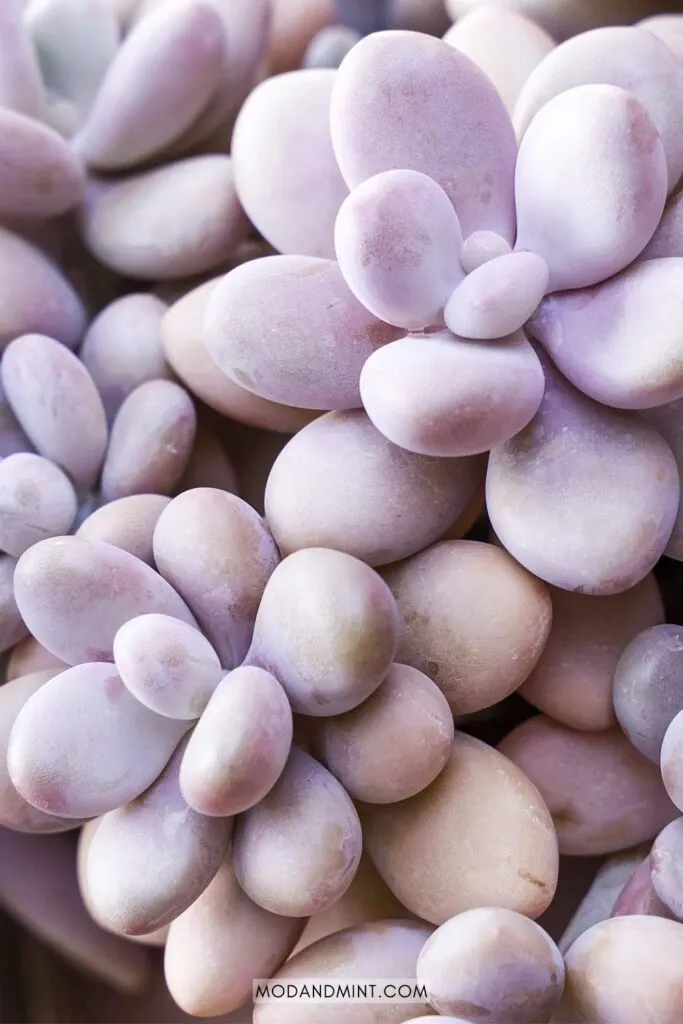
The Pachyphytum oviferum, commonly known as Moonstone succulent, grows chubby, rounded leaves in pretty pastel colors.
The matte powdery leaves come in shades of light green or blue gray, and turn pink or purple when grown in bright light.
The succulent leaves store water inside, making them drought-tolerant and easy to care for. Just make sure the plant gets plenty of light and don’t water too often!

Want to buy a Pachyphytum oviferum moonstone succulent? Find it for sale on Amazon.
Moonstone Succulent Care
The Pachyphytum oviferum is native to Mexico and belongs to the Crassulaceae family.
This plant is a popular plant among succulent collectors due to its pretty colors and its ability to grow and thrive in a variety of conditions.


Need a succulent plant care refresher? Check out the Beginners Guide to Succulent Care. It has all you need to know to take care of indoor succulents.
Light Requirements


Moonstones require bright, indirect light to grow indoors. It’s best to place it near a window that gets several hours of bright, indirect sunlight each day.
The brighter the light conditions, the more pronounced the pink or purple the leaves will be. Leaves will stay greener in low light.
But watch out for too much direct light. Dry, brown spots on the leaves can be a sign of sunburn. These marks can not be fixed. Protect your plant from direct sun with a sheer curtain.
If your moonstone succulent is growing tall and leggy, it is seeking and stretching for more light. To stop the leggy growth, move the plant closer to a window. Supplement with a grow light if your home doesn’t receive enough natural light.
Read more: Do succulents need sun?
Watering


The moonstone succulent is very drought-resistant. In their native habitat, they go through long dry spells followed by heavy rain. They store water inside while waiting for the next rainfall (or indoor watering).
Indoors, allow the soil to dry out completely between waterings. When you do water, be generous. This is called the soak-and-dry method. Soak the soil when you water, then let it dry out before watering again.
Only water your moonstones like this in spring and summer. Slow down watering in fall and water very sparingly in winter.
Leaves should feel firm. The first signs of underwatered moonstone succulents are drooping wrinkled leaves.
Don’t water too often. Overwatering is the most common problem with these plants and can lead to root rot.
If the roots rot, they can’t absorb any water and can’t supply water to the plant. Signs of overwatered moonstones are leaves feeling soft and mushy and looking translucent yellow before turning brown or black and dropping off.
Unfortunately, root rot is irreversible. But you can save an overwatered succulent by propagating any healthy parts left.
If in doubt, don’t water yet. Underwatering is easier to fix than overwatering. If you are uncertain, you can use a moisture meter to help you out with when to water.
Read more: How often to water succulents.


Fertilizing
Use a diluted liquid succulent fertilizer to feed your moonstone succulent once a month in spring and summer.
Be sure the soil is damp before fertilizing and don’t fertilize in winter when growth slows down.
Also never fertilize if your plant is recently repotted or is having problems. Fertilizer gives your plant a boost of nutrients when it is actively growing. It is not plant medicine.
Newly bought or recently repotted plants don’t need to be fertilized for at least the first 4-6 months. The potting mix usually already has slow-release fertilizer in it.
Humidity
The Pachyphytum Oviferum thrives in warm temperatures and is not very needy when it comes to humidity.
Moonstones actually prefer moderate to low humidity, and tolerate average household humidity levels.
No need for misting to raise the humidity. Misting will also harm the layer of white powder on the leaves. More on this next.
White Powder on the Leaves
Moonstone succulents have a white powder coating on the leaves. This is completely natural and is called farina or epicuticular wax.
Don’t mistake this powder for some type of fungus or mildew. No need to remove it. Don’t touch the leaves too much since this will damage the coating.
This dusty layer prevents the plant from getting burnt by intense sun and protects against rain water so the leaves don’t get moldy.
The powdery bloom also helps to reduce water evaporation through the leaves making the moonstone plant even more drought resistant.
How to Propagate Moonstone Succulent
The easiest way to propagate moonstone succulents is by taking stem or leaf cuttings and rooting them in water or soil. If your plant is growing baby offshoots at the base, you can also remove and transplant those into their own container.
Single leaf propagation is most like how the plant grows in nature when leaves naturally drop and fall onto the soil.
Gently remove a healthy leaf from the plant. Carefully wiggle until it comes loose.
Before you do anything, let the leaf or stem cutting dry out for a few days. This will give the cut surface time to callous over.
To propagate the cutting in water, put it in a glass or jar with a bit of water and place it in bright, indirect light. Change the water regularly and wait for roots to grow to about 1-2 inches long before potting up in soil.
To propagate in soil, place the calloused cuttings in a small pot with well-draining soil. Keep in bright, indirect light. Mist or water very sparingly until you see new growth.
It’s important to note that not all cuttings will root, and some may take longer than others, so it’s a good idea to take multiple cuttings and be patient.
Want to learn more about propagation? Read the complete guide to succulent propagation and get all the details on the 6 different ways to propagate your plants.
Repotting
Repot in spring in a pot one size up when roots have filled the pot, and or when you see roots growing from the bottom of the pot.
Even if your plant still has room to grow, you want to refresh the soil every two to three years. The soil will have lost all its nutrients and will need to be replaced with fresh well-draining succulent soil. Pumice or perlite can be added to help aerate the soil and improve drainage.
Gently remove your plant from the pot. If needed tap the pot to loosen the soil and roots. Support the plant in one hand, and use your other hand to carefully take the pot off.
Make sure the new pot has drainage holes on the bottom. Without those, excess water has no way to get out and will definitely drown the roots.
Read more: How to repot your houseplants.
Pests
The Pachyphytum Oviferum moonstone succulent is not prone to pests, but like any plant, it can occasionally be affected.
The most common pest on indoor moonstones are mealybugs. Inspect your plant regularly. These small white bugs like to hide in between the leaves.
Use a cotton bud and gently reach in between the leaves to soak the mealy bugs in alcohol.
Read more: Identify Common Houseplant Pests and How to Get Rid of The Bugs
Are Moonstone Succulents Toxic to Cats?
The Pachyphytum Oviferum is considered non-toxic. It is safe to grow at home around your cats or dogs.
Want more round leaf plants? Check out this list of stunning round leaf plants!

