
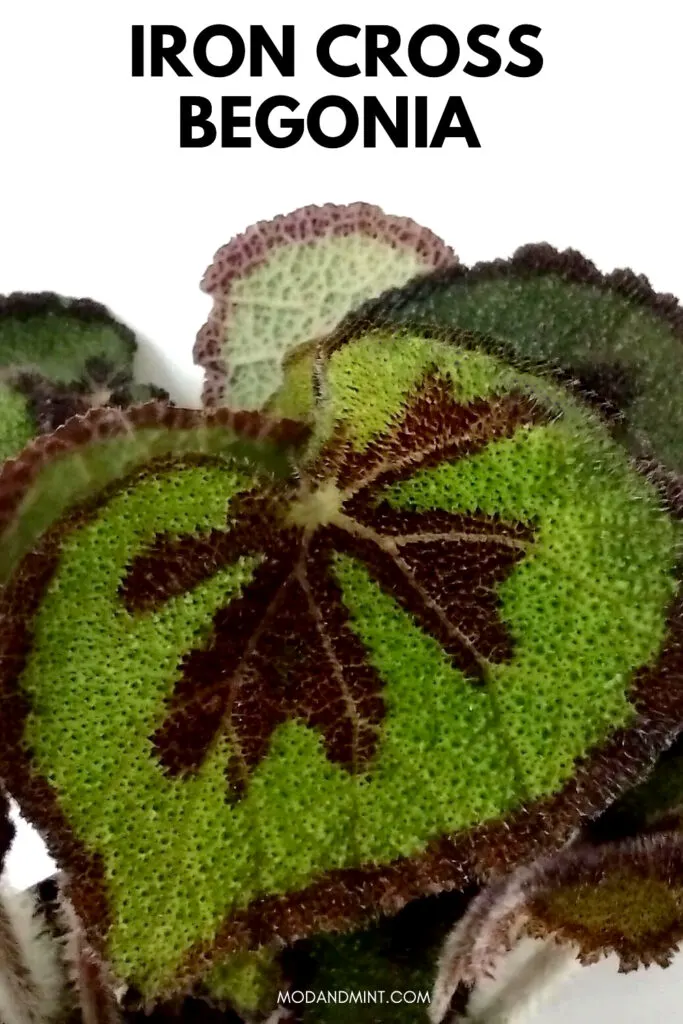
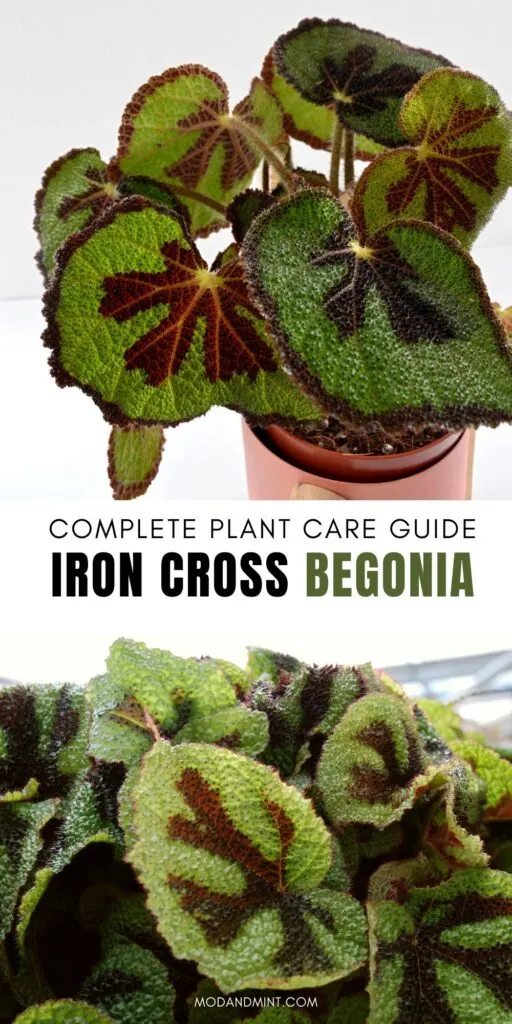
The Begonia masoniana is also known as the Iron Cross Begonia or Mountain Begonia. It grows striking asymmetrical leaves, each with a dark brown medieval cross pattern.
Begonias are a diverse group of more than 1000 species with various growth habits, leaf shapes and sizes, endless leaf colors and color patterns, and many interesting types of flowers. What makes the iron cross plant extra special are the small hairs that grow on the puckered leaves and stems. When light falls on the leaves it brings out a beautiful shine.


Want to buy Begonia Masoniana plant? Find it for sale on Amazon!
Iron Cross Begonia Masoniana Care
Not too long ago, the Begonia masoniana was considered rare and difficult to cultivate. However, plant breeders have managed to acclimatize them and now many can own and grow them indoors.
The variegated type iron cross plant, the Begonia masoniana Variegata, is very similar to the common one except for the slight dark burgundy border visible along the leaves’ perimeter.

Need a plant care refresher? Check my Guide to Basic Houseplant Care.
Light Requirements
Begonia masoniana plants are native to the jungles of China and Vietnam. There they grow in dappled or shaded light under the canopies of tall tropical trees.
Indoors the best place for your iron cross begonia is in a spot with bright, indirect light, such as an east-facing or north-facing window.
Too much direct sun can burn the leaves and make the leaf markings fade. Filter the light with something like a sheer curtain.

Watering
The Begonia masoniana has underground rhizomes that store water and nutrients inside. This way the plant can survive periods of drought. Don’t water this plant too often. Let the soil dry out slightly between waterings.
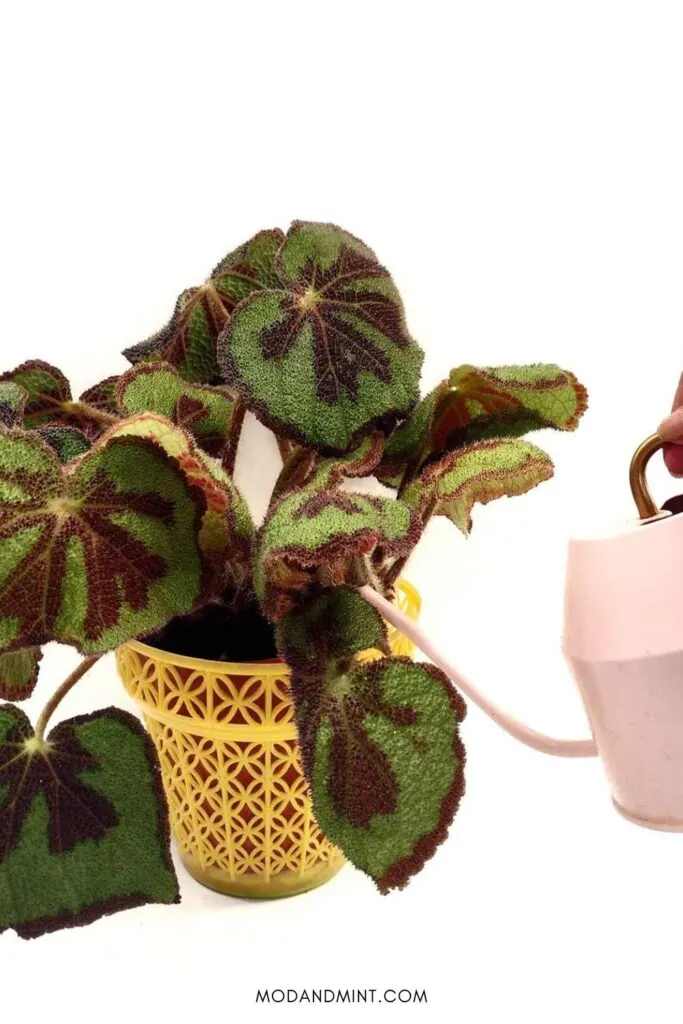
Iron cross Begonias are prone to mildew if water gets on the leaves. Use a watering can with a long spout or water from the bottom. To bottom water, fill a bowl or cachepot with water. Place your begonia inside so it can soak up water through the drainage holes on the bottom of its pot.
If the soil gets too dry, the leaves will start to curl and droop. But they will quickly recover once it gets water. Leaves will dry out and get crispy if they are underwatered for a longer period.
Use a diluted liquid plant fertilizer once a month in spring and summer.
Water less and don’t fertilize in winter when your begonia goes dormant and doesn’t grow. You might notice leaves dropping suddenly in winter when the begonia masoniana goes into dormancy. It might look like the end of your plant, but continue care and it will grow back in the spring.
For more information read my post on when and how to water your house plants.
Humidity
In nature, Iron cross Begonias are used to grow in medium to high humidity. At home, you will most likely need to take some action to raise the humidity around your plants.
Brown, crispy edges on leaves and tips are often a sign that your iron cross begonia needs more humidity.
DO NOT MIST your begonia masoniana. Although it likes high humidity, it doesn’t like water on its leaves. The best way to provide your plant with more humidity is to put a small humidifier nearby.
Soil and Repotting
Repot in spring in a pot one size up when roots have filled the pot, and or when you see roots growing from the bottom of the pot.
It is also time for a bigger pot when you notice the rhizomes pushing up against the inside of the container. Just like it happens when Snake plants or ZZ plants get too big for their pots. If your plant is in a plastic pot, you will see or feel bumps on the side. Rhizomes growing too crowded in a clay pot might actually crack it.
Even if your plant still has room to grow, you want to refresh the soil every two to three years. The soil will have lost all its nutrients and will need to be replaced with fresh well-draining soil.
The Begonia masoniana prefers slightly acidic soil. A store-bought African Violet potting mix is a good option.
Gently remove your plant from the pot. If needed tap the pot to loosen the soil and roots. Support the plant in one hand, and use your other hand to carefully take the pot off. Make sure the new pot has drainage holes on the bottom. This is a must. You want any excess water to have a way out.
For step by step instructions, read my post on how to repot your house plants.

Begonia Masoniana Propagation
The Begonia masoniana can be propagated by dividing the underground rhizomes, or by taking stem or leaf cuttings.
Propagation by Division
Propagating by rhizome division is easy and has a high success rate. This is a much quicker way to propagate than by leaf propagation. When splitting the rootball and rhizomes and repotting the parts in separate containers, you have complete plants already. Whereas when propagating cuttings, it may take a long time to grow them into a decent-sized houseplant.
- Take the plant out of the pot. Gently remove as much old soil as possible without damaging the roots and rhizomes.
- Decide where to divide the plant. Each section needs some leaf growth as well as part of the rhizome and roots attached.
If there are multiple rhizomes and you can divide without having to cut through them, that should be the first choice. - If needed, make a clean cut through the rhizome and roots. Otherwise, gently separate with your hands.
- Pot each part in its own planter. Keep them in bright indirect light.
- Water once and wait to water again until you see new growth.
Propagation from Leaf Cuttings
Propagation by taking leaf cuttings is a fun and popular method to propagate rhizomatous and Rex begonias. The Begonia masoniana takes a little more time to root, but with care and patience, one leaf can grow multiple new plants!
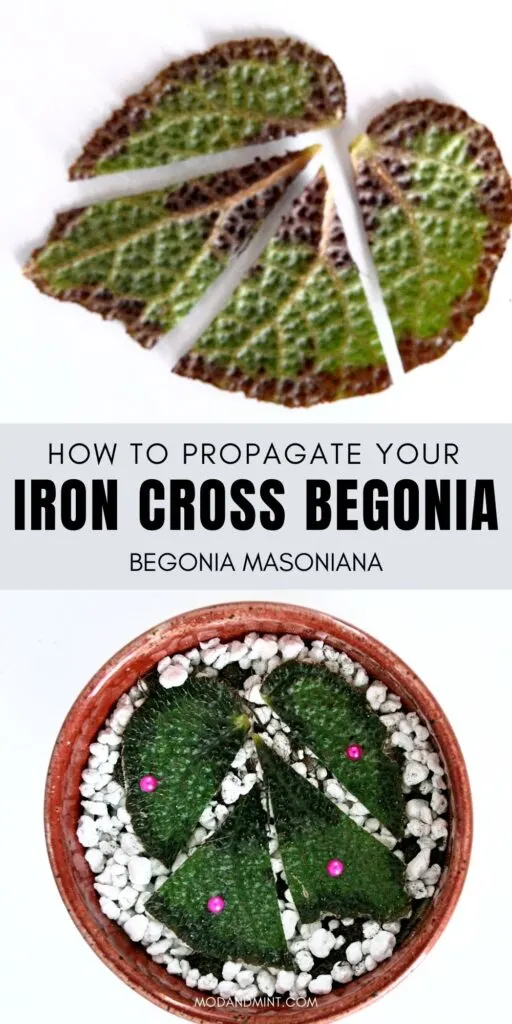
- Prepare a healthy leaf by cutting it up into wedge sections with a slight taper towards the leaf stalk.
- Place the leaf sections face up, on moist coconut coir, perlite, or a seed starter soil mix. Keep the rooting medium moist at all times, but do not allow it to be soggy wet.
- Place small pebbles or pins on top of the leaf parts to weigh them down.
- Cover the propagation container with plastic wrap or a plastic bag. Make a few holes in the plastic cover to prevent too much moisture inside.
- Place the cuttings in a location where they get plenty of bright light, but out of direct sunlight.
- Plantlets will appear in 3 to 6 weeks.
About a week before you want to transplant the new baby begonias, remove the plastic cover of the container gradually a little each day. This “hardens them off” to prevent the shock if they would otherwise suddenly be pulled out of the protection and humidity of the closed container.
Want to learn more about plant propagation? Read my guide where I explain the 6 different ways to propagate your plants.

Begonia Masoniana Flowers
Mature iron cross begonias can flower under the right conditions. Don’t worry if your plant doesn’t bloom. Many indoor begonias don’t flower at all. If they do, it is usually in spring or early summer. The flowers are small, pinkish-white, and inconspicuous.
Crispy Leaves
Dry, crispy leaf tips are a common problem with indoor iron cross begonias. Leaves will start to turn brown from the tip inward. Most often this happens because the humidity is too low,
Begonia leaves can also turn brown and crispy if they get too much direct sun or are very underwatered.
Investigate and adjust. Raise the humidity around your plant, and move it away from the window a bit if needed.
White Spots on the Leaves
If you see powdery white spots on the leaves of your begonia, you are seeing signs of mildew. This fungus can show up when the foliage has gotten wet.
If it’s one or two leaves, simply pinch them off. Improve air circulation around the plants so if they do get wet, they will dry faster. Severe cases will need fungicide treatment.
Is Iron Cross Begonia Toxic to Cats?
The Begonia masoniana is considered mildly poisonous when ingested. It can cause vomiting and salivation in dogs and cats. The most toxic part are the underground rhizomes.
It is quite rare for cats or dogs to get seriously hurt from eating plants. But it is always important to research and find out what type of plant you’re bringing home. Maybe skip this plant to keep your pets safe.
More Foliage Houseplants
Looking for more leafy houseplants? Check out these stunning plants:
- The green/white/pink leaf Stromanthe Triostar Plant.
- Prayer plants‘ leaves open during the day and fold up at night like praying hands.
- Large, wavy-edged leaves on the Alocasia Polly.
- The umbrella plant grows long oval leaves that grow in an umbrella-like circular cluster.
- Caladiums grow large heart-shaped leaves with pink, green, and white variegation.
J Wang
Wednesday 23rd of July 2025
Thanks for the guide. First time plant parent, the iron cross begonia is from a friend and I'm so worried about the wilting. It's been with me about 3 weeks. Never watered plants properly before this one, and the pot it came in had no drain hole. I don't know if it's because of dry home or because I don't water enough. I just re-pot it in a pot with a drain hole. Hope it stays alive.
earl campbell
Sunday 19th of March 2023
My Grandmother died in 1987. I still have her Iron Cross. It has had periods of survival, good growth, and once totally died but revived after letting it sit for many months before rewatering. Right now it is losing many large leaves to browning but also growing new ones. Not sure what to do with it. I'm in constant fear of killing it. I have never been able to propagate a new plant. Love it, Earl in Hartland, MI
Mod and Mint
Tuesday 21st of March 2023
Hi Earl, I wish I could give you a magic cure to save your precious plant! It is good to hear you managed to keep it going for so long. Begonias usually don't even have that long of a life span, no matter how good you care for them they usually only last a few years. You should definitely try and propagate a leaf and see if you can start over with new plants that will still be closely related to your grandmother's plant. Don't give up on the original plant though since you say it is still growing new leaves. That is definitely a good sign. I'm keeping my fingers crossed!
Susan Ott
Tuesday 10th of January 2023
My iron cross begonia was given to me about 45 years ago. I have had it, started others from dropped leaves, shared and now they are getting so big. Guess mine might have set some kind of record for longivity.
@growwslow
Sunday 22nd of January 2023
@Susan Ott, 45 YEARS?! I reaaaallly want to see that. I have a masoniana and a ferox in mu collection but pretty modest in size still.