
The Stromanthe sanguinea Triostar (pronounced stroh-MAN-thee san-GWIN-ee-a) is a stunning tropical houseplant.
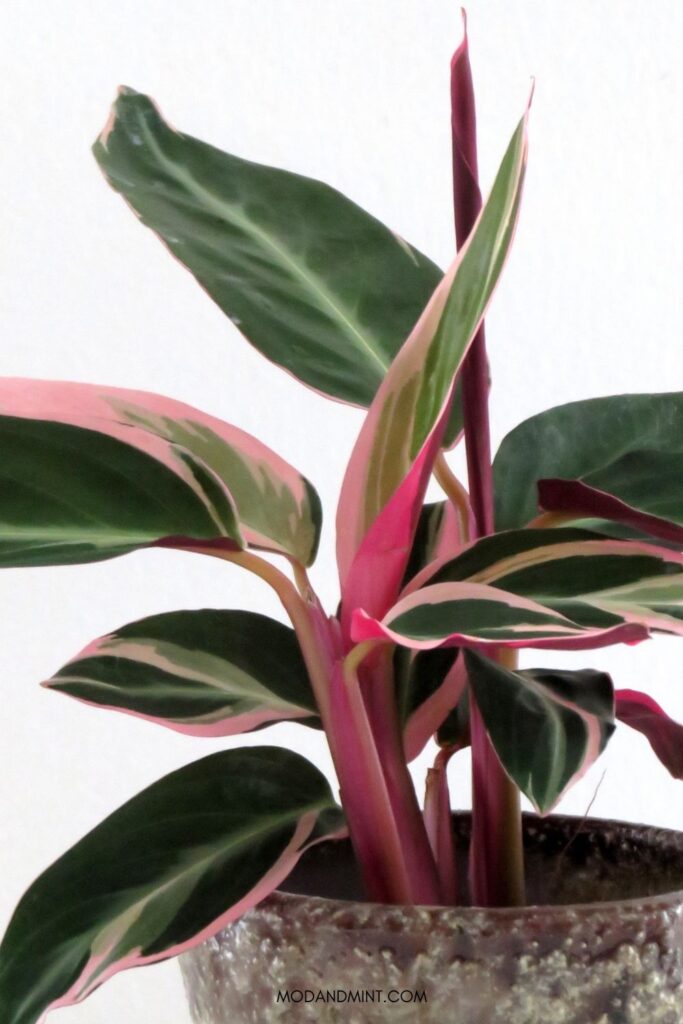
The Triostar features large, broad leaves in shades of green, cream, pink, and burgundy. The gorgeous leaves make it a real showstopper.


Stromanthe Triostar
As a member of the prayer plant family, the leaves of the Stromathe open and close like praying hands as a response to changes in sunlight during the day and night.
It thrives in bright, indirect light and prefers a warm environment. It’s important to keep the soil consistently moist and the humidity high.
Need a plant care refresher? Beginners Guide to Houseplant Care.


Want to buy a Stromanthe Triostar plant? Find it for sale on Amazon!
Light
In its native habitat, the Triostar grows in dappled, shaded light under the canopies of tall trees. Indoors, the best place is in bright, indirect light.
When the Stromanthe triostar is grown in too little light, colors and variegation may fade. Leaves will stay smaller and overall growth will slow down.
Too much direct sun can make the colors fade, and wilt and burn the leaves, turning them brown and crispy. Make sure to protect your plant from the sun with something like a sheer curtain.
Water
Water regularly to keep the soil slightly damp. The soil should feel like a wrung-out sponge.
If the soil feels moist, don’t water but wait one or two days and check again. If the soil is dry, go ahead and water thoroughly to saturate all of the soil. Allow all excess water to drain out of the bottom of the pot. Then allow the top layer of soil to dry out before watering again.
These plants are known to be sensitive to chlorine found in tap water causing the tips of the leaves to turn brown and dull. To prevent this, use distilled water, or let tap water sit overnight before using it.
Overwatering can lead to yellow leaves and root rot, while underwatering can cause the leaves to droop, wilt, and dry out. Leaves should feel firm. If in doubt, don’t water yet. An underwatered plant is easier to revive than an overwatered plant. If you are uncertain, you can use a moisture meter to help you out with when to water.
Further reading: How to use plant moisture meters – How to water your indoor plants.
Fertilizer
Use a diluted liquid plant fertilizer once a month in spring and summer when the plant is actively growing.
Be sure the soil is damp before fertilizing and don’t fertilize in winter when growth slows down. This is a delicate, sensitive plant and can easily get burnt leaf tips if fertilized too often.
Also never fertilize if your plant is having problems. Fertilizer gives your plant a boost of nutrients when it is actively growing. It is not plant medicine.
Newly bought or recently repotted plants don’t need to be fertilized for at least the first 4-6 months. The potting mix usually already has slow-release fertilizer in it.
Want more Prayer plants? Check out the care guides for the Calathea orbifolia, Ctenanthe Burle-Marxii, and the Calathea lancifolia.
Humidity
In their natural habitat, Stromanthe plants are used to a warm and humid environment. To grow well indoors, you will need to increase the humidity around your plant.
Brown, crispy leaf tips are often a sign that it needs more humidity. The best way to raise the humidity is to place a small humidifier near your plant.
A good place for a triostar plant is a bathroom with a bright window. The steam from the shower will provide the humidity it loves.


Soil and Repotting
Repot in spring in a pot one size up when roots have filled the pot, or when you see roots growing from the bottom of the pot.
Even if your plant has room to grow, you want to refresh the soil every two to three years. The soil will have lost all its nutrients and will need to be replaced with fresh soil. A well-draining special aroid potting mix is a good choice for your Stromanthe plant.
Make sure the new pot has drainage holes on the bottom. This is a must. You want any excess water to have a way out.
Read more: How to repot your plants.

Leaves Pointing Down Not Moving Up
If your Stromanthe isn’t praying at night and the leaves keep pointing down, it is probably getting too much or too little light. These plants need a noticeable difference in light and dark for the leaves to open and close.
When it gets too much light, the plant will think it’s still daytime and not fold up the leaves at night. When it gets too little light it will keep leaves open to try to get as much light as possible.
Leaves Curling
When the leaves on your prayer plant are curling in, and the edges become crispy, it usually means that it needs water.
Leaves also tend to curl if the humidity is too low, or if the plant is getting too much direct light. Increase humidity and, or, move away from the light.
Further reading: How to fix common prayer plant problems.


Is the Stromanthe Triostar Toxic to Cats?
As a part of the Marantaceae plant family, the Stromanthe sanguinea Triostar is considered non-toxic.

Want more pink plants? Check out this list full of stunning pink houseplants!
Raewyn
Tuesday 25th of March 2025
How do I stop my plant from not releasing from the stem
Carol
Thursday 27th of October 2022
hi....loved your triostar page....my plants(2) are starting to show roots coming out of drainage holes. It's fall/winter here is northern Virginia. Should i wait til spring to repot even though the roots are starting to come thru or must i repot now. Thanks for your info