Haworthia Succulent Plant Care Guide (Zebra Plant)
The Haworthia (pronounced huh·wur·thee·uh) is a small, easy-to-care-for succulent plant.

Haworthia Succulents
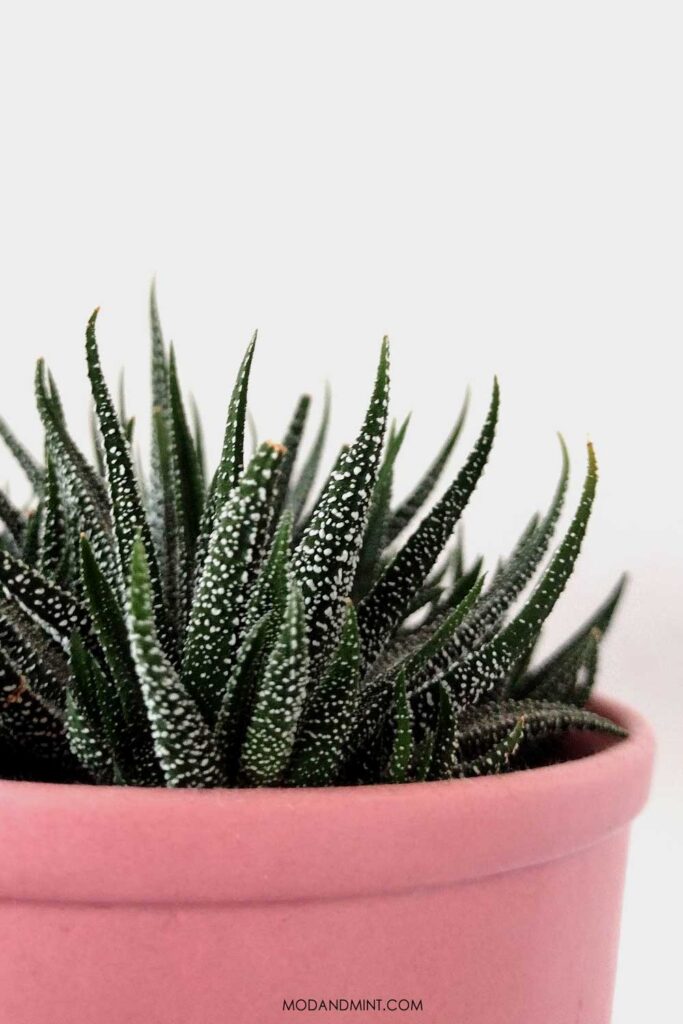
Most types have green upright succulent leaves that grow together in tight rosettes. Because of the pattern most Haworthias have on their leaves, they are commonly called zebra plants or zebra cactus (even though it is not a cactus). The markings vary by type and are often striped or dotted with small white spots.
Read more: Indoor Succulent Care Guide.
Light
Haworthia plants are native to South Africa, growing in the shade of rocks or shrubs. So they are used to living in partial shade. This makes them very suitable to grow in low-light homes.
Unlike most other succulents, haworthia doesn’t like full sun all day. It could survive and adjust to bright light, but the leaves will eventually turn a reddish/brown color.
Read more: Houseplants that can grow in low light.
Watering
Haworthia plants store water inside their leaves. This means they do not need to be watered very often. These plants can handle the occasional lapse of neglect.
The best way to know when it is time to water is to look at your plant and check the soil. If the top layer of the soil feels moist, don’t water but wait a few days and check again.
It needs water when the soil has been dry for several days. Leaves shriveling or curling inwards is another way you can see your plant wants water.
Underwatering is better than overwatering. Watering too often will lead to root rot. If you are unsure if it is time to water or not, you can purchase a moisture meter to help you out.
Haworthias will go dormant in winter. When light levels are lower, growth slows down and the plant will need to be watered less often.
Read more: How to water succulents.

Soil and Repotting
Repot when the roots have filled the pot or are growing from the drainage holes on the bottom. Also, transplant into a bigger pot when there are so many baby pups growing that they are outgrowing the pot.
Refresh the soil every two to three years, even if your plant still has room to grow. The soil will have lost its nutrients and will need to be replaced with fresh well-draining succulent soil mix.
Choose a pot with drainage holes on the bottom. This is important. Haworthias don’t like their roots to sit in wet or soggy soil for too long. If there are no drainage holes, excess water has no way to get out and can drown the roots.
Read more: Guide how to repot your plants.

Propagation
Haworthias are one of the easiest to propagate plants. The simplest way is by removing offsets. Mature haworthias grow baby plants around their base. These can be removed with roots already attached, ready to be potted up, and grow into full new plants.
These baby plants are referred to as pups, offsets, offshoots, or plantlets. Multiple pups can grow around your plant at the same time. When they start to grow a bit, you can remove them from the parent plant to create new plants. Or, if they have enough space, you can let them be and grow right where they are.
Read more: How to propagate Haworthias by removing the pups.

Want your own Haworthia plant? Find it for sale on Amazon!
Is Haworthia an Aloe?
Haworthia plants and aloe plants often get confused. It is not surprising, since they look somewhat similar. They are different types of plants, but both are part of the same Asphodeloideae plant family. Just like Gasteria plants, another similar-looking relative.
You can give your haworthia the same overall care as you would an Aloe or Gasteria.
Is Haworthia Toxic to Cats?
Haworthias are non-toxic and safe to have around kids, cats, dogs, and other pets.
Watch out if you have an Aloe. Although very similar, the aloe is considered to be toxic. So keep that one out of reach. Learn more about the risks of toxic houseplants around your pets (and find out which plants are non-toxic and safe!).
Further reading: Best houseplants for beginners.