

Rhaphidophora Tetrasperma Care Guide – How to Grow a Mini Monstera
The Rhaphidophora tetrasperma is a trendy houseplant with fenestrated leaves that resemble the larger Monstera deliciosa, bringing a touch of tropical vibes to your home.
The Rhaphidophora tetrasperma is great if you don’t have enough space to grow a large Monstera deliciosa, because it stays smaller, grows faster, and forms holes in its leaves quicker.
This plant care guide has all the practical tips on watering, light, humidity, propagation, and more!

Need a plant care refresher? Check out the Beginners Guide to Basic Houseplant Care. Filled with all you need to know to take care of your indoor plants.
Indoor Rhaphidophora Tetrasperma
Because of their resemblance, retailers often sell the Rhaphidophora tetrasperma as a mini monstera, monstera minima, or dwarf monstera. Although this plant looks like a small Monstera deliciosa, it is not the same.
Both of them are so-called aroids coming from the same Araceae plant family and require similar care. Just like the Monstera adansonii, another Deliciosa lookalike.
Want to buy a Rhaphidophora Tetrasperma? Find it for sale on Amazon!
Light Requirements
The fast-growing Rhaphidophora tetrasperma originally comes from tropical Thailand and Malaysia where it grows in dappled or shaded light under the canopies of tall trees.
Indoors, your dwarf Monstera likes bright, indirect sunlight. A good spot is near an east-facing or north-facing window.
It can tolerate lower light situations. But too much shade may cause the leaves to stay smaller and might not form the distinctive perforations. Vines may also grow leggy with more space between the leaves reaching for the light. Consider getting a LED grow light if your home doesn’t receive enough natural light.
Dust can collect on the leaves. The leaf pores get clogged making it harder to take in light. Occasionally wipe down the leaves with a damp cloth, or bring your plant to the bathroom and treat it to a gentle room temperature shower.

Watering
In its natural habitat, the Rhaphidophora tetrasperma plant is used to grow in a humid environment, on moist soil.
In your home, water your plant regularly to keep the soil slightly damp, but never soggy. The soil should feel like a wrung-out sponge.
If the soil feels moist, don’t water but wait one or two days and check again. If the soil is dry, go ahead and water thoroughly to saturate all of the soil. Then allow the top layer of the soil to dry out before watering again.
Watering too often can lead to yellow leaves and root rot, while underwatering can cause the leaves to droop, wilt, and dry out. Leaves should feel firm. If in doubt, don’t water yet. An underwatered plant is easier to revive than an overwatered plant.
If you’re uncertain, you can use a moisture meter to help you with when to water. And read up on the basics of watering your indoor plants.
Fertilize
You can fertilize your mini Monstera to supplement poor soil or give your plant a boost during the growing season. Use a diluted liquid fertilizer about once a month in spring and summer.
Be sure the soil is damp before fertilizing to prevent burning the plant’s roots, and avoid fertilizing in the winter when the plant’s growth naturally slows down.
Newly bought or recently repotted plants don’t need to be fertilized for at least the first 4 to 6 months. The potting mix usually already has slow-release fertilizer in it.
Also never fertilize if your plant is having problems. Fertilizer is not plant medicine. It gives your plant a boost of nutrients when it is actively growing. It’s important not to over-fertilize, as this can lead to a buildup of salts in the soil that can damage the plant’s roots.
Humidity
The Rhaphidophora tetrasperma can grow and adapt to average household humidity levels. However, it will do better if you raise the humidity.
A good place for a dwarf Monstera is a bathroom or kitchen with a bright window. The steam from the shower or cooking will provide your plant with the humidity it loves.
The best way to raise the humidity is to place a small humidifier near your plant.


Moss Pole Climbing Support
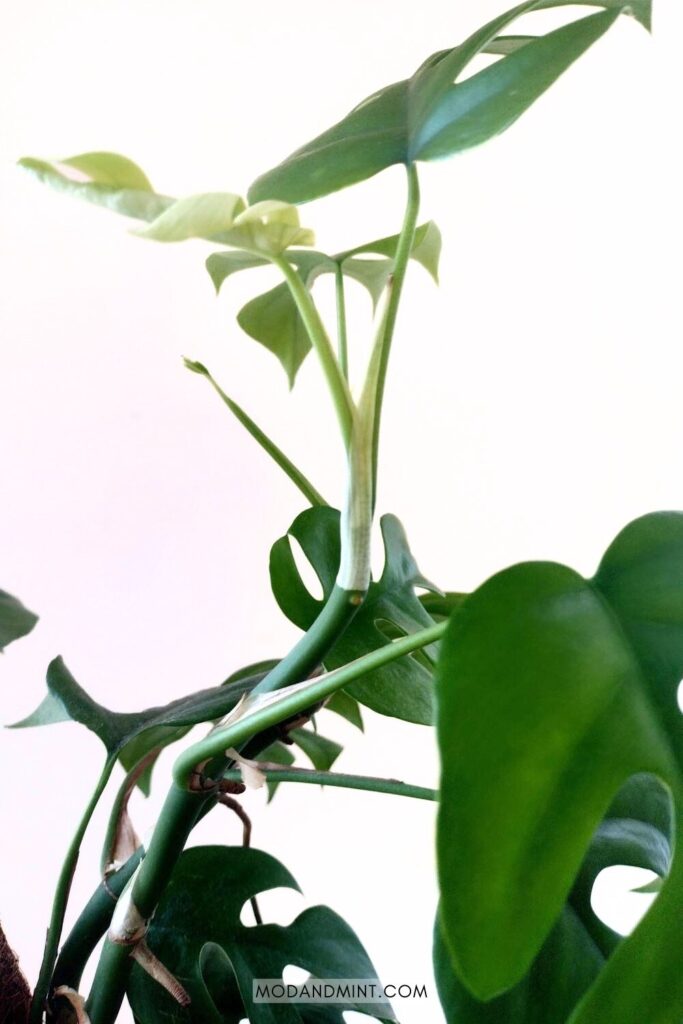
In its natural habitat, the Rhaphidophora tetrasperma uses aerial roots to climb up trees and large branches. When your plant grows larger, you can give it something to climb on. A moss pole is a great option.
Place the pole in such a way that leaf nodes are touching it, or at least are very near to it. Aerial roots will grow from these nodes, grabbing onto the stake. Mist frequently so the roots can attach themselves more easily.
Read more: How to attach a Rhaphidophora tetrasperma to a moss pole!

Soil and Repotting
Repot in spring in a pot one size up when roots have filled the pot, and or when you see roots growing from the bottom of the pot.
Even if your plant still has room to grow, you want to refresh the soil every two to three years. The soil will have lost all its nutrients and will need to be replaced with fresh soil.
A well-draining special aroid potting mix is a good choice for your Rhaphidophora tetrasperma.
Gently remove your plant from the pot. If needed tap the pot to loosen the soil and roots. Support the plant in one hand, and use your other hand to carefully take the pot off.
Make sure the new pot has drainage holes on the bottom. This is a must. You want any excess water to have a way out.
Read more: How to repot your houseplants.
Rhaphidophora Tetrasperma Propagation
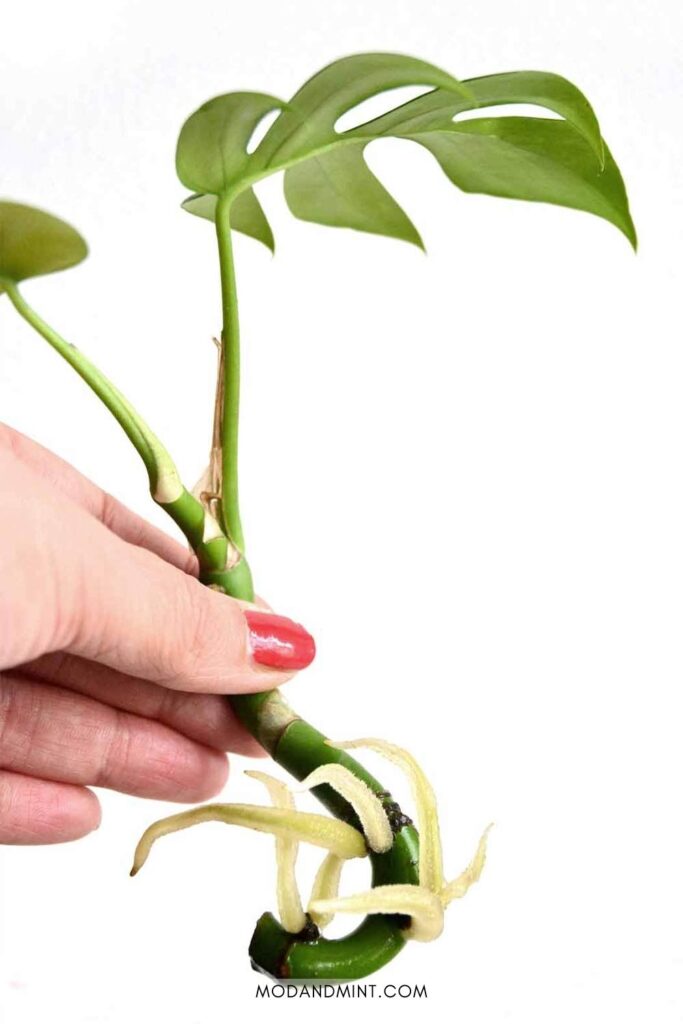
The easiest way to propagate is by taking stem cuttings and rooting them in water or soil.
Cut a stem cutting with a few leaves. Remove the leaves from the lower part of the cuttings. To water propagate, let the cuttings dry and callous over before placing in water. Keep in bright, indirect light. Change the water regularly and after a week or so roots will start to grow. Transplant to soil when roots are about 1 – 2 inches.
To propagate in soil, plant the calloused cuttings in a small pot with well-draining soil. Keep in bright, indirect light. Mist or water very sparingly until you see new growth.
To speed up the propagation process, you can apply a rooting hormone powder to the cutting before planting it. This powder stimulates the formation of roots and results in stronger, better-rooted plants. If you don’t have any, you can skip it. It might just take a little longer.
Want to learn more about plant propagation? Read the complete guide explaining the 6 different ways to propagate all your plants.

Rhaphidophora Tetrasperma Yellow leaves
The leaves of an indoor Rhaphidophora tetrasperma can turn yellow for a few reasons.
Most often it is because the plant has been overwatered. Give the soil more time to dry out, and adjust your watering schedule going forward.
If overwatering isn’t the cause of the yellow leaves, it could be that your plant is getting too much direct sunlight. If the plant is too close to a window, it can be chlorophyll loss turning the leaves yellow.
But there’s more. Over- or under-fertilizing can also lead to yellowing leaves. Too much fertilizer can burn the roots and make the leaves go yellow. Not enough fertilizer can cause iron or nitrogen deficiencies which also cause yellowing leaves.
On the other hand, if you over-fertilized your plant, you want to carefully remove the plant from the pot and clear the soil away from the roots. Gently rinse the roots with lukewarm water. Repot in fresh well-draining soil.


Leaf spot shows up as brown or black water-soaked spots on the foliage, sometimes with a yellow halo around them. These dead tissue spots can spread really quickly. Prune off all leaves that have any spots as soon as you notice them.
Plant Pests
Like many houseplants, the Rhaphidophora tetrasperma can be susceptible to pests such as spider mites, mealybugs, aphids, and fungus gnats.
However, with proper care and regular inspection, you can prevent and manage pest infestations. Keep the leaves clean and inspect your plant for any signs of pests, such as webbing, sticky residue, or tiny insects on the leaves to catch a possible infestation before it becomes severe.
Thoroughly check under the leaves and in axils where insects tend to hide.
Remove the pests manually if possible, and isolate the plant from any others to prevent the pests from spreading. Treat the plant with an appropriate pest control method.
Learn more about common houseplant pests and what you can do to get rid of them.
Rhaphidophora Tetrasperma Toxic to Cats?
The Rhaphidophora tetrasperma plant is considered mildly toxic when ingested. It may cause stomach pain, irritation of the mouth, tongue, and lips, excessive drooling, vomiting, and difficulty swallowing.
Although it is uncommon for pets to get seriously hurt from eating plants, keep this one out of reach of children and pets.
Read more: Keeping Your Pets Safe: Identifying Toxic Plants in Your Home.




My mini is getting brown spots that look almost like bruises and the leaves aren’t a deep green …. help! I don’t want to lose my plant
Hi Anna, without knowing the conditions of the plant, it’s hard to say, but it sounds like a watering issue. My first guess would be overwatering. Have you maybe watered your plant too often lately? The color could be a slight yellowing due to overwatering, but be aware that new growth usually starts out a little paler can turn a darker green as they mature.
Hope this helps a bit!
I have a Lacy Tree Philodendron and it has these little cracks in the leaves. Why is that happening? Btw, I love your website!
Hi Claire, How is your Philodendron doing? Without seeing it, it’s hard to say what is wrong with it. Is it just really dry? Sometimes leaves can get so dry they crack.
My Raphidophora Tetrasperma seems like not surviving/thriving at all. First there’s one leaf that turned yellow, second the leaves are all droopy. I bought this plant from etsy 3 weeks ago, since i got it, leaves are droopy, i put this plant by my west facing window with indirect sunlight, but no changes at all, leaves stayed droopy. Any tips, suggestions would be greatly appreciated!
Hi Mel, Sorry to hear your Rhaphidophora isn’t living its best life. How is it doing now? When you bring a new plant home, some stress is always to be expected. Your plant gets moved and needs to adjust to its new living and care conditions. Did you do anything else when you just brought it home? How many times have you watered it? Let me know how your plant has settled in.
Hello. My name is Anna too. Lol. I bought my RT maybe two or three weeks ago and I overwhelmed it by watering it one day.
I let it drain but the original soil was too soggy. It was left to dry for a couple of days because the leaves started to get droopy.
I thought it was developing root rot? One of the leaves started yellowing so I changed the potting soil completely. Before repoting I examined it and the roots looked okay and did not have a rotting smell.
After repoting, I placed water in the saucer so the soil will soak it up and lightly watered the top soil. Leaves are still droopy and now there are a few brown spots on some of the leaves.
I have it placed by a south-east area in my apartment with filtered light from jalousie windows and the window screen. So direct light isn’t an issue. Humidity isn’t either since the climate is generously humid.
I’m not sure what else to do and it seems like it’s on its last leg.
Can mold that resulted from over watering cause damage to the roots as I let it dry out?
Hi Anna too lol.. I’m sorry to hear you are having problems with your Rhaphidophora tetrasperma plant. Your plant is probably very stressed by all the things it had to go through. Moving into a new home, overwatering, repotting.. I would not repot it again, and don’t water too often. Make sure the soil is not overwatered at this point, let it dry out, and just give it a rest for a while. Remove any affected leaves and give it time to recoup and start new growth. Hope your plant pulls through, keep me posted!
Hi!
For my tetrasperma it’s been doing really well and put out new leaves. Some of the leaves were yellowing so I looked at the pot and noticed roots coming through the holes so it was super root bound. I just repotted it and put on a moss pole. It has a couple of growth points shooting out that don’t quite look right though. They almost look like they are coming in dead, like kind of brownish and not very firm, where my other new growth points were bright green. I don’t know if this is the result of it being root bound and it just needs to adjust or something else? Any tips would be appreciated! Thanks!
I potted my propagation a couple of days ago after seeing a new leaf open and now all the leaves are wilting idk what to do!
Hi Tommy, do you mean you transplanted a cutting from water to soil, and now the leaves are wilting? The cutting will need to adjust to the move, it might still perk up. Keep it in bright indirect light. Did you water it just after when you potted the cutting? That could cause the leaves to wilt. Hold off from watering a few days after potting them up. Hope this helps. I love a good plant propagation story so I hope your plant pulls through!
Hi! I noticed the stalk of my mini turning pale, almost yellowing and wrinkling. I’m terrified it’s root rot. Is it saveable or should I take clippings and start from fresh?
I have five branches in one pot all 4 branches are healthy but one branch has some issue all the leafs on that branch is sloppy I have observed that specific branch is drying and shrinking in width. Do let me know why only one branch is showing this problem and not the other four.
I’m having a similar problem to Annie Claire…. I have 3 RT’s that I have recently added to my collection 1 to 3 months ago. Each were purchased from a different location. Two of them have a brown leaf growing out of the main stem I’m not sure what would cause this. I know that I purchased them before I true warm weather (I’m from NY state), but none of them were in super cold weather. Only 50 degrees or so and not for very long. Trip to car and trip in the house. I’m curious what would cause this? And if it would be better to cut off the stem to propagate or will a new growth point start belwo the brown leaf?
Should I clip off my small new growth? I have better lighting now. If I don’t clip off the small leaves, will it continue to grow small?
If I should prune the small leaves,where should I cut it?
Thanks!!
HELP!! I just noticed some leaf tips on my tetrasperma have gone a bit black but not dry. I watered it once since I got it recently. Also, I had it pulled away from and eastern facing window but I’ve just put it right at the window sill where it gets dappled morning light. Is this issue fixable? Thanks so much and great site..
Hi,
Thank you for sharing some tips on the plant.
I hope you’re well. I’ve bought my first Rhaphidophora Tetrasperma last week and repot into a bigger pot with existing soil and is not wet, just moist. However, I kept seeing new translucent spots/ areas growing on the leaves and one of the leave have brown/black tips. What does this mean?
Hoping for some tips as I don’t want to loose my plant.. ;(
I was given a cutting, and after just one week, the unfurled leaf is turning brown. Any ideas? The other two leaves are green.