
The Ponytail Palm, or Beaucarnea recurvata, is a happy looking and very easy-to-care for indoor plant.
Ponytail palms don’t need a lot of care, and can handle some neglect. As long as you don’t water it too often, your plant will be fine. This is a great plant for beginners!
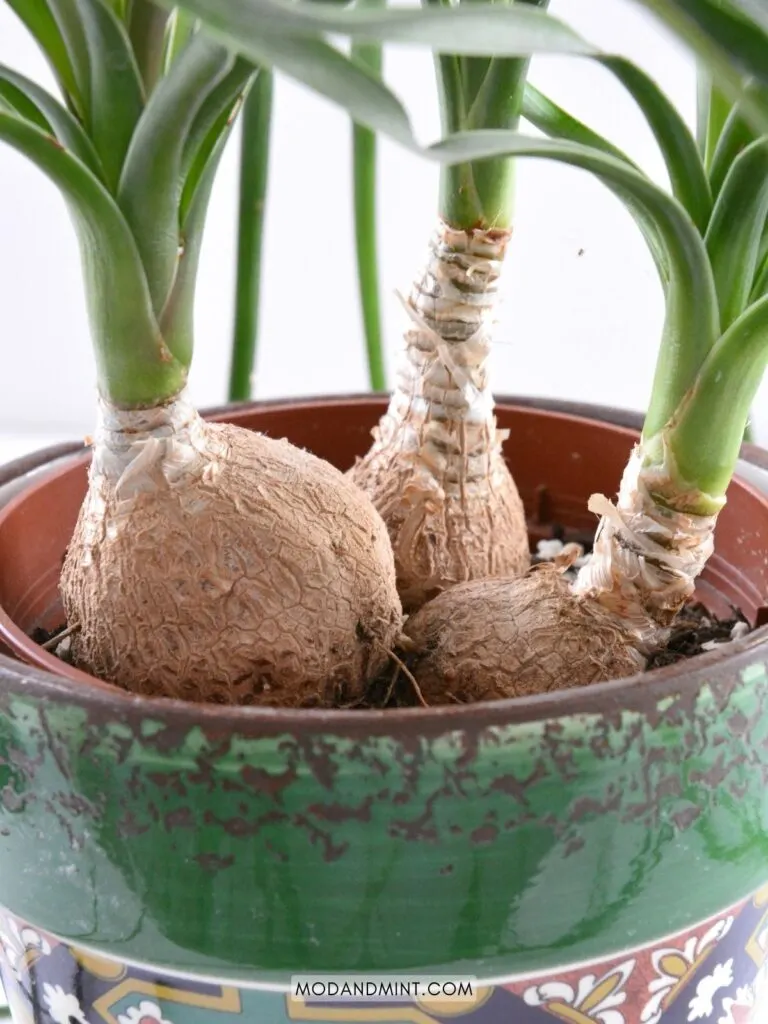
Ponytail palms get their common name from the way their leaves grow up and out as if tied in a ponytail. Another common name is Elephant’s foot plant because of the shape of the bulb on the bottom.


Want to buy a Ponytail palm? Find them for sale on Amazon.
Ponytail Palms
The Ponytail palm is native to semi-desert areas of southeastern Mexico. It is part of the Agave family and a so-called caudex plant. This means it forms a water-storing succulent caudex, or bulb, at the base. More on this later.
Need a plant care refresher? Check out the Beginners Guide to Houseplant Care.
Plant nurseries or garden centers will often plant multiple bulbs close together in the same pot. This way your plant looks fuller from the start. It can be a bargain to buy ‘one’ plant and turn it into multiple new plants.

Light Requirements
Growing in the desert, ponytail palms are used to being in full sun. In your home, give it a place where it gets as much light as possible. Indoors they like a lot of bright, indirect light.
Your ponytail palm can also survive in a low light, partial shade situation. But it is best to give it at least a few hours of (morning) sun to do really well.
Watering
Ponytail palms grow a large bulb, a caudex, at the base of their trunk. This succulent caudex is where the plant stores water for possible periods of drought.
When the plant is still small, the bulb looks more like an onion than an elephant’s foot. As the plant matures, the base of the trunk will grow wider and thicker.
The caudex will feel firm and full when it has just been watered. The bulb will shrink, shrivel, and look and feel deflated when the plant is thirsty.
Overwatering is the most common problem in ponytail palm plant care. To prevent overwatering, don’t water too often. Allow the soil to dry out between waterings.
If you are uncertain you can use a moisture meter to help you out with when to water. And read up on How to water indoor plants for all about proper houseplant watering.
Water very sparingly in winter. Water it just enough to make sure the bulb doesn’t completely shrivel up.


Soil and Repotting
Every two to three years repot in spring when the plant is actively growing. The soil will have lost its nutrients and will need to be replaced with fresh well-draining potting soil. A succulent type soil is a good choice for this plant.
If your plant has outgrown its pot, repot it in a pot one size bigger than the original. Try to give the plant about an inch of space around the trunk. Keep about half of the caudex above the soil. Don’t completely cover the bulb.
Make sure the new pot has drainage holes on the bottom. Without those, excess water has no way to get out and will drown the roots.
In need of a repotting reminder? Follow the steps on how to repot your plants.
Pruning
You don’t have to trim the leaves of your ponytail palm. Just let them grow and cascade down as they would in nature.
If you do want to trim the leaves, you can. Your plant will be fine. Just don’t prune more than one-third of all the leaves at once. Cut at an angle. That way, it will show less that the leaves have been cut.
The evergreen leaves are long and grass-like. Use caution when trimming or repotting because the leaves have sharp serrated edges which can irritate your skin.
Ponytail Palm Propagation
Mature ponytail plants grow bulb offsets from the base. Propagating by separating these baby pups is very simple to do.
How to Separate Ponytail Palm Bulbs
Make sure the baby offsets are at least about 4 inches tall before you remove them. By then they have most likely already formed their own roots.
- Take the plant out of the pot and remove some soil to expose the bulbs.
- Gently tease the roots apart. Carefully separate the bulbs, trying not to damage the roots too much.
Or use a clean, sharp knife to make a straight cut in between the bulbs you want to separate. - Allow the roots to rest and heal for at least a day.
- If working with young offsets that don’t have a lot of roots yet, apply a bit of rooting hormone to encourage stronger and faster-growing roots.
- Pot the baby plants up in their new pots, keeping about half of the caudex above the soil.
Keep in bright, indirect light, and moderately moist soil until you see new growth. At that point, resume regular care.


Yellow Leaves
It is normal for older leaves to eventually turn yellow, then brown, and finally dry up and fall off. As long as new leaves are still growing from the crown, it is all just part of the life cycle of your plant.
When more leaves suddenly turn yellow, it is most likely caused by overwatering. Watering too often and not letting the soil dry out can result in root rot. If roots rot, they lose the ability to absorb water and can’t supply any water to the plant. You might notice drooping leaves and a soft caudex happening simultaneously.
Remove the yellow leaves and hold off on watering for a bit while you let the soil dry out.
If the situation is bad, you might need to remove the soil and inspect the roots. Remove any black, rotted roots. Carefully repot and adjust your watering schedule going forward.
Brown Leaf Tips
Brown leaf tips usually occur when the plant is either underwatered or the humidity is too low. Investigate and adjust going forward.
You can safely trim off brown tips, or remove any leaves that have turned yellow or brown. These leaves won’t recover.
Mushy Caudex Bulb
If the caudex of your ponytail plant is soft and mushy, it is most likely because of overwatering. Watering too often causes rot. It will start at the roots and proceed to the caudex.
If the inside of the bulb has started rotting, it may not recover. But if you catch it in time you might be able to still rescue your ponytail palm.
Gently remove the plant from its pot and inspect the roots. You want firm, white, healthy roots. Black, mushy, possibly smelly roots are rotted and won’t survive. If there are still some healthy roots, proceed. Remove all the rotted roots first. Put the plant in well-draining soil and move it to a warm spot with bright, indirect light. Water very sparingly.
It will take some time to recover. Wait for new, healthy growth. At that time resume regular care. Beware of overwatering again.
Are Ponytail Palms Toxic to Cats?
I have yet to meet a cat that doesn’t like to chew on a ponytail palm. Just like spider plants, those green grass-like leaves attract almost every cat.
Fortunately, ponytail palms are not toxic. It is safe to grow at home around your cats or dogs. You just might want to keep it out of reach, but in this case, it will be more to protect your plant than your pet.
Jeanette
Monday 30th of October 2023
My palms are 50 yrs old grew to the ceiling had to cut down and doing great I put a little short fence so my cats can't chew on rhem
Mod and Mint - Deborah Green
Tuesday 31st of October 2023
Hi Jeanette, Your plant sounds amazing! Our cat is also very much attracted to the grassy type leaves and will munch on them if she gets the change. A little fence around it is a great idea!
Sherry
Sunday 3rd of April 2022
Tickled with my Ponytail Palm recvd from Amazon! Didn’t realize there can be multiple “elephants feet” in one pot. Looking forward to growing the little Ponytails into nice big plants? ThNks for the info!
Summer binde
Sunday 13th of February 2022
My ponytail is in a 10 inch nursery pot and there's a few roots coming from the bottom holes. However currently the trunk has 2 inches or more from the side of the pot. If I up it to a 12 inch will it be too much room I know they like to be snug in Their pots.
Katherine Nightingale
Tuesday 11th of January 2022
Mine (ceiling height) has a pup growing from the middle of the trunk, not from the bottom. I'm not sure if I need to take it off, and if so, how? Thank you
Star Roche
Monday 6th of December 2021
Hi 👋. I have a ponytail plant I bought when it was 8- 10 inches tall, (about 10 years ago) it's now about 5 1/2 ft or taller. I haven't been able to repot it in about 4_ 5 years. The soil doesn't look real good. I can't repot it, to heavy and big. Friends won't help because they say, if it dies.......... can I take some of the old soil and replace it with new? How do I do that? I'm afraid I might damage the roots. It mist definitely needs repotted or renewed soil. It's a beautiful plant and I want it to continue to thrive for years to come. Any info you can share would be greatly appreciated. Thank you.