
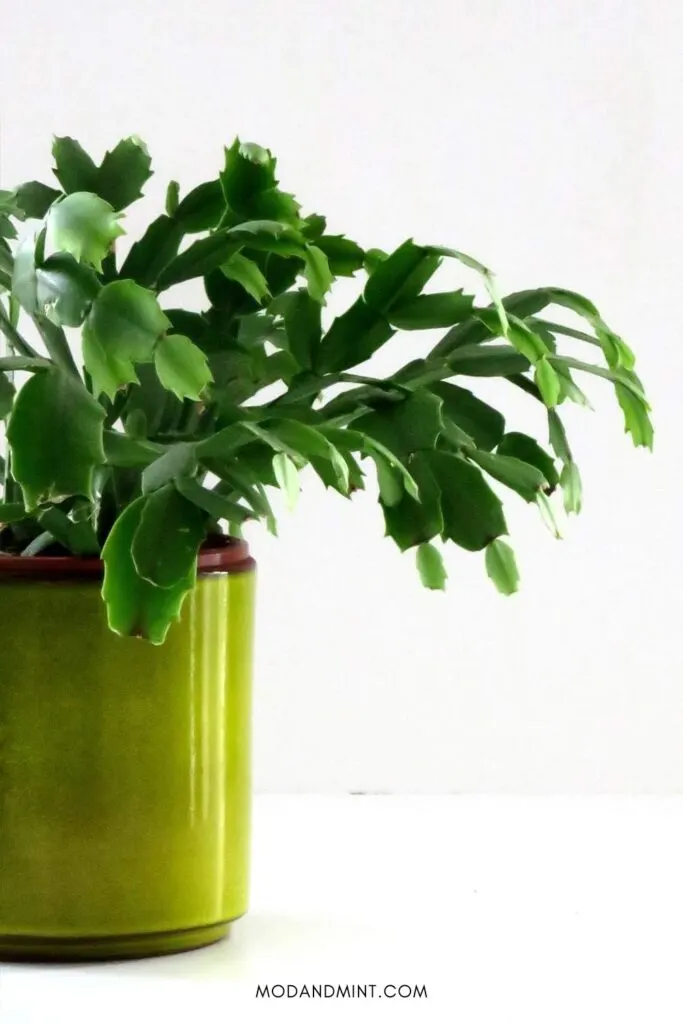
The Thanksgiving Cactus (scientific name Schlumbergera truncata) is a popular holiday houseplant native to Brazil, known for its segmented stems and bright, tubular flowers that bloom around the Thanksgiving holiday.
This winter-flowering plant is popular for its low maintenance requirements and its ability to add a splash of color to indoor spaces during the colder months.
This plant guide has easy-to-follow care tips on how to get your Thanksgiving cactus to grow flowers, and the basics of water, light, humidity, propagation, and more.


Looking to buy a Thanksgiving cactus? Find it for sale on Amazon!
Thanksgiving Cactus Care
The native habitat of the Thanksgiving Cactus are the coastal mountains of south-eastern Brazil. There they grow as epiphytes in rainforests, particularly on tree branches or in rocky areas with high humidity.
The plant has adapted to these conditions with segmented stems that store water and aerial roots that allows it to anchor onto other plants or rocks, absorbing nutrients and moisture from its surroundings.
Scientific name: Schlumbergera truncata. Common names: Thanksgiving cactus, Holiday cactus, Crab cactus.
The Thanksgiving cactus is a classic heirloom plant. Cherished, passed down through the generations. Its popularity is no mystery: it’s a low-maintenance houseplant, safe for pets, and incredibly simple to propagate.
Basic Succulent Care Refresher: Beginners Guide to Succulent Care.
Is Thanksgiving Cactus Toxic to Cats?
The Schlumbergera truncata Thanksgiving cactus is considered non-toxic. It is safe to grow at home around your cats or dogs.
However, it’s always a good idea to prevent pets from chewing on houseplants, as it can cause mild digestive upset.
Light Requirements
In general, provide your Thanksgiving cactus with plenty of bright, indirect light.
Since the holiday cactus comes from a low-light spot in the rainforest, you want to protect it from too much direct sunlight indoors.
The leaves will change color turning red or purple in very bright light conditions. Move it away from the window a bit or protect it with a sheer curtain to give it some shade from afternoon sun. Leaves will stay greener in low light.
Read more: How much sun do succulents need?
Watering


Thanksgiving holiday cacti are used to growing in a humid environment, on moist soil. They are not as drought-tolerant as most other cactus plants are.
They can be especially thirsty during the flowering period, so water generously.
The succulent stems on a Thanksgiving cactus do store water inside and should feel firm. The first signs of an underwatered Thanksgiving cactus are soft, wrinkled leaves. Dehydrated leaves feel thin and shriveled. Give your plant a thorough watering and the leaves will firm back up.
At the same time, be careful not to water too often. Overwatering is the most common problem with these plants and can lead to root rot. Signs of overwatering include soft, mushy leaves that turn yellow before going brown or black.
When in doubt, hold off on watering. It’s easier to fix underwatering than overwatering. If you’re unsure, a moisture meter can be a valuable tool to determine when to water. For comprehensive watering guidelines, check out our resource on How often to water succulents.

Pruning
Pruning a Thanksgiving Cactus can help maintain its shape, and enhance its overall health. It also encourages branching out and makes the Thanksgiving cactus fuller.
The stems of a Thanksgiving Cactus are made up of connected segments. Choose the parts you want to remove. Usually, at least two new segments will grow from where you pruned it.
The best time to prune a Thanksgiving cactus is in spring through summer or right after it has bloomed.
Avoid pruning too much at once. Do not remove more than one-third of your plant’s growth. Plants need their leaves to grow and thrive.
Thanksgiving Cactus Propagation


The easiest way to propagate a Thanksgiving cactus is by taking stem cuttings and rooting them in water or soil.
To propagate in soil, remove a cutting from the plant. Gently wiggle until it comes loose. Or use a clean, sharp pair of scissors or pruning shears, to make a cut between the segments.
Let the cutting dry and callus over for about 2-3 days. Dip the ends in rooting hormone. This powder helps the roots to grow faster and stronger and prevents fungus growth. If you don’t have any, you can skip it. The process just might take a little longer without it.
Plant the cuttings about an inch deep in well-draining succulent soil. Place them in a bright location with indirect light.
Water very sparingly until you see new growth. At that time, continue with regular care.


If you like to see the roots grow, you can choose to root the cuttings in water before you plant them in soil.
Want to learn more about propagation? Read the complete guide to succulent propagation and get all the details on the 6 different ways to propagate your plants.
How to Get a Thanksgiving Cactus to Bloom


First of all, patience is key. Thanksgiving plants can flower when they reach maturity, which is usually around 1 to 2 years of age.
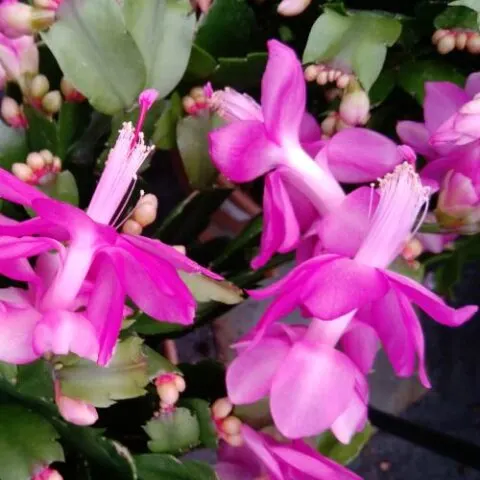
Once mature, they can produce colorful flowers, ranging from whites, pinks, reds, and purples to even two-toned varieties.
The flowers unfold somewhat similarly to the graceful flowers on a fuchsia plant. Their outer leaves gently curl backward toward the stem, creating an interesting tubular shape.
For precise holiday cactus flowering, you can give your plant a ‘dark treatment’. You put your Thanksgiving cactus in the dark to regulate light and temperature and encourage blooming. Perfect for those aiming for a Thanksgiving flower spectacle.
Continue reading, at the end there are step-by-step instructions on how to do such a dark treatment to get your Thanksgiving cactus to bloom.
Alternatively, you can let nature take its course. As fall approaches and daylight hours decrease, your plant may bloom on its own, though the timing may not align precisely with the holiday season.
Flowering can
Flower Buds on a Thanksgiving Cactus


As your Thanksgiving cactus begins to form flower buds, keep it warm and humid while keeping the soil consistently moist.
Don’t relocate plants when they are growing flower buds. Especially not somewhere with different light conditions or temperatures. These holiday cacti are sensitive to change and may respond by dropping flower buds.
Additionally, flower buds have a natural tendency to follow the light source. Movement or rotation of the plant can cause the buds to twist and ultimately drop off. Therefore, it’s best to minimize their movement.


How to Get Thanksgiving Cactus to Bloom (Dark Treatment)
In nature the Thanksgiving cactus is triggered to bloom as the days shorten and temperature drops.
At home, you can mimic this by giving your plant a dark treatment and get your holiday cactus to grow flowers indoors.
To induce flowering, start the dark treatment 6-8 weeks before desired bloom time.
Materials
- Thanksgiving Cactus
- Dark location, closet, or box large enough to cover the plant.
Instructions
- To mimic shorter days, place your holiday cactus in a dark room or closet for 12-14 hours daily. You can also place a box over your plant each night around 6 p.m. and remove it the next morning when you wake up around 8 a.m.
- Provide your plant with cooler night temperatures. Keep it in the range of 50-65 °F (10-15 °C).
- If you can’t get the temperature cool enough, increase dark time to compensate.
- Water less frequently than normal.
- When flower buds appear, you can stop the dark treatment.
Recommended Products
As an Amazon Associate and member of other affiliate programs, I may receive a commission from qualifying purchases at no additional cost to you.

Related Reading: Common Holiday Cactus Care Problems – Difference between Christmas, Thanksgiving and Easter cactus.


Kelley
Saturday 11th of November 2023
What is the difference between the Thankgiving cactus and the Christmas cactus? I don't see any difference.
Mod and Mint - Deborah Green
Tuesday 14th of November 2023
Hi Kelley, I've wrote a (short) article all about the differences between the Thanksgiving and Christmas cactus. Scroll to the bottom there for a photo of the leaves for easy identification. Hope that helps!
Helen
Thursday 24th of August 2023
some of my plants are living but not growing, what can I do to help them grow?
Carol
Saturday 4th of February 2023
My fishbone cactus is doing well, it was propagated from a leaf approximately 8 months ago. It has recently developed many aerial roots appearing along the leaves. To me the roots are unsightly and detract from the beauty of the plant. Will cutting off these roots damage the plant? Thanks, Carol
Carolyn Boling
Wednesday 11th of January 2023
I would like to order a start of an Easter Cactus. Do you sell them?
Mod and Mint
Thursday 12th of January 2023
Hi Carolyn, I am sorry, I do not sell plants, I just teach people how to care for them!
Carolyn Boling
Wednesday 11th of January 2023
I have the most beautiful plants and they bloom and bloom. I do have one that was sort of a rose pink color last year. This time it was a pale pink but still had a few darker pink mixed it. This is the first time I ever saw one change colors. Is this common?
Mod and Mint
Thursday 12th of January 2023
Hi Carolyn, Yes it is known to happen that holiday cactus flowers can change colors when they bloom multiple times. It can be caused by changes in growing conditions like light, temperature, and fertilizer. It can also be that your plants were hybrids and are reverting back to the original dominant color. It is nothing to worry about!