Strawberry Begonia Care Guide (Saxifraga stolonifera)
The Saxifraga stolonifera is commonly known as Strawberry Begonia and is an easy-to-care-for hanging house plant.
The ordinary strawberry begonia grows green, rounded leaves with light green, silvery veins. The variegated strawberry begonia (Saxifraga stolonifera tricolor) has green leaves with white and pink variegation around the scalloped leaf edges.
Both the regular Strawberry Begonia and the variegated Strawberry Begonia require the same care. Provide them with bright, indirect light and water regularly to keep the soil slightly moist.

Want to buy an Strawberry Begonia? Find it for sale on Amazon!
Strawberry Begonia
The Strawberry Begonia is native to East Asia. In nature, this plant grows on forest floors and in between rock crevices, in shaded, moist areas.
Although called Strawberry Begonia, it is neither a Begonia nor a strawberry. The plant does have leaves similar to a Begonia, and resembling heart-shaped leaves of a strawberry plant.
Scientific name: Saxifraga stolonifera. Common names: Strawberry Begonia, Strawberry Geranium, Mother of Thousands.

Basic Plant Care Refresher: House Plant Care for Beginners.
Light Requirements
Indoors the best place for your Strawberry Begonia plant is in a spot where it gets two to four hours of morning sun and bright, indirect light the rest of the day.
The variegated Strawberry Begonia Tricolor needs at least three hours of direct sunlight to prevent it from getting leggy and losing the pretty variegation. If the leaves are fading, your plant is not getting enough light. To enhance the color, move to a spot where it will get some (indirect) sun.
Avoid too much direct sunlight, especially on hot summer days. Dry, brown spots and holes in the leaves can be a sign of sunburn. Move your plant further away from the window, or filter the light with a sheer curtain.

Watering
In its natural habitat, the Strawberry Begonia plant is used to grow on moist soil.
In your home, water your Strawberry Saxifraga regularly to keep the soil damp, but not soggy. The soil should feel like a wrung-out sponge.
If the soil feels moist, don’t water but wait one or two days and check again. If the soil is dry, go ahead and water thoroughly to saturate all of the soil. Let all excess water drain out of the bottom of the pot. Then allow the top two inches of soil to dry out before watering again.
If in doubt, don’t water yet. An underwatered plant is easier to revive than an overwatered plant. But do not let the soil dry out so much that the leaves start to get crispy and brown on the edges.
Use a watering can with a long spout to reach the soil and not get any water directly onto the leaves. The leaves have tiny hairs on the surface, much like an African Violet plant. Getting these fuzzy hairs wet can lead to fungal issues.
Reduce water in the winter, providing just enough to prevent the soil from drying out completely.
If you are uncertain, you can use a moisture meter to help you out with when to water. And read up on the basics of watering your indoor plants.

Fertilizing
Use a diluted liquid plant fertilizer to feed your Strawberry Begonia once a month in spring and summer. Be sure the soil is damp before fertilizing and don’t fertilize in winter when growth slows down.
Also never fertilize if your Strawberry Begonia plant is recently repotted or is having problems. Fertilizer gives your plant a boost of nutrients when it is actively growing. It is not plant medicine.

Humidity
Strawberry begonias can grow in average household humidity, but they prefer moderate to high humidity levels. Brown, crispy leaf edges can be a sign that your plant needs more humidity.
The regular green Strawberry Begonia grows best if kept fairly cool. The variegated Tricolor likes normal warm room temperatures.

When to Repot
Repot in spring in a pot one size up when roots have filled the pot, or when you see roots growing from the bottom of the pot.
Even if your plant still has room to grow, you want to refresh the soil every two to three years in spring. The soil will have lost all its nutrients and will need to be replaced with fresh soil.
A good choice for your Strawberry begonia is a regular houseplant potting soil with pumice or perlite mixed in to help aerate the soil and improve drainage.
Make sure the new pot has drainage holes on the bottom. Without those, excess water has no way to get out and will drown the roots.
In need of a repotting reminder? Follow the steps on how to repot your plants.

Strawberry Begonia Propagation
The Strawberry Begonia can be propagated from seed or by division, but the easiest way to propagate is by rooting the small baby plants.
Mature plants send out long stolons, threadlike runners with little plants growing at the tips.
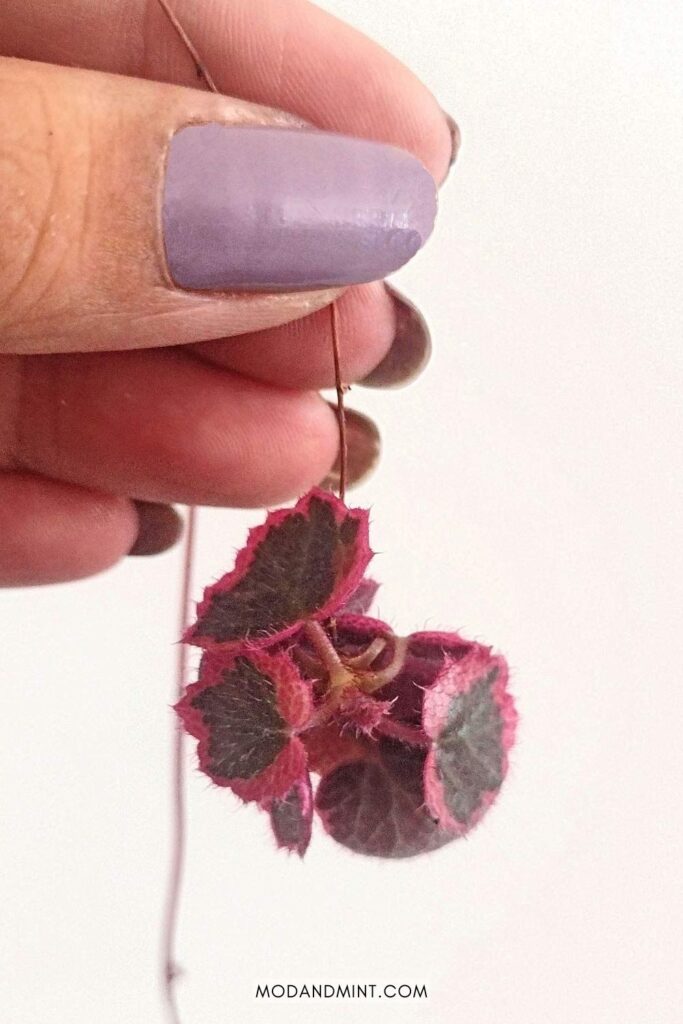
The runners emerge from the center of the plant and can grow a few feet long. They may occasionally divide into several threads.
Choose the largest, healthiest baby plants and remove them from the runners. Plant them individually into small pots in slightly damp soil. Place them in indirect light in a warm room. They will root within a few weeks.
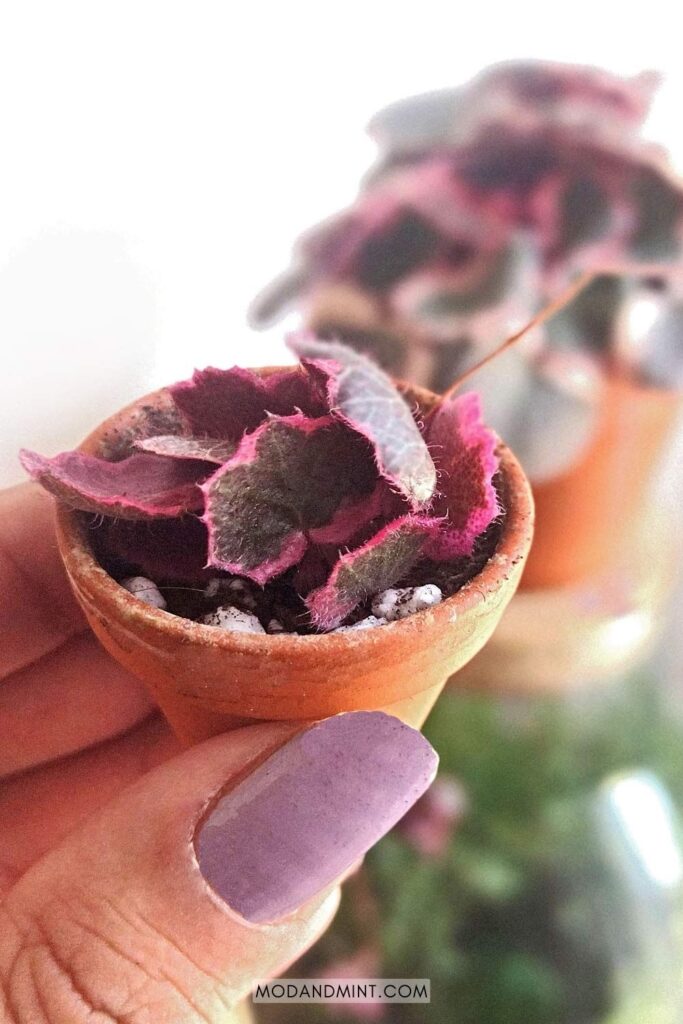
Another method is to keep the baby plants attached to the runner while propagating. Just like you can do with baby spider plants.
Place a small pot beside the parent plant. Don’t remove the baby plant from the runner. Position the plantlet onto the small pot. You can use a piece of bent wire to anchor the plantlet if needed. Wait until it has grown roots before detaching from the parent plant.
Flowers on a Strawberry Begonia
Strawberry Begonias can bloom indoors if their growing conditions are just right. Don’t worry if your plant doesn’t bloom. Many indoor Strawberry begonias don’t flower at all.
If they do, it is usually in spring or early summer. The flowers are small, white, or pink and grow in clusters on tall, slender flower stalks. When the blooms fade, you can prune these stalks.
Pests
Watch out for common pests like mealybugs, spider mites, and scales.
Regularly inspect your plant for any signs of bugs to detect a possible infestation before it becomes severe. Thoroughly check under the leaves where insects tend to hide.
Learn more about common houseplant pests and what you can do to get rid of them.
Is the Strawberry Begonia Toxic to Cats and Dogs?
The Saxifraga stolonifera is considered non-toxic. As mentioned before, the Strawberry Begonia is not a real Begonia. Those are poisonous.
The leaves are considered to be antibacterial and anti-inflammatory and have been used in herbal remedies in ancient Asian medicine.
Learn more about the risks of toxic houseplants around your pets (and find out which other plants are non-toxic and safe!).
Want more round leaf plants? Check out this list of stunning round leaf plants!