
Tradescantia Care (Spiderwort Wandering Jew Plant)
Tradescantia Spiderwort is an easy-to-care-for vining house plant that grows vibrant leaves and dainty, spider-like flowers.
For optimal growth, place your Tradescantia in bright, indirect light, plant in a well-draining potting soil, keep it consistently moist but not soggy, and maintain high humidity.
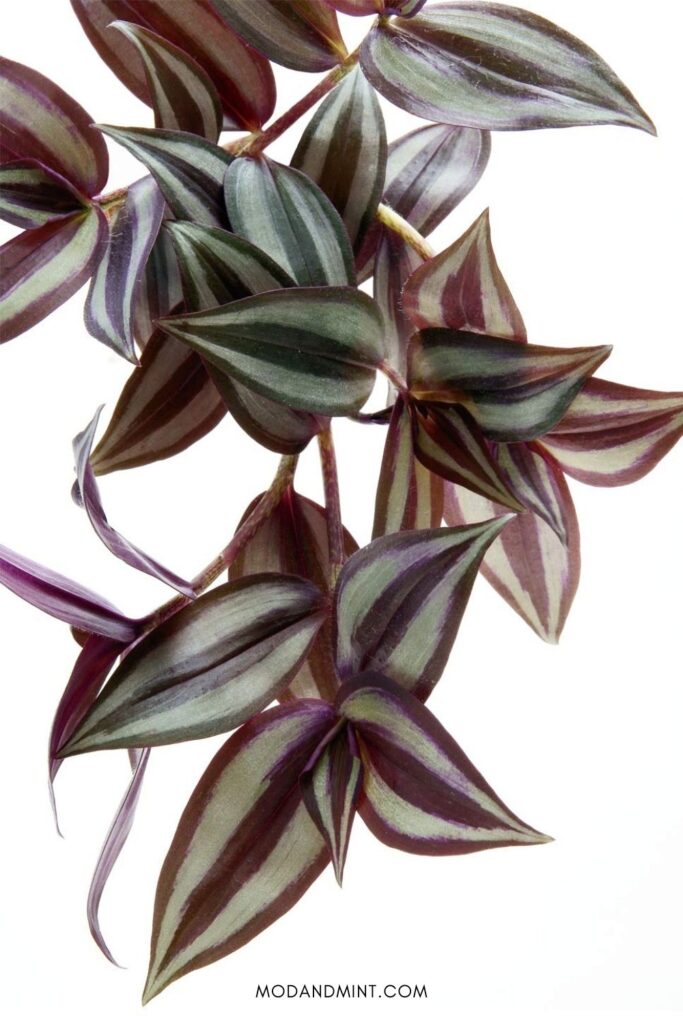
Tradescantia Plants
Tradescantia plants are native to the Americas, primarily found in various regions of North and South America.
They like bright, indirect light, moist soil, and high humidity. If you can give your plant the right care, it might start flowering and grow small pink or purple flowers that last just one day.
Want to grow your own Tradescantia plant? Find it for sale on Amazon!

New to indoor plants? Start with our beginner’s guide to house plant care.
Tradescantia Varieties
There are about 70 varieties, the most common being the Tradescantia Zebrina, with green leaves and silver stripes, and the purple spiderwort, the Zebrina burgundy.
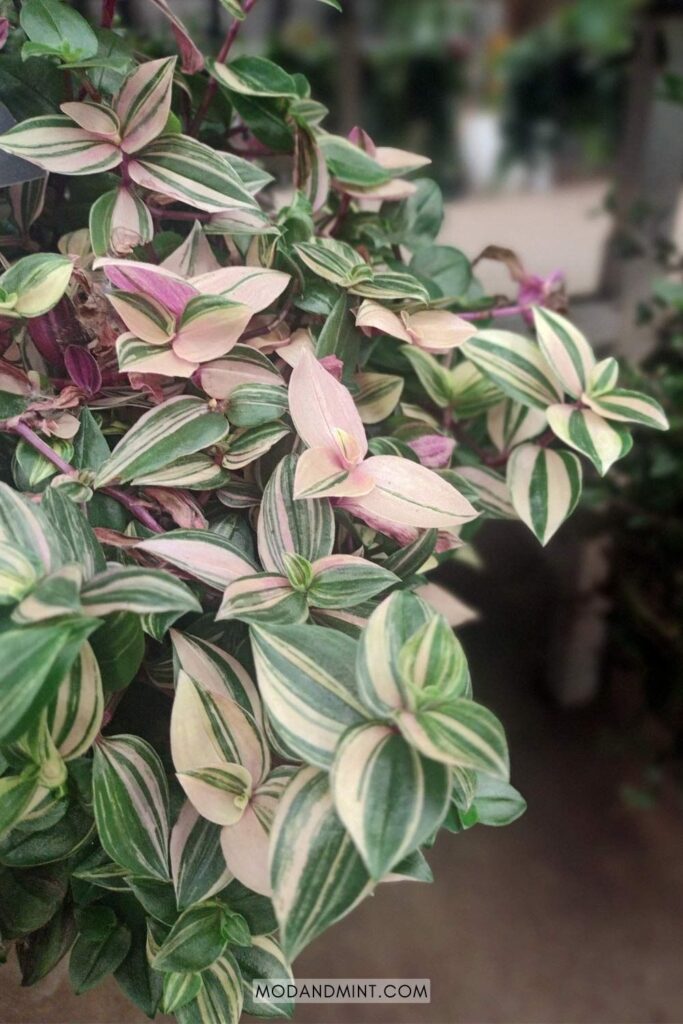
There are pink and lilac variegated types like the Tradescantia fluminensis tricolor and Tradescantia Nanouk.

Tradescantia Wandering Jew Name
Although there are multiple common names for the tradescantia plant, for a long time the most commonly used name was the Wandering Jew plant. It is still being used by a portion of people but for a growing group of people, this name raises a few eyebrows.
Why is the Tradescantia commonly called a Wandering Jew? There are a few different stories that go around.
Some say that it got the common name Wandering Jew, because of the wandering way it grows. It spreads quickly, with sections of stem all growing in slightly varying directions, wandering about.
Others say it was because propagated cuttings of the plant were passed on to friends and family like wanderers traveling the world.
But this just explains the Wandering part. The Tradescantia could have just been called the Wandering Plant. Why the Jew part?
I wasn’t there when the name was first used, but the explanation most often heard is that of an old Christian myth about a Jew who was said to have had a bad attitude right before the crucifixion, mocking Jesus. It is said that Jesus responded by condemning him to wander the earth until the second coming.
In recent years the name Wandering Jew is used less frequently. People use the alternative Wandering Dude, or Spiderwort. The official name Tradescantia is also being used more and more.

Light Requirements
Tradescantia plants grow best in bright, indirect light. Provide your plant with enough light to keep its color and maybe even flower. The ideal location is an east or west-facing window. This gives your plant enough light in the morning or late afternoon, and plenty of bright indirect light the rest of the day.
Avoid too much direct sunlight. This can scorch the delicate leaves, leaving dry brown spots that won’t heal. Move your plant away from the window, or filter the light with a sheer curtain.
If the light is too dim, growth will slow down, leaves stay smaller and maybe lose variegation (if they had any). Vines may also grow leggy with more space between the leaves reaching for the light. Pinch off the leggy stems and move your plant somewhere with more light.
Consider getting a plant grow light if your home doesn’t receive enough natural light.
Watering
Water your plant regularly to keep the soil slightly moist. The soil should feel like a wrung-out sponge.
Check and when the soil feels moist, wait for one to two days and check again. If the soil is dry, go ahead and water generously, saturating the soil. Let excess water to drain out of the bottom of the pot. Then allow the top layer of soil to dry out before watering again.
Overwatering is the most common problem. To prevent overwatering, don’t water too often. If you are uncertain, you can use a moisture meter to help you with when to water.
Watering too often can lead to yellow leaves and root rot, while underwatering can cause the leaves to droop, wilt, turn brown, and dry out. Leaves should feel firm, not limp.
Read more: The right way to water your indoor plants.

High Humidity
Tradescantias like warm temperatures and moderate to high humidity. Brown, crispy leaf tips are often a sign that your plant needs more humidity, a common problem for these plants.
The best way to raise the humidity is to place a small humidifier near your plant. For even more humidity, grow your tradescantia in a closed terrarium.

Soil and Repotting
Repot every two to three years in spring when the plant is actively growing. The soil will have lost its nutrients and will need to be replaced with fresh well-draining potting soil.
Transplant in a pot one size up if the plant has outgrown its original pot. Roots will have filled the pot or grow from the bottom of the pot.
Proper drainage is essential, as Tradescantia plants are susceptible to root rot if the soil stays consistently soggy. Make sure the new pot has drainage holes and that excess water can escape.
Read more: Step-by-step guide on how to repot your house plants.

Pruning
Pruning should be part of the regular care routine. It helps maintain the shape, encourages bushier growth, and prevents leggy or overcrowded growth.
Pinch back the tips of the stems. Simply use your fingers or pruners to snip off the tips of the stems just above a leaf node (the area where leaves are attached). This prompts the plant to produce new side shoots.
Don’t prune too excessively at once, as plants recover better from gradual and moderate pruning.
Tradescantia Propagation
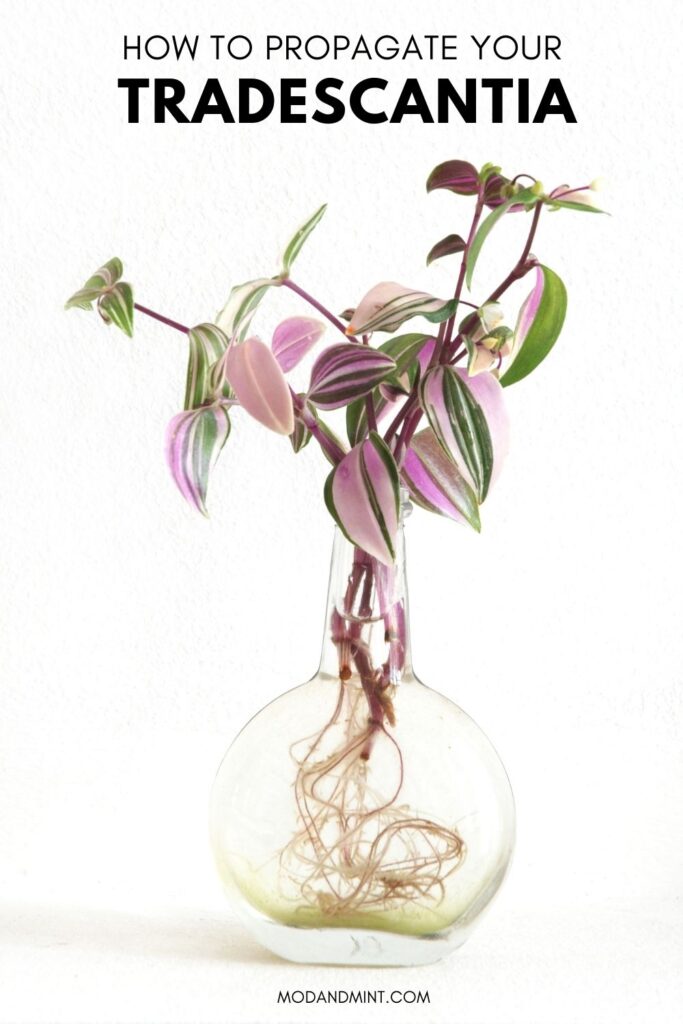
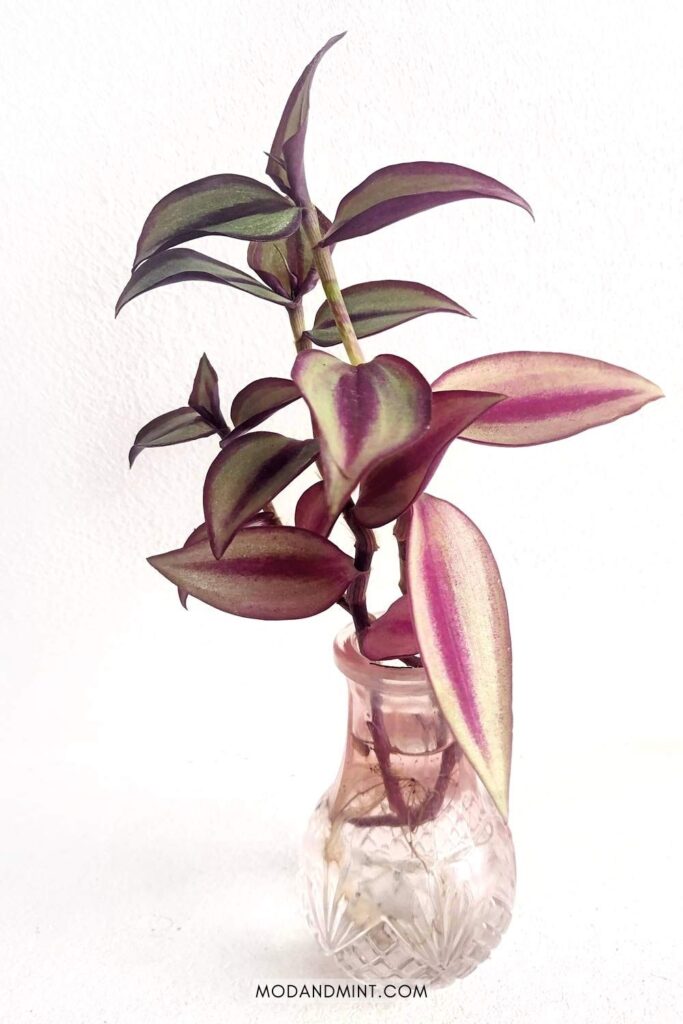
The easiest way to propagate a Tradescantia is by taking stem cuttings and rooting them in water or soil.
Take cuttings with a few leaves and remove the leaves from the lower part of the cuttings.
- To water propagate the cuttings, place them in water and in bright, indirect light. Change the water regularly and transplant to soil when roots have grown to about 1 – 2 inches.
- To propagate in soil, plant the cuttings in a small pot with well-draining soil. Keep in bright, indirect light. Mist or water very sparingly until you see new growth.
To speed up the propagation process, you can apply a rooting hormone powder to the cutting before planting it. This powder stimulates the formation of roots and results in stronger, better-rooted plants.
Read more: 6 ways to propagate your favorite house plants.

Variegated Tradescantia Care
Variegated variations like the Tradescantia Zebrina, Tricolor, or Nanouk can lose their pink or lilac variegation and turn solid green for different reasons.
Pink coloration often fades when the plant grows in insufficient light. It can also happen when it is too hot or too cold for the plant to grow its variegated leaves.
When the plant does not have the right conditions, it will revert to growing solid green leaves because it is trying to save its energy. Growing those beautiful variegated patterns costs a lot of energy it just doesn’t have.
When the variegated leaves start turning a solid green, get pruning! Green leaves grow faster than variegated ones, so if you do not prune them, they will take over your entire plant. When all the solid green leaves are pruned, move your plant to a spot where it gets more light.
Related reading: How to fix common Tradescantia care problems.

Are Tradescantia Plants Toxic to Cats?
According to the ASPCA, the Tradescantia is considered mildly poisonous when ingested. It may cause skin irritations.
Although it is uncommon for pets to get seriously hurt from eating plants, keep this one out of reach of children and pets.
Read more: Indoor plants safe for cats.


I have a Wandering Christian plant. The history of the name comes from Jews being kicked out of Spain by the Christians during the Spanish Inquition; when they were murdered and kicked out of Russia during the programs; when they were rounded up and gassed and burned in ovens, all by the Christians! I really love my Wandering Christian plant!
That’s so interesting, thanks for sharing!
@Jacqui,
I worked in a florist the owner always referred to Tradescantia as the Wandering Sailor. Very English, I thought. :))
@Mod and Mint, a name that is becoming more common these days is Wandering Dude
Oh, that’s a good one! Thanks for sharing!
@Mod and Mint, I don’t get why we’re renaming the plant. Is “Wandering Jew” offensive to Jews? I’m a Jew and it doesn’t offend me at all. It doesn’t offend any other Jews I know. Why would we be offended at folklore that isn’t even part of our belief system?
I imagine most people who find it antisemitic are Christians, because the Jesus-related folklore means something to them. They’re offended on our behalf… even though it means nothing to us.
@Janine,
My mom was a Christian and she always told me that the name Wandering Jew was a term of respect to Israelis because their forced wanderings. Israelis not only survived but thrived like the plant does. Never a slur in our home. I have 3 varieties of this beautiful plant.
Hello Deborah,
Love your article. It took me a while to find an informative one on Tradescantia fluminensis Tricolor. I recently got one from a friend of mine. It’s bushy and long, but only the top has some pink variegation but maybe 5-10% of the whole plant. After reading your article, I suspect that she didn’t leave it in enough light, and didn’t prune away the green non-variegated leaves. I am just wondering, if I start pruning away the green non-variegated leaves, can I nurse this plant back to its pink variegated state? My bright urban apartment is south-west facing with large glass windows. It can get lots of bright indirect sun away from the windows. Please advise.
Hi Lindsay,
You are saying all the right things. I would definitely give it more light. And you can prune away the green leaves.
But that will be most of your plant.
You could also try to propagate it by division. Take your root ball and carefully separate the part that still has the pink variegation.
This will leave you with a small pink Tradescantia, and you have the rest of the plant still intact to grow and keep as a green Tradescantia.
Good luck!
Can a solid green cuttings from a tricolour tradescantia still produce a pink variegation?? Or it wont anymore?
Hi Prinsesa,
I’m sorry to say, but once a plant loses its variegation and goes back to green, it won’t get its former variegation colors back. *sadface*
Hi Deborah, thanks so much for such a useful article.
I’ve been growing Tradescantia’s for a couple of years and a friend gave me a new one, which seems to have brought some problems with it. Unfortunately these problems have spread to my others plants.
I get strange mottled leaves and brown spots. It’s driving me mad. Any thoughts?
I have photos that I can send over. Any help would be much appreciated 😊
Thanks,
Mel
Hi Melanie, It’s hard to say but if it is spreading to your other plants, it’s definitely an infestation that you want to stop as quickly as possible. Quarantine the affected plants and research what type of pest you are dealing with. Hope you can save your plants!
Can you leave it out side in the winter months Joyce
Hi Joyce, I focus on indoor plants, but yes, you can keep a Tradescantia outdoors. I don’t know where you are, but they like warmer climates and a bright, but partially shaded location.
@Joyce, If you live in zone 9-12 then yes. Any colder and the plant will suffer and die in the winter.
Hi, I have successfully grown my var. cuttings and looking beautiful. My problem is location for these plants during the winter months. Our house is surrounded by trees and no west facing windows. The cuttings rooted very well next to a table lamp, leaves retaining colour. Can I keep the newly potted cuttings in the same location?….
Hi Annie, Good job on growing your cuttings. I would keep a close eys on them when they are getting less light. If you see them struggling, maybe consider getting a special plant grow light. Good luck!
Thank you for the informative article. I bought a nanouk online and when it came, the stems had roots but we’re all welted along with all the leaves on the stem except for the top ones. I put them in soil and the stem started to stiffen up after a few days but all the leaves in the stems all died (Except for the top ones) so I pulled them off. Now I have three super long stems and only leaves on very top. Each stem has about 2 to 3 nodes (from the dead leaves I pulled off). My question is, if I cut one of the stems in half, will the bottom rooted part of the stem grow new leaves if it has no leaves right now? Please let me know what you think I should do. I can send you a pic too. Thank you!!!
Why is my tricolor leaves soft? What could be the reason and solution for it? Thanks so much
Hi Zoe, Without knowing the plant’s conditions and care regime, it’s hard to pinpoint. When you say soft, do you mean wilted amd droopy? Does it get any light? How often do you water? Could it just be thirsty, or have you maybe watered it too often and is that the reason that it’s looking a bit sad?
How long should I allow the wandering Jew stems to grow before pruning? Or should I cut off the long legs that hang down?
Hi Yvette, There is no rule how long the stems need to be before you prune. I cut leggy stems back to where they are not leggy. It will just grow back fuller.
hi there,
i’ve had my tradescantia Nanouk plant for about 3 weeks now. i repotted it because it came in a small nursery pot, but the bigger pot is perhaps still abit on the small side. the plant doesnt seem to be growing. i’ve watered it and it gets quite alot of sun. I see my ivys and spider plant growing quite quickly but this is remaining stagnant. Is this normal, for i read that this is a fast growing plant. thanks!
Hi Margaret, How is your plant doing now? Let me start with the size of your pot. It’s not so that a larger pot size will make your plant grow larger. Too large of a pot even raises the risk of overwatering because there is too much spare soil around the plant, taking longer to dry.
If your plant is just growing slowely right now, but otherwise looking healthy, I wouldn’t worry too much. In the colder winter months, your tradescantia will naturally grow slower.
Nice article. Always was fascinated by the name ‘Wandering Jew’ now I know how it came to be. Always wanted to get me this plant and now I can choose freely from the Plant and Decor
Hi Jimmy, thanks for your comment. And good luck with your new plant!
Hi, how do I get my variegated Tradescantia to turn more pink? Thanks
Hi Ramona, Make sure your variegated Tradescantia gets enough (indirect) light. Less light, less color on the leaves. And if your plant happens to start growing some solid green leaves, prune those out. Good luck!
Hi so I just got 2 wandering jew plants my first they are for a chameleon enclosure they are both in 2 inch pots. So is any required pot size or can they grow successfully in small pots
Hi Victor, I do not have experience with animal terrariums or vivariums. But I do know Tradescantia plants can do well in such an environment. I have seen it in a terrarium grown spread out as a ground cover, but you could also place it somewhere higher and let it cascade down.
You can prune your plant to keep it smaller in size if you want. But eventually, the roots will grow and will want to be in a larger pot. Without seeing them I cannot say how long your 2-inch pots are large enough.
If they do outgrow their pots and you want to keep them small, you could remove them and carefully divide the plant and its roots into two.
Hope this helps, good luck!
I have a wandering jew plant on my kitchen window, it is doing very well, but now it’s getting too big & I don’t have anywhere else to put it, should I hang it up in a hanging string beside the window?
Hi! I’ve had one of these beautiful plants for a few months now. It was doing great until recently when I started noticing some brown spots forming on a few leaves. They are mostly on the leaves closer to the top and it appears to be slowly spreading. Help!
Hi there, I was hoping you can help me with my wandering Jew nanouk? I’ve come across many forums and yours seems to help me the most! Most of the stems/ stalks of the plant are growing thick and beautifully, however, I have three smaller stems (just began to grow) that are thin and soft. I’ve re-potted to ensure the plant is not root bound or having root rot, she’s on a south facing window and gets plenty of indirect sunlight, and I water every week. I’m not sure what to do anymore I’ve looked almost everywhere and can’t find any advice on what to do with thin stems. Please help me, what should I do?!
I just bought my first 2 WJ Tradescantia Variegata plants. They are both solid green. The identity card shows they should yellow and white bands. Reading this page has enlightening me on their care but my question is if I’m to prune away the green areas I wouldn’t have any plant left as the whole thing is green-both of them. What do you suggest I do?
My tradescantia Zebrina is over 2 feet tall and refuses to trail downwards. The only explanation I can think of is the window it was sitting in front of had sunlight coming from up above so the stems were reaching upwards to get more light? I’ve moved it to an shelf next to the window a little higher in hopes that the stems will bend downward to catch the sunlight but I know I’m risking the variegation to weaken without it being in more light. I’ve never seen a Zebrina get this tall before without any sign of trailing down haha someone please help! Also, not sure if this means anything, but the stems are VERY thick and sturdy… I’d say they’re about a half inch thick if you can believe it. Maybe gravity will eventually win and they’ll start to fall? Who knows.
Hi Erika, thanks for your story. It could definitely be that your plant is growing towards the light. Another thing I’m thinking about, could it be possible that you have a Tradescantia Nanouk instead of a variegated Zebrina? They look a lot alike. The nanouk is specially cultivated to have shorter, thicker stems among other things, to make it easier to care for. There is a photo in the article you can check out. The nanouk grows more upright and bushy.
My Nanouk plant is getting some brown spots on the leaves .. what am I doing wrong?
Hi I have a pink variegated tradescantia and it’s growing with veriegation but those parts are not pink anymore, they are dark green and light green/ yellow. Why is this? Or will they mature into pink?
I propagated some cutting from my lavender tradescantia. The mother plant has large leaves, however the propagated cuttings are growing much smaller leaves. Why is that?
I love the Tradescantias have several. I love your article. Many things I didn’t know. I have the tri color and the multi color Discolor. I know they say too remove the green stems. But I actually think it makes the plant what it is. Green is still beautiful with the pinks. Just wondering if you don’t remove the green will it take over and you won’t get any more pink? Or can I just leave it alone and love it as it is?
Hi Kimberly, happy my article was helpful to you! How are your tradescantias doing now? Did you remove the green parts, or did you decide to leave them? Would love to hear how that went.
My experience is that the green leaves grow faster and thus overtaking the plant and pushing out the pink growth over time. That’s why I advise removing at least most part of the green growth. You could leave a few, I agree that all the different colors make these plants extra pretty. Just keep a close eye on it so the green doesn’t completely take over the plant. If the pink is gone, it usually doesn’t return. Unfortunately… Good luck!
We call our tradescantia, wandering dude!
Hi, thanks for your article. It’s helped me with caring for my tradescantia tricolour. Recently I’ve noticed the pink/cream leaves and the whites on the variegated leaves have started turning yellow-green and I’m not sure why. I’m in Australia, it’s currently summer here and I’ve left my plant next to a west facing window, bright and indirect sunlight. I water only when soil is a bit drier.
I’ve had this plant for a good 2-3 months now and it used to have more pink leaves but not as much now 😢My guess is perhaps the tap water im using to water my plants. I’ve also noticed the whites on my spider plant leaves are also getting a yellow hue. Maybe they are related. Any ideas?
It would help to know if they prefer to be kept in a small pot, or need a roomy pot with 50%+ spare soil for growth.