
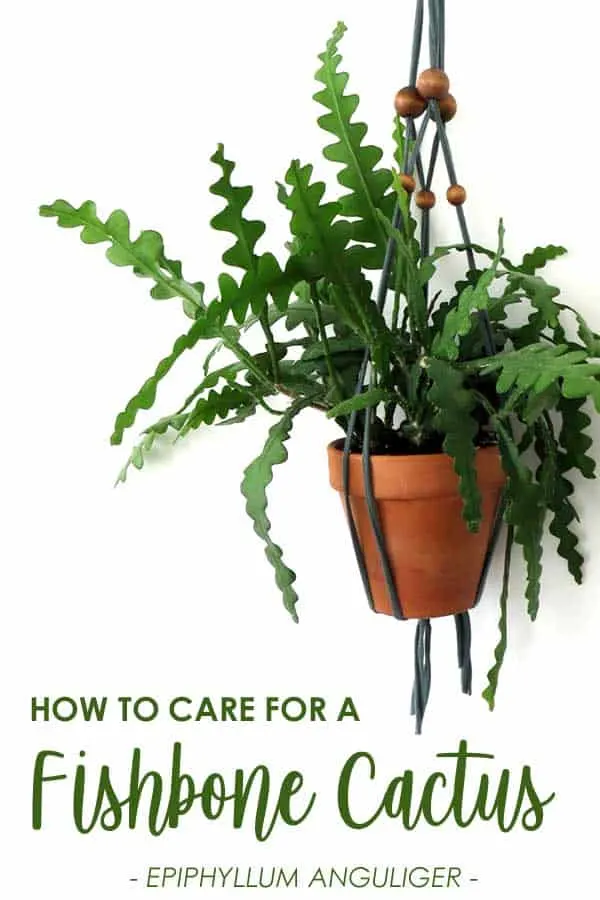
The Fishbone Cactus (Epiphyllum anguliger) is an eye-catching succulent that grows long, trailing stems shaped like fishbones.
It is easy to care for: Provide bright, indirect light, and allow the soil to dry out slightly between waterings. Maintain a consistent indoor temperature, and fertilize during the growing season.

Want to buy a Fishbone cactus? Find it for sale on Amazon!
Fishbone Cactus
Scientific name: Epiphyllum anguliger. Common names: Fishbone cactus, Zig Zag Cactus, or Ric Rac Cactus.
The fishbone cactus is native to the tropical rainforests of Mexico. As an epiphytic cactus, it grows on other plants and trees in the understory of the forest, protected from direct sunlight.
The zig zag leaves start out growing upwards, but when they get larger, they will start to trail down. New leaves grow randomly from the base of the plant, but also from the tops or sides of other leaves.
Some leaves will immediately show the recognizable zigzag shape, other leaves start out straight, like a stick, then with enough light, will form the zigzag.
Further reading: Indoor plants for beginners.


Read more: Basic Guide to Succulent Care.
Light Requirements
Indoor fishbone plants prefer bright, indirect light. They can tolerate lower light conditions, which is common in many indoor settings.
But too little light will slow down its growth and the stems can start to grow leggy. They will stretch and reach to the light. Resulting in leaves with a less defined zig zag shape.
Lots of sun exposure can turn the leaves red. And dry, brown spots on the leaves can be a sign of sunburn. Move your plant further away from the window, or filter the light with a sheer curtain.

Watering
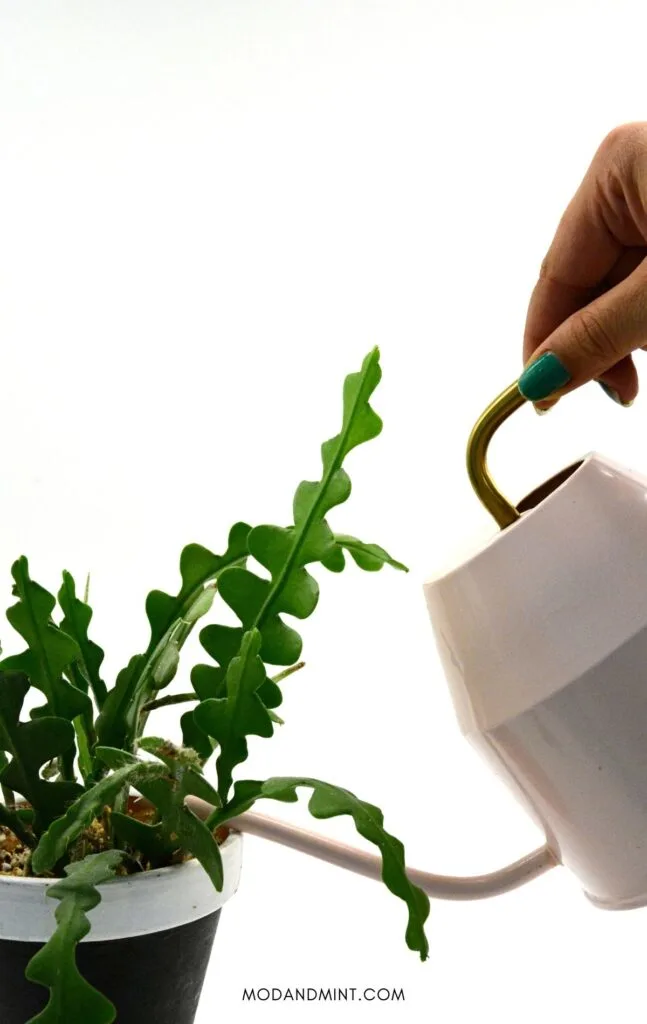
Zig Zag plants are used to moist and humid conditions. They do not come from dry deserts as most cacti do. This means that your fishbone cactus likes more water than the average cactus.
Water frequently, especially during spring and summer. Check the leaves and the soil to know when to water. The leaves will feel limp instead of firm and start to wrinkle. Water when the top of the soil has dried out.
Keep the soil slightly moist and fertilize with a succulent fertilizer about once a month during the growing period.
In winter, water less, and don’t fertilize. Water it just enough to make sure the leaves don’t shrivel up completely.
Watch out for overwatering. Signs that you are watering too often are yellow, or brown mushy leaves, and rotted roots.
Read up on how and when to water succulents for a quick refresher on indoor succulent watering.


Soil and Repotting
Repot your plant in spring or summer when the roots have filled the pot and/or roots are growing from the drainage holes on the bottom.
Refresh the soil every two to three years, even if it still has room to grow. The soil will have lost all of its nutrients and will need to be replaced with fresh well-draining succulent soil. Transplant in a pot with drainage holes, one size bigger than the original pot.
After repotting wait at least four to six months before using any fertilizer. The potting mix usually already has slow-release fertilizer in it.
Read more: Basics of repotting house plants.
Flowers
Mature fishbone plants can grow flowers when they get enough light and are overall very happy with their growing conditions.
There is nothing wrong with your plant if it doesn’t bloom. Most indoor fishbone plants don’t flower at all. If your plant does bloom, the flowers will open at night and only last one or two days. Don’t miss it!
To grow flowers, the plant needs to be mature enough. Zig zag cacti won’t flower until they reach 2 or 3 years. They also need plenty of light and regular fertilization in spring and summer.
Aerial Roots
You might wonder why your plant is growing roots above the ground. Those are called aerial roots and are quite normal. Especially in epiphytic plants like the fishbone cactus.
Most epiphytic plants produce aerial roots to absorb moisture and nutrients from the air. Orchids and Monstera plants like the Deliciosa and Adansonii have them as well.
Epiphytic plants don’t need soil when they grow on the branches of other plants and trees. They will hold on to their host plant with their aerial roots. So it might just be that your fishbone cactus is growing aerial roots in search of something to cling to.
But aerial roots can also appear if your plant needs more humidity, or is lacking nutrients. So do a quick checkup when you see aerial roots on your fishbone cactus. Maybe you do need to give it some water. Or raise the humidity.


Prune and Propagate a Fishbone Cactus
Super long stems can safely be pruned and cut back to shorten. New stems will usually grow right from where made the cut, making your plant grow back fuller. Another bonus is that you can easily propagate the cuttings and turn them into new plants!
It is best to prune and take stem cuttings in spring to late summer. For propagation, use young, healthy leaves for the best chance of success.
You can propagate a large plant by division, or root cuttings in soil or in water. Read more about all the ways to propagate plants or get all the specifics on fishbone cactus propagation.
Plant Pests
The most common pests to watch out for are spider mites, scale, and mealybugs.
Keep the leaves clean and dust-free and inspect your plant regularly for signs of pests to catch a possible infestation before it becomes severe.
Is the Fishbone Cactus Toxic to Cats?
The fishbone cactus is considered not toxic. It is safe to grow at home around your cats or dogs.
Learn more about the risks of toxic houseplants around your pets (and what to do if they have eaten from your plants).


Carl French
Wednesday 8th of May 2024
Have a Fishbone Cactus and want to know what fertilizer to use and what kind of soil to use when reporting.
Cheryl Herndon
Tuesday 25th of July 2023
Please suggest a fertilizer for succulents and explain the contents (like potassium, nitrogen etc) and what each chemical nourishes
Shirley Weller
Tuesday 2nd of May 2023
The number of blooms should read 15, not 5.
Shirley Weller
Tuesday 2nd of May 2023
I have had my fishbone cactus for 3 years and in that time it has flowered twice. Last year I had about 5 blooms in the space of about 2 weeks. Sadly the orchids type blooms don’t last long but the perfume is wonderful and fills my kitchen. Last year, after flowering, I found 3 bulb shaped growths, approximately 4-5cm long by 2-3cm wide. I believe they are the fruits. I have left them on the plant as I’m not sure what to do with them. I have photos of both the flowers and fruits but am unsure how to include them with this comment.
Claudia Davis
Thursday 30th of March 2023
my ric rac cactus has long, thin shoots growing out of main leaf with fine spines. What does this mean?