
Is your Chinese money plant (Pilea peperomioides) having problems? Wondering what is going on and what to do to help your plant? Here are the most common Pilea care issues.
I have been there. One day your plant is flourishing, the next day leaves are turning yellow? It happens. Let me go through 5 of the most common Pilea care issues. And what to do to fix them.
Yellowing leaves may signal overwatering, so allow the soil to dry between waterings. Drooping leaves can indicate thirst, while brown edges may result from low humidity.
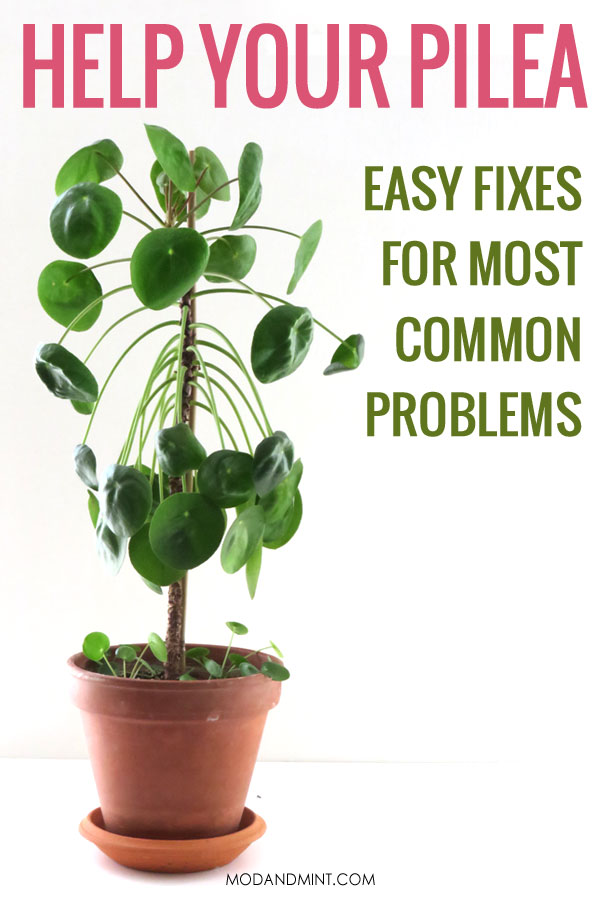
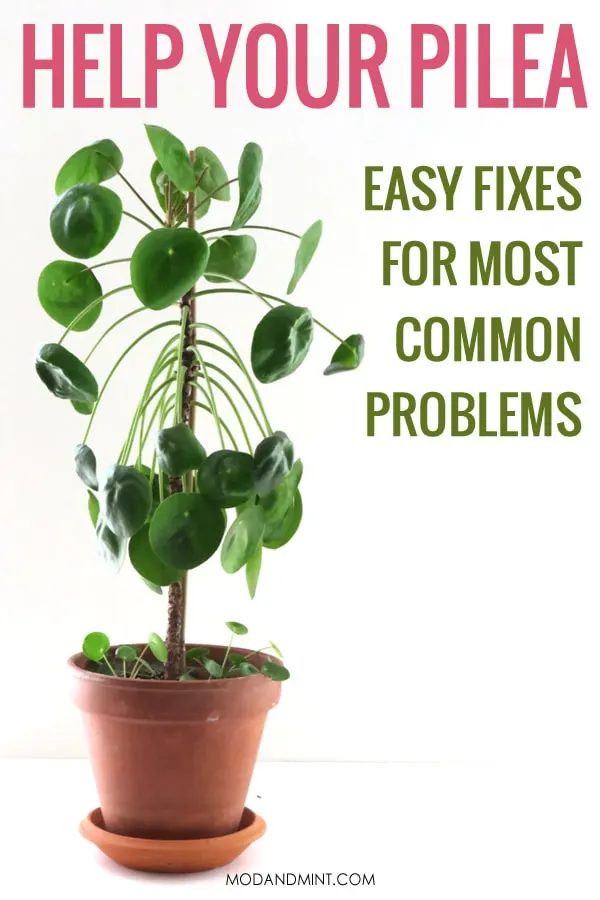
There seems to be some confusion that different websites give different answers on things like why are the leaves on your Pilea curling. The thing is, most plant problems can be caused by more than one thing.
It’s a matter of inspecting your plant and thinking about the care it has been getting so far. That way you can eliminate possible reasons and find what might be the issue for your particular plant.
Related reading: Chinese money plant care.
What’s wrong with your Pilea Peperomioides?
- Curling Leaves
- Drooping Pilea
- Leaves Falling Off
- Leaves Turning Yellow
- Leaves Turning Brown
- Propagation – No Baby Plants Growing
Most problems can be easily sorted by adjusting things like your watering schedule, or by moving your plant to another location with more or less light.
Don’t fertilize when your plant is struggling. Fertilizer is not plant medicine. It will only stress out an already stressed-out plant. Analyze, adjust, and when your plant recovers, continue your normal care routine.
1. Curling Leaves
Let’s start with why leaves can start to curl inwards. When those round pancake leaves all of a sudden look cupped and curved, investigate.
Have you recently moved your Pilea? It could be that your plant is getting less light than it was used to. Leaves can curl when they don’t have enough light. This happens a lot during winter as well.
However, keeping your Pilea peperomioides in too much direct light can stress out your plant and have its leaves curl up. Look at how much light your plant is currently getting and move your plant to where it gets more or less light.
If it is not the light, check the soil and think about when you last watered your Pilea. When the soil is consistently kept too dry, this too can cause the leaves to pucker and curl.
On the other hand, overwatering can make the roots rot, which can then lead to cupped leaves as well. If you have overwatered your Pilea peperomioides, it might be wise to repot your plant in dry soil. Add some perlite or pumice to the soil for better drainage.
Also, look carefully at the back of the leaves. You are looking for bugs. Hopefully, you won’t find any, but an infestation of mealy bugs or spider mites can hurt your Pilea in a way that makes the leaves curl and bend.
To get rid of pests on your plants I would recommend treating them with a natural pesticide. You can get neem oil spray and use that on your plant.


2. Drooping Pilea
It is normal for older petioles to droop a little (petioles are the thin stems that connect the round leaves to the main stem). These petioles on the bottom might droop trying to lift the weight of larger leaves. This is completely natural.
If it’s not just the older leaves drooping and you suspect that there is more to it, it could be a watering issue. Overwatering can cause wilting and drooping leaves, but a lack of water can make the petioles wilt as well. Investigate the soil and adjust your watering schedule accordingly.
3. Leaves Falling Off
Don’t worry if an occasional leaf drops from the bottom. Leaves might drop when they are older.
When more leaves suddenly fall off, there is a problem. This is almost always because of a watering issue. Either too much or too little.
4. Leaves Turning Yellow
As with a few other issues, if it is just one old leaf turning yellow and falling off, and new leaves are still being produced on top, nothing to worry about. You can safely remove any leaves that have turned yellow. These leaves won’t turn green again.
If you see a lot of splotchy yellow leaves, in combination with drooping stems, it usually is an issue with overwatering and not enough drainage. Your Pilea might be in too big of a pot, in heavy soil, or has no drainage holes.
Yellow leaves can be caused by a lack of fertilizer, but this is more rare.
Further reading: Rise in popularity of the Chinese money plant.


5. Leaves Turning Brown
Over time some Pilea leaves can get some small imperfections and brown spots. This is normal.
Dry, crispy brown spots on the leaves are often caused by too much direct light. Move your plant away from the window, or protect it with a sheer curtain.
Brown spots can also be a sign of fertilizer burn, caused by fertilizing too much. If this is the case, hold off on fertilizing and dilute it by half the next time you use it.
6. Propagation: No Baby Plants Growing
If your Pilea peperomioides is not growing little baby plants, it could be just a matter of time. Only mature plants can grow babies. Maybe yours is simply still too young. Keep caring for your plant and have patience. Your plant will mature and grow babies when it’s ready.
When you have a healthy, mature plant and it is not producing any offspring, check if it is getting enough light and is being watered properly. If it’s spring or summer, you might want to treat your plant to a dose of fertilizer.
Don’t cover the top of the soil with pretty pebbles and rocks. This is not good for the soil and will make it harder for the babies to grow.
Related reading: Propagate the small Pilea plants – Chinese money plant meaning.


Iain
Saturday 19th of November 2022
I've had a pilea for over a year and have repotted twice as it's grown.
Recently I've been finding tiny white bugs in the tray. I also found them in the soil of one of the small cuttings I repotted a couple of months ago when I looked at it with a torch.
These wriggle about and will jump if I disturb them. In the tray they seem to all group together. I've tried rinsing them out of the tray, but they keep appearing again.
Initially I though these might be fruit fly larvae but wondering what else they might be (in the UK).
A few of the leaves have pale blotches but overall, the plant looks healthy, especially the newer leaves at the top (I did remove some root rot a few weeks ago) and has several new shoots growing from the top of the roots.
Mod and Mint
Saturday 26th of November 2022
Hi Iain, how is your Pilea doing? It sounds like maybe thrips or whiteflies. You can read more about plant pests here to identify and find out how to get rid of them. Pests are never fun and should not be ignored. I hope you can save your plant!
Gret
Thursday 31st of March 2022
Hello there, I’ve had my piles for over a year and it was doing really well. I then moved to NC and it started giving me problems a few months later. Thinking back it could of been stressed out for the change in temperature coming from a warm climate that is Florida. Almost all the bottom leaves started dropping like flies and now I’m left with a tall stem of about 7 inches that is bare and then about 9 leaves towards the top of the plant that haven’t fallen off yet. Some of which are older and they are a bit droopy and slightly curled inward. I have some new growth of baby leaves coming from the top center of the stem. Any tips on what to do? Should I trim the stem and let new roots grow out and replant? I was trying to save the height of the plant but that this point I’m willing to start over if necessary lol. I’d hate to kill it off and give up on it.
Laura
Wednesday 2nd of February 2022
Hey, just wanted to add an observation: I've had Pilea leaves curl in response to cold as well, when the plant was too close to a window as the season changed. Thanks for your articles and happy planting to those reading :)
Mod and Mint
Wednesday 9th of February 2022
Hi Laura, yes, it could happen because the Pilea is too cold. So many possible causes for all these plant problems! Luckily if it is because of cold, it is easy to move the plant away from the window a bit. Also, look out for drafts. Happy planting! And thank you for joining in the conversation here. 🪴
Kathleen Johnston
Saturday 6th of November 2021
MY plant was doing okay then it just started dropping leaves. I was going to put it in another pot with new soil. I decided to water it first and see what happened. The plant perked up, so should I just wait and see if I get new growth?
ROSEMARIE MILLARD
Saturday 18th of September 2021
My Pilea has got a lot of brown up the stem I was wondering if it should have as it quite healthy. Thanks